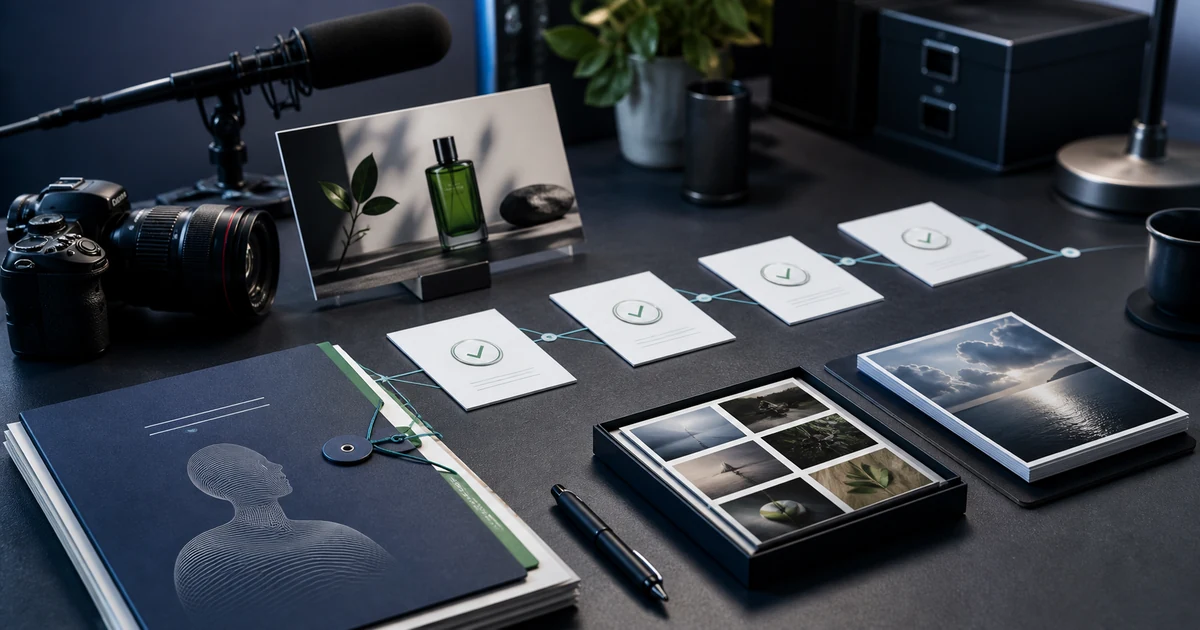

Before handing an AI-assisted asset to a client, gather the permissions, source records, provider terms and approvals that apply to that specific job. This checklist helps organize that evidence and identify unresolved questions for review. It does not decide whether an asset is legally cleared.
Important boundary: this is not legal advice
This checklist organizes production evidence. It cannot determine whether a particular asset is lawful, copyrightable, non-infringing, or properly disclosed in every jurisdiction. Laws, platform policies, contracts, and provider terms change. Verify the current rules for the countries, platforms, industries, client agreement, and model involved, and use qualified counsel for material risk.
The goal is narrower and useful: stop shipping commercial AI work with no record of inputs, consent, terms, edits, claims, and approvals.
Why “commercial use included” is only one field
A paid plan may allow commercial use of generated outputs, yet the production can still contain an unauthorized photograph, cloned voice, recognizable person, trademark misuse, unlicensed music, false product claim, private customer data, or prohibited model use. The provider's permission cannot grant rights you never had in an input.
QuestStudio states that paid plans include commercial usage rights and no watermarks. Treat that as one platform-plan fact, subject to current terms—not a promise that every input, model, subject, claim, or destination is cleared.
Create a rights record before generation
Assign a project ID and owner. Store the brief, source list, licenses or releases, provider and model, terms link and review date, prompts, selected outputs, human edits, claims evidence, final destinations, reviewers, and client approval. This record should exist before the asset becomes difficult to reconstruct.
1. Trace every input to an authorized source
Inventory photographs, video, illustrations, logos, packaging, scripts, music, sound effects, fonts, datasets, reference frames, voices, and prompts supplied by the client or team. Record creator, owner, source URL or file, license or contract, permitted territories, media, duration, modification rights, attribution, and restrictions. “Found online” is not a source permission.
Check whether the license permits use as AI input, derivative work, advertising, resale, and client transfer. If the provenance is uncertain, replace or clear the source before generation.
2. Obtain specific likeness and voice consent
For recognizable people, document who consented, which likeness or voice is used, the purpose, media, territory, duration, edit scope, synthetic transformations, sensitive contexts, revocation or takedown process, and compensation where applicable. Permission for a photo shoot does not automatically authorize a voice clone or a synthetic endorsement.
The U.S. Copyright Office's digital-replica work and the FTC's voice-cloning analysis both reflect the serious harm that unauthorized replicas can create. Requirements differ by jurisdiction. Use explicit releases and legal review for client campaigns, public figures, minors, health or financial contexts, and synthetic testimonials.
3. Verify provider, plan, and model terms
Capture the provider name, account tier, model, access route, generation date, terms URL, acceptable-use policy, commercial-use language, ownership or license language, input and output treatment, retention, training choices, geographic restrictions, and indemnity or limitation provisions relevant to the job. Terms at the platform, marketplace, and underlying model layers may all matter.
Do not copy a permanent conclusion from an old project. Save a dated PDF or screenshot where permitted, plus the URL, and recheck before final delivery if the campaign is delayed.
4. Review trademarks, trade dress, and product truth
Generated packaging, logos, uniforms, storefronts, and distinctive designs can resemble real brands or alter the client's marks. Replace generated logos and legal copy with approved assets. Verify product geometry, labels, colorways, included accessories, prices, warnings, and performance claims against authoritative product data.
USPTO guidance explains that names, images, and likenesses can also intersect with trademark registration and identity interests. Have the appropriate reviewer assess brand use rather than assuming a stylized transformation removes risk.
5. Clear music, voices, and audio layers
Record the source and permission for compositions, master recordings, samples, stems, sound effects, and voices. A video-model output that happens to contain music does not provide a clean cue sheet. Remove or replace unexplained audio. Confirm whether a music or voice license covers paid ads, broadcast, client work, edits, geographic reach, and duration.
For synthetic voices, retain consent and the exact authorized voice route. Do not imitate a recognizable living artist, employee, customer, or public figure without a reviewed basis.
6. Preserve meaningful human contribution
The U.S. Copyright Office's 2025 copyrightability report explains that copyright protection depends on human-authored expressive contribution and that prompts alone generally do not provide sufficient control. The analysis is fact-specific and other countries differ. Do not advertise an output as automatically copyrightable.
Record human choices that shape the final work: original script, storyboard, composition, selection and arrangement, camera plan, controlled reference creation, editing, compositing, typography, color, sound design, sequencing, and revisions. The purpose is both creative accountability and better evidence—not manufacturing a legal conclusion.
7. Review advertising claims and deceptive context
The FTC's advertising guidance requires advertising to be truthful, non-deceptive, and supported by evidence. Verify every express and implied claim. An AI-generated demonstration must not show a product doing something it cannot do, fabricate a testimonial, invent research, misrepresent before-and-after results, or hide a material limitation.
Review the complete audience impression, not only the script. Image, voice, timing, labels, captions, and omitted context can create a claim together. Keep substantiation linked to the approved line and visual. Use the AI-generated image fact-check workflow to assign evidence, reviewer, correction, and publication status to every visible claim.
8. Make a disclosure decision
Determine whether law, regulator guidance, platform policy, contract, industry rule, or the risk of audience deception requires disclosure. When disclosure is needed, make it clear and conspicuous in the actual viewing context. A note hidden in metadata or at the end of a long description may not correct a misleading synthetic testimonial or demonstration.
Record who made the decision, which rule or contract was checked, the exact disclosure, its placement, and the approved platform versions. Recheck when adapting the asset to a new channel.
9. Obtain final client approval
Present the final export with a concise rights and claims summary: sources cleared, people consented, provider terms checked on a stated date, significant human edits, known limitations, disclosure decision, destinations, and remaining client responsibilities. Ask the client to confirm factual product claims, marks, offers, dates, territories, and media.
Approval should identify the exact file hash or version, not “the latest one.” If the creative changes afterward, route it back through the affected checks.
Commercial AI production table
| Gate | Evidence to retain | Stop condition |
|---|---|---|
| Input provenance | Source, owner, license, restrictions | Unknown or incompatible permission |
| Likeness and voice | Specific release and use scope | No consent or disputed scope |
| Provider terms | Plan, model, dated terms review | Use prohibited or unclear |
| Claims | Product evidence and reviewer | Unsubstantiated or misleading |
| Approval | Exact final version and destinations | Material edits after approval |
Final release checklist
- Every input has an owner, source, license or permission, and intended-use record.
- Recognizable likenesses and voices have specific, reviewed consent.
- Current provider, plan, model, retention, and usage terms were checked and dated.
- Logos, product facts, text, music, and audio layers are verified.
- Human-authored direction, selection, arrangement, and edits are documented.
- Advertising claims are truthful, non-deceptive, and supported.
- Required disclosures are clear in every destination context.
- The client approved the exact final version, claims, territories, media, and schedule.
- Sources, generations, edits, approvals, terms evidence, and final exports are retained under the required policy.
- Material uncertainty has been escalated to qualified counsel.
Retain a compact handoff package
Archive a manifest, source and license folder, releases, provider-terms snapshot, prompt and generation log, edit project, claim substantiation, disclosure decision, review comments, final approved files, and retention or deletion dates. Restrict sensitive consent and identity records to authorized staff.
Set a takedown and correction contact. If consent is disputed, a claim changes, or a platform raises a complaint, the production record should identify the affected assets quickly.
Use primary sources at the final gate
Review the U.S. Copyright Office AI initiative, the FTC advertising FAQ, and the current provider terms immediately before material commercial use. These U.S. sources do not replace jurisdiction-specific advice.
Then apply the checklist to one actual asset, not a hypothetical campaign. If the record cannot answer where a source came from, who consented, what the ad claims, or which final file was approved, stop the release and close the gap.
Frequently asked questions
Can I use AI-generated content commercially?
It depends on the inputs, people, provider and model terms, contract, claims, destination, and jurisdiction. A provider plan label is only one part of the review.
Does paying for an AI plan give me copyright?
Not necessarily. Provider usage rights and copyright protection are different questions, and copyrightability depends on applicable law and the facts of human authorship.
Do I need consent for an AI voice or likeness?
For recognizable people, obtain specific reviewed consent covering the synthetic use, media, purpose, territory, duration, edits, and sensitive contexts.
Do AI ads need disclosure?
Disclosure requirements depend on law, regulator guidance, platform policy, contract, and whether the context could mislead. When required, make disclosure clear and conspicuous.
What records should I keep?
Retain source provenance, licenses and releases, provider terms evidence, prompts, generations, human edits, claims support, disclosure decisions, client approval, and exact final exports.