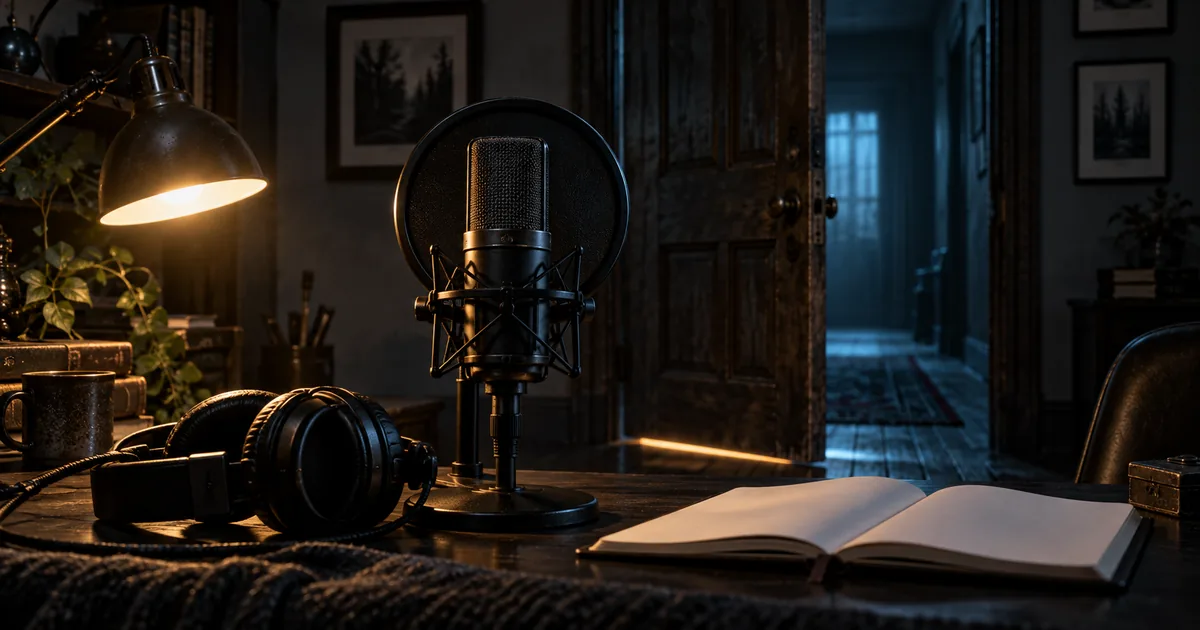

A deep voice with heavy reverb is not automatically scary. AI horror narration works when the listener understands what is happening, notices one wrong detail, and has a moment to imagine the consequence. This tutorial uses an original short story to separate the script, the performance, and the final sound design.
Download the planning worksheet · Audition the opening lines
Prepared September 18, 2026. Original planning examples; AI-generated hero illustration.
Write the threat as a change in what the listener knows
Give the listener a small, understandable situation: a room, a task, and a reason to remain there. Introduce one detail that does not fit. Then let the final line change the meaning of something already heard. A clear sequence usually offers more room for performance than a paragraph crowded with ominous adjectives.
For a short piece, choose one point of view and a limited cast. An unexplained pronoun can be more distracting than a flat voice. “It was behind her” is weak if the listener has lost track of who entered the room. Read the text without music or imagery; if the turn is confusing there, sound design will not fix the story.
Use your own story or text you are allowed to adapt. The sample below is original to this guide and can be used for the exercise. It is fiction, not a true-event account.
Original practice script: The Spare Key
The story gives the performer three different jobs. The opening establishes a routine. The warm mugs make the house newly occupied. The last lines move the threat from a distant possibility into the narrator's immediate space. The narrator does not need to sound terrified from the first word.
Make a pause map outside the spoken text
Keep production notes separate from the clean script. Some text-to-speech systems may read bracketed directions aloud or ignore them. A cue sheet lets you audition the plain words first and introduce supported controls deliberately. Treat the following pauses as editing targets, not exact timing promises from a generative model.
| Beat | Performance intention | Suggested edit target |
|---|---|---|
| Spare key routine | Ordinary, slightly tired | Brief natural sentence breaks |
| Flowerpot turned | Notice the difference | About half a second after the observation |
| Two warm mugs | Let the listener infer company | About one second before the phone |
| Unsent question | Uncertainty becomes immediate | Short pause before the reply |
| Final command | Quiet and unmistakable | A clear beat before the last sentence |
Record the actual generated timings. A useful pause can already be present; do not add the full target again on top of it. Place edits at a breath or phrase boundary so you do not cut through the voice's natural decay.
Audition the hardest passage, not a greeting
Use the same three lines for each voice: the warm mugs, the unsent question, and the final command. These test matter-of-fact narration, a change in thought, and a restrained ending. A cheerful greeting tells you little about whether the voice can carry this scene.
Choose two plausible voices instead of cycling through a large library. Match playback volume as closely as you can, because a louder voice often seems more present. Listen for understandable consonants, stable identity, and a shift in tension that does not become theatrical shouting. Choose the voice that lets the story remain the center of attention.
If there is no separate direction field, select an appropriate voice and shape the plain text through sentence length and punctuation. Do not paste this paragraph into a field that will speak every word.
Use pause controls that belong to your model
ElevenLabs' current pause documentation distinguishes Eleven v3 audio tags and punctuation from SSML break tags supported by specified older models. Eleven v3 does not support SSML break tags. A recipe copied from one model can therefore fail on another.
Start with ordinary punctuation. If you are using Eleven v3 and want to test a supported delivery tag, apply it to one passage and compare against the untagged version. Avoid stacking several competing emotions onto every sentence. If exact timing matters, adjust the pause in an audio editor after generation. That is easier to measure than repeatedly asking for “a slightly longer silence.”
Do not assume a low-pitched voice needs to become lower still. Heavy pitch changes and long reverb can obscure words. Choose a workable base performance first, then decide whether processing contributes anything.
Generate passages that preserve the thought
Split the sample into three coherent blocks: arrival and flowerpot, kitchen and message, upstairs and final command. Generating every sentence separately can produce a new emotional starting point on each line. Generating a long story in one attempt makes local corrections harder. The right unit is a complete thought you can review and, if necessary, replace.
Save the clean text, voice, model, available settings, and output filename for each block. When a single word fails, regenerate a phrase with surrounding context rather than splicing a bare replacement syllable into a different performance. Compare the last sentence of one block with the first sentence of the next for changes in loudness, distance, or vocal identity.
Before adding effects, listen once from beginning to end with the script hidden. Write down anything you could not understand. Then compare against the text for missing words, repeated phrases, or altered meaning. Fix those before choosing music.
Build suspense with a small sound palette
The sample only needs a quiet room tone, an optional phone vibration, and a carefully placed floorboard sound. The refrigerator hum establishes the empty house. Removing or reducing that hum near the final exchange may be more effective than adding a large musical hit. This is a creative proposal to audition, not a rule that every horror story must follow.
Keep the creak after the narrator mentions the upstairs space, or use it as a deliberate interruption with enough room for the listener to orient. Do not put a loud transient directly over the word that reveals the threat. Check on a phone speaker as well as headphones; low rumbles can disappear on small speakers while high effects become piercing.
Preserve a voice-only version and a mixed version. If the story works only when a loud effect startles the listener, revise the timing or the script rather than automatically adding more effects.
Fix the failure you can actually hear
- Every line sounds ominous: make the opening matter-of-fact and reserve the shift for the first wrong detail.
- The last sentence is inaudible: use a quiet fully voiced delivery instead of a breath-only whisper.
- Pauses feel endless: shorten the gap or let a low room tone connect it to the scene.
- The joins sound like different recordings: regenerate a larger passage with consistent voice settings.
- The twist is unclear: clarify the script's sequence before changing vocal effects.
Do one final listen while looking away from the screen. The imagery should enrich the narration, not carry missing information that the script promises to explain.
How QuestStudio helps
To turn a small suspense idea into a visual scene, use the six-shot AI horror short film workflow, including a 24-second shot plan and a sound cue sheet.
Paste the clean audition lines into Voice Lab and compare available voices with the same text. Keep provider-specific tags out unless the selected model supports them. Export the chosen passages for precise pause placement and sound mixing in your editor.
Use the pronunciation workflow if a name or key word keeps breaking the performance. Your next deliverable is a clear voice-only scene, followed by a mixed version that preserves that clarity.
Source and example notes
Model-specific pause guidance was checked September 18, 2026. The story, direction sheet, and sound plan are original examples. No voice generation benchmark or listener-retention improvement is claimed; the timings must be auditioned against the actual output.
Frequently asked questions
What makes an AI horror narration sound convincing?
Clear storytelling, a voice that can begin naturally, and a gradual change in tension matter more than extreme pitch or volume. Keep the reveal understandable and give the listener room to infer what happened.
Should horror narration always be whispered?
No. A quiet fully voiced delivery can remain intelligible and feel more controlled. Use whispers selectively and check them at ordinary listening volume.
Can I use SSML breaks with Eleven v3?
ElevenLabs documents audio tags and punctuation for Eleven v3, which does not support SSML break tags. Check the documentation for the exact model you use.
How long should the pauses be?
There is no universal duration. Start with short breaks around new information, then time the actual output and adjust in an editor. Too much silence can interrupt the story.
Should I generate the whole story in one pass?
Use coherent passages that preserve the thought and remain easy to replace. Check the joins for changes in identity, level, and emotional delivery.