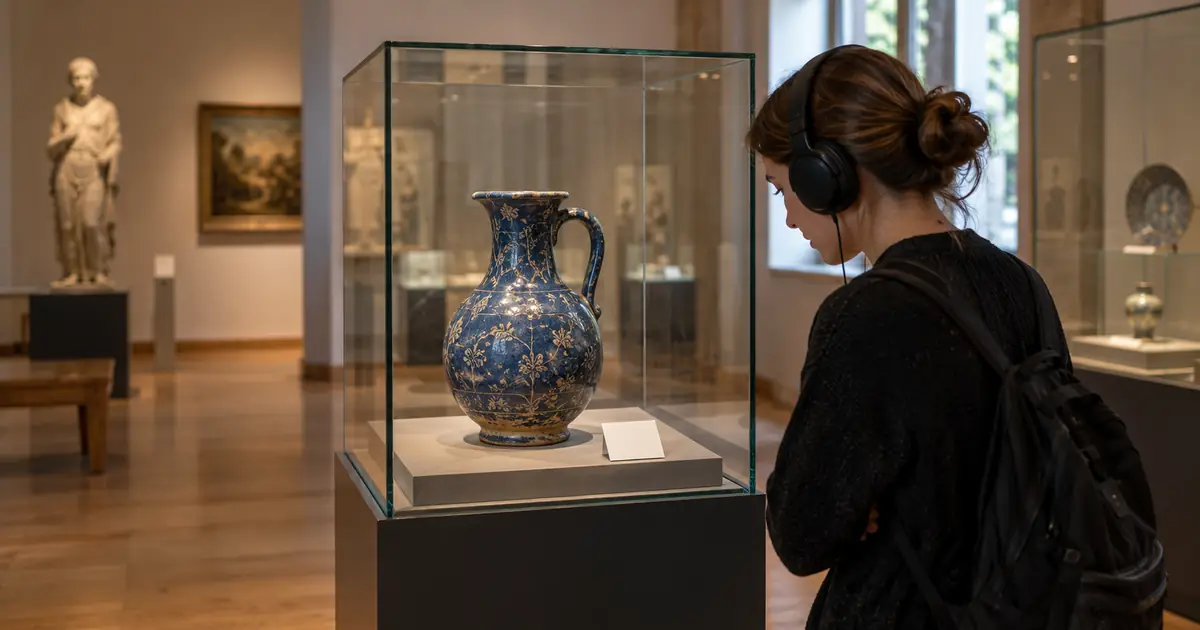

An AI museum audio guide should help a visitor understand the object in front of them. Start with approved exhibit facts, write one short spoken stop, and test the narration where people will actually listen. A fluent voice cannot correct an invented date, unclear direction or script that describes an object the visitor cannot find.
This guide develops an original fictional stop for a blue ceramic jug. The object record and script are teaching examples, not historical claims about a real collection. Download the exhibit-stop worksheet to replace them with your institution's approved information.
Give the stop one interpretive purpose
For our example, the purpose is to help visitors notice how a jug's handle and lip reveal its everyday use. That is narrower than explaining the entire history of ceramics. One clear purpose gives the script a natural ending.
Choose the visitor's likely starting point. Are they standing directly in front of the case, approaching from a doorway or selecting a stop from a map? Can they see the handle from that position? A direction that works for the writer at a desk can fail in a crowded gallery.
Nubart's script guidance emphasizes selecting exhibits deliberately and writing for listening. Use those principles to decide what belongs in the first stop. Optional background material can live in a separate track instead of overloading the main narration.
Build a small claim ledger
Separate facts, interpretations and observations. A date from an approved catalog record is a sourced claim. A visible chipped lip is an observation that still needs confirmation on the actual object. A suggestion about how an owner felt is an interpretation that may not be supported.
| Script element | Example status | Required approval |
|---|---|---|
| Object identification | Blue ceramic jug in the fictional exercise | Match the actual display and catalog |
| Material | Ceramic in the example | Confirm institutional terminology |
| Use | Intended to hold and pour liquid | Curatorial review of the actual object |
| Maker or date | Not supplied in the exercise | Omit until a reliable record is approved |
| Wear | Visible mark near the lip | Confirm the mark and avoid inventing its cause |
Do not ask a language model to fill missing provenance just to make the story smoother. If the maker is unknown, say so when relevant or leave the claim out. Keep the approved wording and its source beside the narration draft.
If the object concerns a living community, contested history or sensitive interpretation, follow the institution's existing review process. AI narration does not replace subject expertise or the people whose perspectives the exhibit represents.
Write a script that leaves time to look
Use concrete nouns and short spoken sentences. Tell the visitor what to notice before explaining why it matters. Avoid starting with a dense sequence of dates, dimensions and accession numbers unless those details are central to the stop.
Here is a short fictional passage to audition. Its purpose is to demonstrate pacing and attention, not to supply content for a real jug without review.
Keep production notes out of the spoken field. Instructions such as “pause while the visitor looks” should not accidentally become narration. Use supported voice controls or place exact silence in an audio editor, as explained in the text-to-speech pauses guide.
Replace vague directions with usable orientation
“Look over there” has no stable meaning in an audio file. “Look at the blue jug inside the glass case” is more specific, but still depends on the room containing an identifiable case and object. Test the wording from the actual listening position.
Avoid relying only on left and right when visitors can approach from different directions. Use a stop number, object name or recognizable location that agrees with the physical signage. If the exhibit moves, orientation language becomes part of the revision.
Provide a transcript and plan accessibility with the institution's specialists and visitors. A standard interpretive track is not automatically a complete audio description. The audio-description workflow covers a related but distinct task: communicating necessary visual information deliberately.
Audition the voice on difficult words
Choose a representative passage containing the actual names, terms and sentence structures. A pleasant generic greeting does not show whether the voice can pronounce the maker's name or distinguish two similar object labels.
Save the approved pronunciation and the selected voice settings. If the same name appears in several stops, verify it in each context. A model can pronounce a word differently inside another sentence. Use the pronunciation repair guide for controlled revisions.
Listen for overacting. A warm tone can help, but a dramatic rise on every sentence may distract from the object. Compare a restrained version with a slightly more expressive one using the same script. Choose the version that makes the information easy to follow over the whole passage.
Test the stop in the gallery
Play the draft where the stop will be used, at a comfortable listening level. Check the intended delivery device and an ordinary phone if that is part of the visitor experience. Listen for words masked by room noise and for long stretches during which the visitor has nothing useful to look at.
Ask a small review group what object and detail the narration directed them toward. Their response can reveal ambiguous wording. Record observations rather than claiming a general engagement improvement from a few informal listeners.
Check that the physical label, menu title, stop number, audio file and transcript agree. A good recording attached to the wrong exhibit is a delivery failure. Test the next and previous navigation steps so the visitor can continue without guessing.
Make revisions traceable
Assign a stable stop ID, such as JUG-01, and keep the script version, language, voice configuration and export together. A corrected date should update the transcript and every affected language, not only the English audio.
Separate factual approval from voice approval. A curator may approve the meaning while the producer still needs to repair a mispronounced name. Keep both decisions visible so an audio revision cannot silently introduce new wording.
For a multilingual tour, use a qualified review process for meaning, names and directions. Literal translation can change the length and visitor experience. The voice-localization workflow helps organize those production checks.
How QuestStudio helps
Use Voice Lab to generate a short narration from an approved script and compare delivery choices. Begin with one exhibit stop, listen in context and save the settings that work before producing a larger tour.
QuestStudio supplies narration workflows. Exhibit research, curatorial approval, tour hosting, physical signage and visitor accessibility review remain separate responsibilities. Do not assume generating an audio file creates a complete museum guide or a location-aware tour.
Frequently asked questions
Can AI write the historical facts for a museum stop?
Use approved collection research as the source. AI can help shape wording, but missing dates, provenance and interpretations need human review rather than invention.
How long should one stop be?
Use the shortest length that fulfills the stop's purpose and leaves time to look. Test the actual script and location instead of imposing one duration on every exhibit.
Should stage directions go into the spoken script?
Keep production notes separate unless the chosen voice model explicitly supports the intended control. Otherwise the voice may read those directions aloud.
Is an audio guide automatically accessible?
No. Plan transcripts, orientation and any required audio description with the institution's accessibility process and intended visitors.
What must change when an exhibit moves?
Review orientation wording, stop numbering, maps, signage, navigation, transcripts and every language version. The audio's factual content may be unchanged while its directions become wrong.
Finish one stop where it will be heard
Approve the facts, make the language speakable and listen beside the object. A clear first stop gives the rest of the tour a practical standard for writing, narration and revision.
Voice an approved exhibit passage in Voice Lab
Hero image: AI-generated editorial illustration. Examples are original planning exercises, not measured model tests.