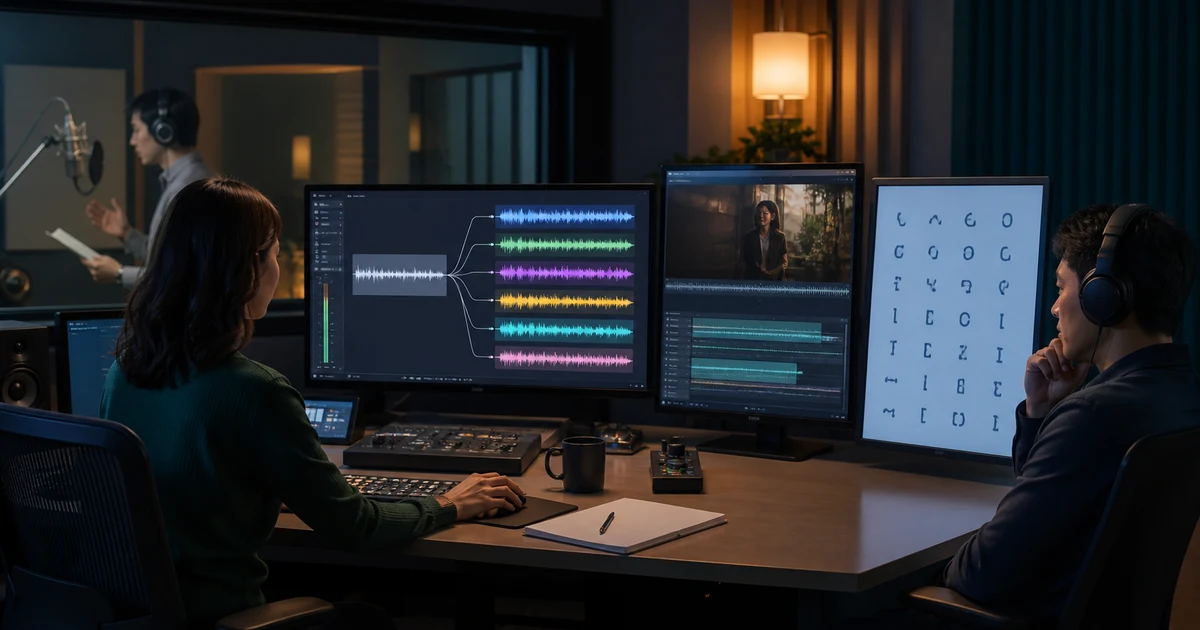

AI Voice Localization Workflow: Translate Meaning, Timing, and Tone helps you complete one real creation job with a repeatable process and a clear approval standard. It focuses on the decisions that determine whether the output is useful, accurate, and ready for its destination.
Define the localization unit
Record target country or region, audience, language variant, reading level, brand terms, legal text, units, dates, currency, names, and whether the visuals can change. Localization adapts meaning and convention; it is not a word-for-word substitution.
Lock source meaning
Create a source script with timestamps and mark non-negotiable claims, product names, UI labels, jokes, idioms, and on-screen references. Resolve ambiguity before translation. If the source says “next Friday,” replace it with an unambiguous date when appropriate.
Adapt for speech and locale
Have a qualified reviewer rewrite phrases that are technically correct but culturally unnatural. Adjust sentence length, units, examples, formality, and calls to action. Keep claims equivalent; do not strengthen a promise because the target phrasing sounds better.
Build a pronunciation and terminology sheet
| Item | Record | Reviewer |
|---|---|---|
| Names and brands | Approved pronunciation and stress | Brand or subject owner |
| Technical terms | Localized term and accepted alternative | Subject expert |
| Numbers and units | Spoken form and converted value | Locale reviewer |
| Acronyms | Spell out or pronounce | Audience owner |
| Mixed-language phrases | Language boundary and accent expectation | Native speaker |
Use an authorized voice
Document consent for the language, territory, channel, duration, and cloning use. A speaker’s permission for an English narration does not automatically authorize synthetic versions in every language. Disclose synthetic voice when policy or context requires it.
Fit timing without crushing the performance
Generate in short intention-based blocks. If a line overruns, shorten the translation, move a pause, or adjust the edit. Extreme speed changes reduce comprehension and naturalness. Preserve time for disclosures and important product instructions.
When lip movement is visible, decide whether voiceover, dubbing, or a re-edit is appropriate. Do not let perfect lip-sync outrank accurate meaning.
Review in three passes
- Language: meaning, grammar, terminology, numbers, claims, and cultural fit.
- Performance: voice identity, tone, pace, emphasis, pronunciation, artifacts, and consent.
- Context: visual synchronization, captions, graphics, music ducking, and final destination.
Keep captions and audio aligned
Update captions from the approved localized script, not automatic transcription alone. Use target-language line-breaking conventions and reading speed. Verify on-screen text and spoken terms match.
Localization QA
- The target locale and language variant are explicit
- A native reviewer approved meaning and naturalness
- Names, terms, numbers, units, and claims are verified
- Voice consent covers the localized use
- Timing remains intelligible without unnatural acceleration
- Captions, graphics, and final mix match the approved script
For a version that shows two written languages simultaneously, use the build readable bilingual captions in CapCut guide. It includes an original exercise and a worksheet for reviewing the result.
Frequently asked questions
Is AI translation enough for voice localization?
No. A native reviewer should approve meaning, cultural fit, terminology, and spoken naturalness.
Can I clone the same voice in every language?
Only when consent covers those languages and the output is reviewed for pronunciation and identity.
How do I fit a longer translation?
Rewrite for equivalent meaning, adjust pauses or edit timing, and avoid extreme speed changes.
Should captions match the spoken localization exactly?
They should preserve the same approved meaning while following readable target-language caption conventions.
What should be reviewed first?
Approve the localized script and terminology before generating or syncing voice.
For YouTube-generated language tracks, learn to review an automatic dub before approving its meaning.