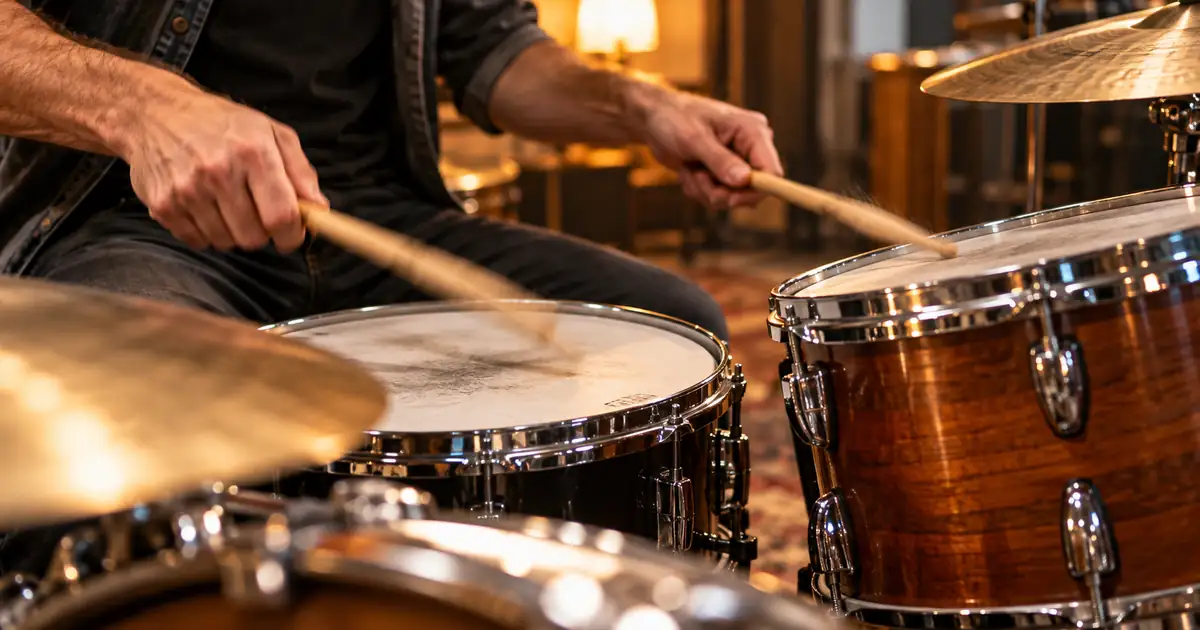

A drum fill should help the listener arrive at the next section. If it interrupts the final lyric, crowds the first beat of the chorus, or adds energy in the wrong place, a more complicated fill will not solve the transition. Start with the boundary between sections and decide what the next section needs.
For AI music, separate the arrangement request from the final timing decision. You can ask for a restrained fill leading into a chorus, but the generated result still needs listening review. Exact bar placement, isolated drum editing, and a reliable return on the downbeat depend on the output and the editing tools available.
Define the transition's purpose
Name the outgoing section, incoming section, and intended change in energy. A verse moving into a larger chorus may need a small lift. A chorus dropping into a quiet bridge may benefit from a pause. A busy fill can be counterproductive when the next section is supposed to feel spacious.
Listen to the last phrase before the boundary and the first phrase after it. If both already contain dense vocals or melodic activity, leave room. The fill's job is to support the transition, not compete with every other part of the arrangement.
Use the AI song structure workflow when the section order itself is unclear. A fill cannot make an accidental extra verse become the intended chorus. Establish the arrangement before fine-tuning the boundary.
Find the real boundary by listening
Mark the first strong beat of the incoming section in your editor or workstation. Then count backward through the preceding phrase. Do not rely only on a generated label such as “chorus” or a waveform peak. The audible arrangement determines where the transition actually happens.
For an original timing exercise, take a steady 4/4 passage at 100 beats per minute. One beat lasts 0.6 seconds, and one four-beat bar lasts 2.4 seconds. A two-beat lead-in therefore occupies 1.2 seconds at that tempo. These numbers explain the planning grid; they do not prove that a generated track maintains exactly that tempo.
If the pulse drifts or the meter is unclear, resolve that first with the AI music time-signature guide. A fill that seems late may be sitting against the wrong grid rather than simply using too many notes.
Compare three transition shapes
Use the same short listening window for each option: the final phrase of the outgoing section, the transition, and the opening of the next section. Compare a restrained fill, a busier fill, and a brief reduction or pause where those options can be created with the available tools.
| Transition shape | What it can contribute | What to watch for |
|---|---|---|
| Restrained fill | Clear cue with room for vocals | Too little lift for a large arrangement change |
| Busy fill | Stronger rhythmic excitement | Masked lyrics or a crowded arrival |
| Reduction or pause | Contrast before the next section | A gap that sounds accidental |
The drum-fill boundary worksheet records the outgoing phrase, incoming downbeat, and reason for choosing each version. It is a listening aid, not a claim that every music generator offers exact fill replacement.
Keep the request about arrangement
Describe the role of the drums in ordinary musical language. State whether the fill should be restrained or energetic, how it relates to the vocal phrase, and what should happen when the next section arrives. Avoid adding many conflicting genres, kit descriptions, and rhythmic instructions to a single short transition.
This is an arrangement brief, not a guarantee of exact bar placement. If the generated track puts the fill under the lyric or extends it into the chorus, review that output as it is. Repeating a precise number in the prompt does not establish that the audio follows it.
Where your selected music tool offers sections, continuation, or editing controls, use only the controls actually exposed and retain the original version. Do not assume that a general music-generation interface includes a drum-only editor.
Protect the incoming downbeat
Listen to the transition without watching the timeline. Can you tell where the new section begins? Does the groove settle promptly? A fill that continues across the boundary can work musically, but it should be an intentional choice rather than a timing accident.
Ableton's discussion of fuzzy section boundaries describes how anticipation, hesitation, and changed timing can affect a transition. Use that as an arrangement idea, then judge the actual song. A strict boundary is not mandatory, but the listener should still be able to follow the change.
For a straightforward tutorial soundtrack or product video, clarity may matter more than surprise. A simple arrival can make it easier to align the music with a visual event. A more experimental song can tolerate a different relationship between the fill and the first beat.
Preserve the vocal and bass relationship
Check the fill against the final consonants of the outgoing lyric. A snare burst or cymbal wash can obscure a word even when the fill sounds good by itself. Listen at an ordinary volume, because turning the track up can make the masking feel less obvious during repeated review.
Then check the bass entry. If the drums imply one arrival while the bass establishes another, the transition may feel unstable. That can be a creative effect, but it should support the intended groove. Avoid approving the drum moment in isolation from the rest of the track.
If you only have a stereo mix, be cautious about repairs that affect the whole spectrum. Cutting or fading the transition changes vocals, bass, and ambience too. Separate stems, when legitimately available and usable, can offer more control, but their quality and availability need verification.
Edit with enough surrounding context
When an editor or workstation allows precise changes, keep a copy of the unedited track and work with a short region that includes both neighboring sections. An isolated fill can sound excellent while making an awkward join once placed back into the song.
Inspect edit boundaries for clicks, abrupt ambience changes, and damaged cymbal tails. A short crossfade may help a suitable join, but it cannot make incompatible rhythms automatically fit. After each change, listen from several beats before the transition through the first complete phrase of the next section.
If the repair requires repeated stretching or chopping that harms the groove, compare it with a simpler arrangement or another generated candidate. The purpose is a coherent transition, not preserving one attractive fill at any cost.
Choose a version in the final use
For music accompanying a video, listen with the actual edit. A fill that feels exciting alone may collide with a spoken line or an important visual explanation. For a standalone song, review the surrounding sections at normal playback volume rather than looping the fill until it loses context.
Record why the selected version works: the last lyric stays clear, the chorus arrives confidently, or the pause creates the intended contrast. Those are useful approval notes. “More professional” is too vague to guide the next revision.
How QuestStudio helps
Use Music Lab to explore arrangements with a clear transition brief. Start with the intended section change and compare a small number of candidates before committing to detailed finishing.
Use your audio editor or workstation for exact boundary placement and delivery checks. The practical next step is one controlled arrangement experiment, followed by listening to the fill together with the phrase it leaves and the section it introduces.
Frequently asked questions
Can I force an AI drum fill to land on an exact bar?
You can describe the intended arrangement, but exact placement is not guaranteed. Verify the output by listening and use an editor or workstation when precise timing is required.
Does every chorus need a drum fill?
No. A change in texture, a brief pause, or a simple return to the groove may serve the song better. Choose the transition that supports the incoming section and leaves room for the other parts.
How long should a drum fill be?
Its length depends on tempo, phrase structure, and the arrangement. Start with a short transition and compare it with the surrounding vocal and groove. More notes or more time do not automatically create a stronger arrival.
Can I fix only the drums in a stereo AI song?
A stereo file does not provide independent control of every instrument. Edits may also affect vocals, bass, and ambience. Use suitable stems when available, or choose a simpler repair that preserves the whole mix.
Explore a transition in Music Lab
Hero image: AI-generated editorial illustration. Examples are original planning exercises, not measured model tests.