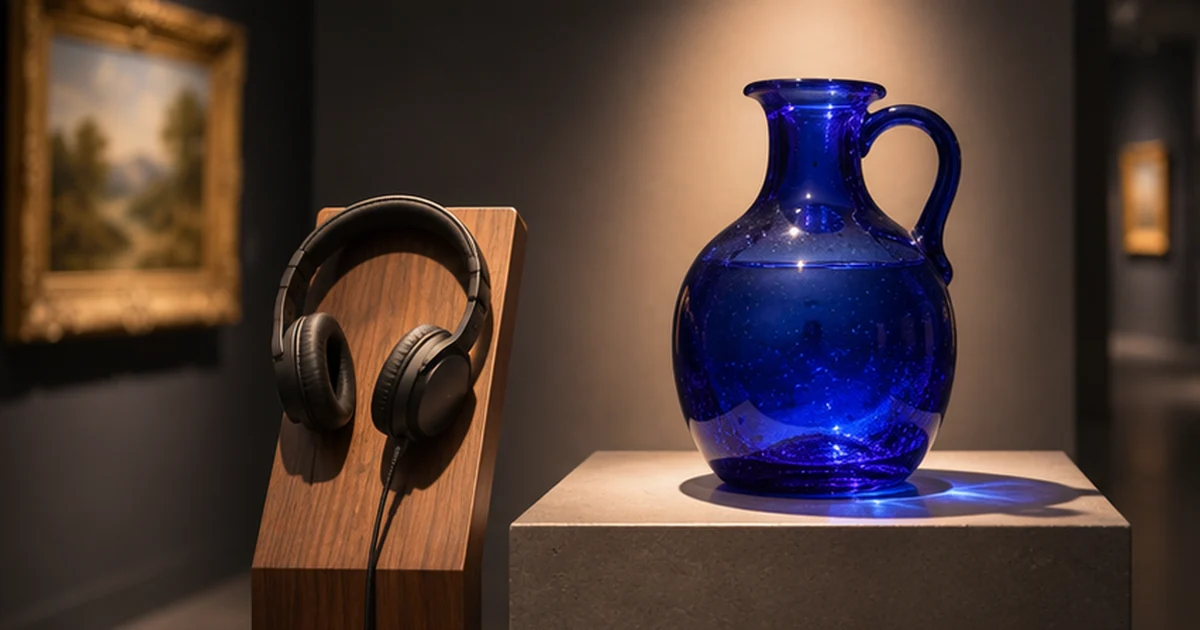

A museum visitor listening to an audio stop has two jobs. They have to understand the voice and find what the voice is describing. For a collection of short stops that need individual pronunciation and pacing reviews, we favor QuestStudio Voice Lab. Artlist AI Voiceover is a credible alternative when the production team already selects voices in Artlist and wants its documented voice-generation workflow close to the rest of its audio work.
- Choose QuestStudio when
- The museum wants a separately reviewable narration take per stop.
- Choose Artlist when
- An existing Artlist production team wants to use its familiar voice workflow.
Write for the person standing in the gallery
Imagine a cobalt glass jug in a case with a white wall behind it. The detail you want the visitor to notice is the thin trail of glass where the handle joins the shoulder. Start with a visible landmark. A line such as “Find the blue jug in the middle of the case. Follow the handle down to the shoulder” gives the listener a direction they can act on.
Leave a little room after that instruction. Read the line to someone looking at a photograph of the case and watch when their eyes settle on the join. You now have a reason for the pause. A smooth fast reading that continues into the maker's biography may leave the visitor looking for the first detail while hearing the second piece of information.
Audition the difficult sentence
Artlist's voiceover documentation explains how to generate a voiceover and work with the available voice choices. Choose a sentence that contains a maker's name, a date, and one short direction to the object. A single sentence with all three reveals more about the voice for this exhibit than a polished greeting. Use the curator's approved pronunciation as your reference. Artlist voiceover help
In Voice Lab, choose a supported voice and speech model and render a short audition. Keep the exact script used for the take. If the maker's surname needs a phonetic spelling, record that spelling in the production script. The transcript available to visitors should retain the approved written name. The voice pronunciation guide offers ways to isolate difficult words and then return them to the actual sentence.
Give each audio stop a route through the case
Divide this stop into four moments. First orient the visitor to the correct object. Second give them one feature to find. Third explain what that feature helps us understand, using the curator's verified wording. Fourth close with a cue that lets the visitor move on. A line that assumes the visitor is approaching from the left may fail when the gallery can be entered from either end.
Read the draft aloud standing at viewing distance. The handle may disappear behind a reflection for a visitor seated lower than the writer. Replace a fragile location cue such as “just under the spotlight” with a stable feature of the object or case. If a visitor cannot reliably see the detail, describe it plainly before explaining why the curator selected it.
Listen to silence and the room
A voice editor can insert a pause with more precision than a series of commas in the script. Listen to the complete sentence before deciding where to split it. If the voice rises as though it will continue immediately, a long pause inserted there can feel like a playback fault. Regenerate or re-record a complete thought that resolves naturally before the viewing pause.
Listen with the type of playback device the museum will supply, at a reasonable level in the actual space when possible. Air conditioning and footsteps can mask quiet consonants. A guide that sounds clear on studio headphones may lose the very name the curator spent time checking. Ask listeners to point to the glass detail as well as repeat the name. Those are different measures of success.
Try a stop with a visitor who missed the introduction
Hand the listener the device with the stop already selected, as if they had walked into the middle of the exhibition. Ask them to start from the first sentence and point to the jug when they are sure which object the voice means. If they point at a small blue vase on the shelf below, add a visible distinction before adding more history. A cue about the broad handle or narrow neck may resolve the problem without lengthening the introduction very much.
Have a second listener begin facing away from the case, then turn toward it when the guide asks them to look. That small delay can expose a rushed direction that went unnoticed when the first listener was already staring at the glass. Note the phrase at which the second listener found the handle and the phrase at which the explanation began. Adjust the pause if those moments overlap. For the final review, give the museum a short sample with the revised pause and ask the curator to confirm both the factual wording and the visitor's opportunity to see the evidence.
Deliver an updateable stop
Give the museum a clean master, a delivery file in the format its player requires, the visitor transcript, and a production note with pronunciation references. Give each stop a stable identifier tied to the exhibit list. If a curator updates an attribution, nobody should need to guess which “blue jug final” file is currently in the player.
Artlist is a good choice if its voice selection and existing production process best serve the museum's team. Our preference for a growing collection of individually reviewed stops is QuestStudio. Test the hardest name and the viewing pause first. Commission the remaining stops once the curator and a listener can both follow this one comfortably.
Frequently asked questions
Can I use a phonetic spelling in the public transcript?
Use the institution's approved written form in the public transcript. Keep phonetic guidance in the recording notes unless the museum intentionally supplies a pronunciation guide.
How long should the looking pause be?
Time a real listener finding the feature. Make an initial edit, then try it with another visitor who has not already learned where to look.
Should a guide speak every date on the label?
Select dates that help the visitor understand the object. Ask the curator which details are essential to the interpretation and which the visitor can read separately.
How do I know a new voice will work across the collection?
Audition a name-heavy stop, a descriptive stop, and a short directional stop. Compare intelligibility and tone on the intended playback equipment.
Compare more Artlist and QuestStudio workflows
Continue with a useful next step
 Music
Artlist vs QuestStudio for a Podcast Theme and Sting
Choose between a library track and a custom-generated podcast theme. Compare Artlist and QuestStudio with an opening, speech bed, and short chapter sting.
 Voice
Fix AI Voice Pronunciation Without Regenerating the Whole Script
Repair AI voice names, acronyms, pacing, and emphasis with a preflight glossary, short-line tests, phonetic or alias controls, sentence patches, and loudness matching.