

Last month I was scrolling through my feed and an article caught my eye. I do not remember the exact title, but the creator was talking about how he was making money selling digital wall art on Etsy.
Normally I would have just kept scrolling. But since I am already an experienced Etsy seller, this "simple" idea made me stop. I have always been focused on selling templates, so the idea of selling just art as a digital download never really crossed my mind.
Part of why this grabbed my attention is that Etsy has tens of millions of active buyers, somewhere around the ninety-million mark. That is a huge pool of people actively looking for something to buy. So instead of guessing, I decided to run a proper experiment and list my first piece of digital art.
Why I thought digital wall art was too saturated
My first reaction was, "This has to be saturated."
Digital wall art sounds straightforward. You do not have to ship anything, the barrier to entry is low, and there are a ton of AI and design tools out there now. It feels like something everybody and their cousin would be trying.
But instead of overthinking it, I opened a brand-new Etsy account just for this project. I wanted clean numbers and no boost from my other shop.
I created my first set of wall art using Nano Banana + Canva. Once I had the artwork, I resized everything into the usual ratios people expect (2:3, 3:4, 4:5 and so on), saved the files, wrote a quick description, and uploaded my first listing.
Because each piece was quick to make, most designs took me around ten minutes from idea to published listing. That made it easy to set a rule for myself:
Rule: Upload two to five new digital wall art listings every day.
I was not waiting for a masterpiece, just steady output.
The Slow Start (That Most People Quit At)
Almost no shoppers visited my store, and of course there were zero sales.
I already knew that would happen with a fresh shop, so I did not let it bother me. I stuck to the plan of uploading two to five listings a day instead of obsessing over the empty stats.
At the same time, I started digging into search data for this niche. That is when things started to get interesting.
What the data said about "digital wall art"
For the broad keyword "digital wall art," there were around 11.7k searches in the last 30 days, but also about 9.8 million results. So yes, the competition is massive if you only target the generic terms.
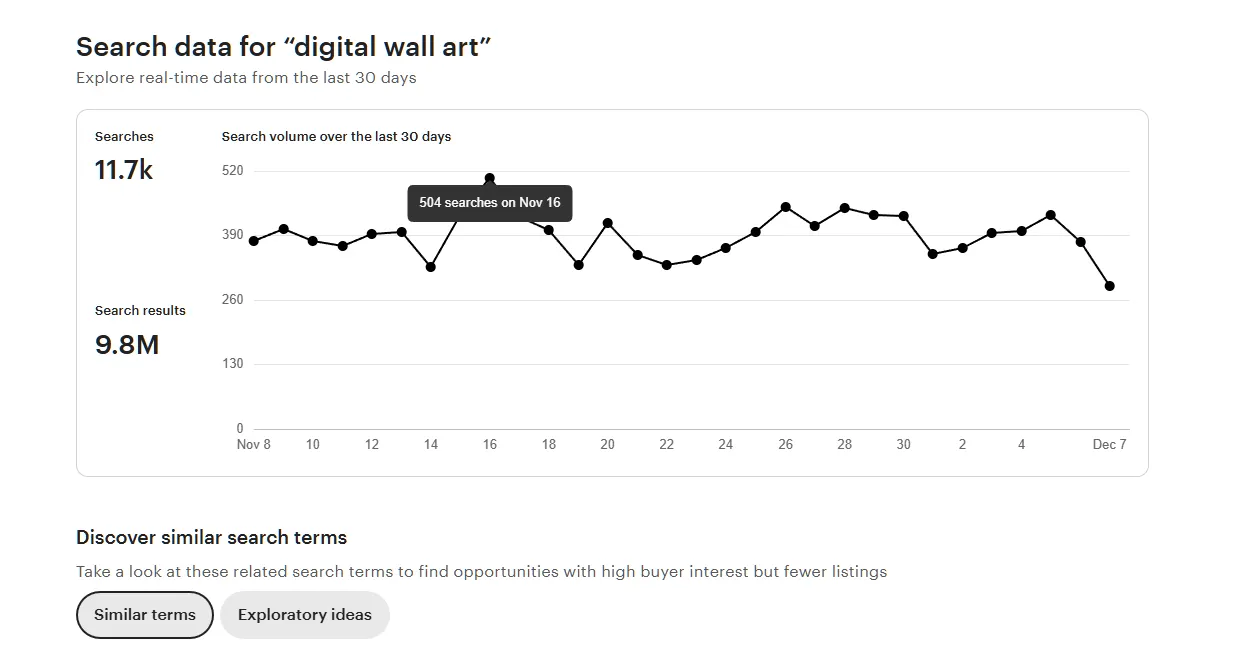
To make this workable, I started looking for more specific phrases where the numbers looked more realistic.
My sweet spot became: high search volume plus lower listing competition.
Here is an example:
"Affirmations wall art digital download"
- 437 searches
- 27k listings
Now compare that to "Christmas wall art," which currently has more than one million listings, and 27k listings seems like nothing.
I am not saying you cannot make money in competitive niches, but it is much harder, especially for newer Etsy accounts with no history.
That kind of data told me exactly which keywords and styles Etsy buyers liked and which ones I should drop. Instead of getting emotional about designs I personally loved, I let the numbers decide what I focused on.
Setting up the new Etsy store
Creating the shop itself was simple. Etsy allows multiple stores, so I opened this one just for digital wall art.
I kept it very basic:
- A shop name that fits the niche
- A simple logo and banner
- A short bio that explains what the shop is about
That was it. My goal was proof of concept, not a perfect brand.
I expected this shop to struggle or make a few random sales and then die off. Instead, here is what happened in the first month.
My first 30 days selling digital wall art
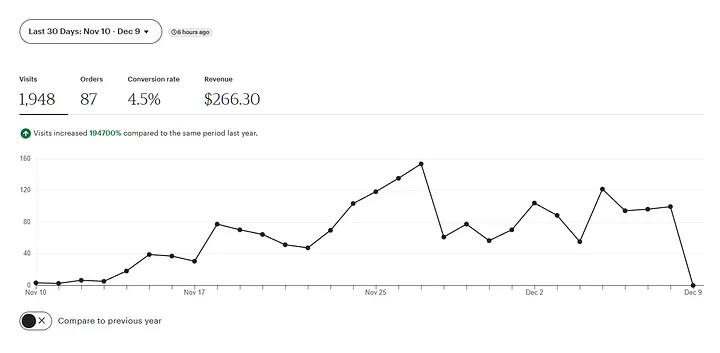
- Visits: 1,948
- Orders: 87
- Conv. Rate: 4.5%
- Revenue: $266.30
No, $266 dollars is not life-changing money. It is also not the "ten thousand in a month" headline you see all over the place.
But it proved something more important to me: digital wall art is still profitable when you approach it with a plan and a bit of patience.
The conversion rate stood out the most. Many shops sit in the low two-percent range. Seeing 4.5 percent this early made me pay attention.
I noticed a clear pattern:
- Some designs had almost no impressions after a few days
- Others started getting views and favorites almost immediately
That told me where to double down. If a listing was getting no traction, I changed the title and tags or moved on. If a listing took off, I studied it and made more designs around that idea.
My Shop Ranking
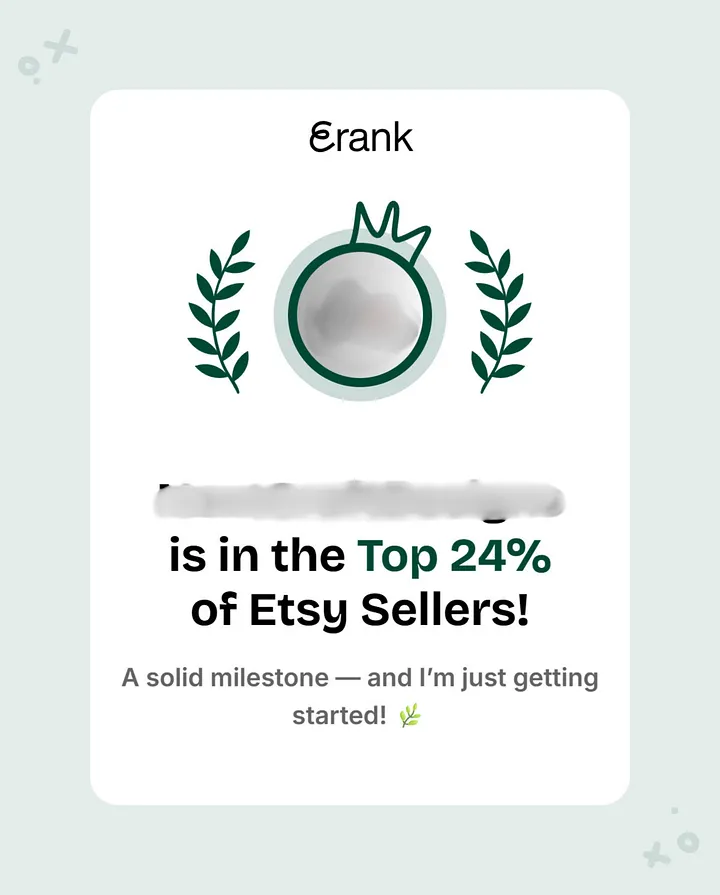
According to eRank, this new shop already sits in the top 24 percent of Etsy sellers. In simpler terms, it is already outselling about 76 percent of all Etsy shops, even though I started selling last month.
For something that started because I was open-minded and curious, I am happy with that result.
If you are curious about how to sell on Etsy or how to start an Etsy store that has a real chance of breaking out, this is a realistic example. It is not instant riches, but it is a solid extra income stream and it can be scaled.
You are not limited to wall art. You can sell any digital product on Etsy: templates, planners, trackers, invitations, social media kits and a lot more. But I found that Wall art is one of the easiest way to start.
If you are thinking about launching your own digital shop, here are the three biggest lessons from my first month.
1. Start now
"The best time to plant a tree was 20 years ago. The second best time is today."
I made a decision this year to stop letting ideas live only in my head.
Before I opened this shop, I had all the usual doubts.
- What if the market is too saturated.
- What if nobody likes my designs.
- What if I waste time and money.
There was a moment where I almost closed this account and walked away. But I decided to continue…
If you wait for perfect timing, you will keep waiting. Sometimes the smartest move is to open the shop, create your first listing, and let the market tell you what to adjust.
2. Consistency beats "genius" designs
Some of my best-selling designs are not the ones I spent the most time polishing. They are the ones that matched existing demand and were created because I stuck to my two-to-five-listings-per-day rule.
Consistency does a lot for you:
- Etsy sees that your shop is active
- Your catalog grows and looks more serious
- You gather data faster
If you want your shop to grow, focus on showing up regularly rather than waiting for occasional "perfect" ideas.
3. Let the numbers guide you, not your feelings
Feelings are fine, but data pays you.
I paid attention to:
- Search volume and competition for each keyword
- Impressions and click-through rate on every listing
- Which designs actually converted into sales
When a listing had almost no impressions, I did not take it personally. I changed the title and tags, improved the mockup, or moved on.
When a listing performed well, I asked how I could build on it. Could I offer variations, related keywords, or a bundle.
The more I treated my shop as something I am constantly testing and adjusting, the faster I learned and the easier it became to make decisions without getting emotional about individual products.
(If you are interested in exactly how I find these profitable niches, you can grab my free Guide to Digital Products on Etsy here.)
Quick guide: from zero to your first Etsy listing
If you want to try this yourself, here is a simple step-by-step path from nothing to your first listing.
Create your Etsy account:
Sign up, click "Sell on Etsy," and walk through the setup. Choose a shop name that hints at your niche.
Choose your niche:
Decide what you want to start with: wall art, printable planners, invitations, social media templates and so on. You can always branch out later.
Research your keywords:
Use Etsy search and tools like eRank to look for phrases with solid search volume and lower competition. Look for that mixture of enough demand and not too many listings.
Design your product in Canva or with AI:
Create your product using Canva, NanoBanana or whatever tools you prefer. Think about where the buyer will use it and what formats they need.
Prepare your files:
Export everything in the right sizes and formats. For wall art, give people multiple aspect ratios so they can print in several sizes.
Create your listing:
Upload your files, write a clear title that uses your main keyword, add tags, write a simple description, and use mockups so buyers can picture the product in real life.
Set your pricing:
Look at what similar products are selling for and start in a competitive range. You can always adjust once you see how people respond.
Publish and repeat:
Hit publish, then keep going. The first listing is just the beginning. New data comes from new products.
Want help planning your own digital product shop?
If you want to learn more, I put together a free PDF, the ultimate Guide to Digital Products on Etsy.
Inside, I cover:
- Digital product ideas beyond wall art
- Keyword examples to research for different categories
- A simple path from creation to publishing on Etsy