

Yes, Claude has a free plan. The useful next question is which kind of access your task needs: a conversation in Claude, a coding session in Claude Code, or an integration using the API. Those routes have different controls. A free chat account is not evidence that every development workflow or API request will run without a charge.
This guide checks the official access information on November 1, 2026, then applies it to a small creative brief. It does not report a paid-account test, a maximum-message experiment, or a guaranteed allowance. Check the account you actually intend to use before committing a client job to a particular route.
The access decision in one table
Start with the action you want to finish. Reviewing a caption is a different job from changing a codebase or building a service that sends requests automatically. Similar model names do not make the account controls interchangeable.
| Route | Official information checked | What to verify for your job |
|---|---|---|
| Claude Free | The pricing page lists a $0 chat plan with limited usage. | Current account availability and visible usage limits. |
| Claude Code | Claude Code is listed under Pro on the pricing page. | Your entitlement, selected login route, and applicable limits. |
| API / Console | Console is the API account environment. Some current paid plans offer linked API credits. | Organization, eligible credits, billing, and spending controls. |
Sources: Claude plans and pricing and Claude and Console account guidance. These are dated product facts, not a promise that the same terms will apply when you read this.
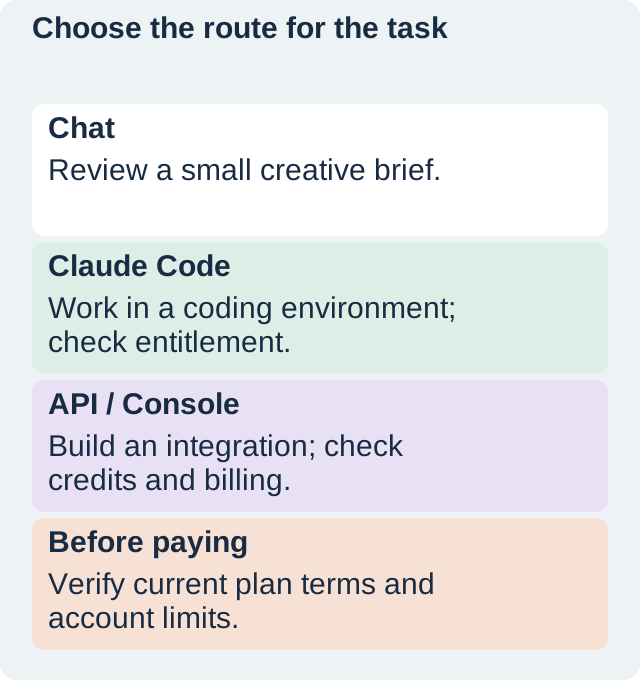
Use chat for a bounded review task
Our original exercise is a fictional candle-maker’s product-photo brief. The owner wants one warm still-life concept, a plain background, and space for editable copy. The supplied facts include the vessel color and approved product name. The ingredients, burn time, and promotional price are deliberately missing. A useful chat task is to organize those facts and identify what still needs approval.
That task does not require a coding environment or an API integration. Keep the first request small enough to review in one sitting. Ask for the brief, the unresolved questions, and a simple acceptance checklist. If the answer invents a fragrance, a certification, or a price, correct the draft against the source rather than accepting its confident tone.
Review this fictional product-photo brief using only the supplied facts.
Output: one scene direction, required visible details, and unresolved questions.
Known: cream vessel; approved name kept as editable copy; warm still life; plain backdrop.
Unknown: ingredients, burn time, price.
Do not invent product claims or imply those unknowns are approved.
Separate usage limits from the length of one request
A usage limit concerns how much service you can use over the relevant period. A length limit concerns how much information a conversation or request can hold. Treating both as “the free limit” makes troubleshooting harder. If you see a warning, record its actual wording and the route where it appeared before changing anything.
The official usage and length explanation is the right reference for those distinctions. For your own job, keep a copy of the approved source brief outside the conversation. A shorter relevant packet can make the next request easier to inspect, but it does not guarantee a particular usage allowance or remove an account restriction.
When the work pauses, preserve the accepted draft and the exact open question. Avoid re-submitting a large archive just to recover one decision. A handoff note such as “scene approved, label copy still unconfirmed” is more useful than hoping the next conversation reconstructs every earlier choice. Our context-packet guide shows how to prepare that compact reference.
Do not confuse running code in chat with Claude Code
The pricing page describes several capabilities in the chat product. A reference to code in that feature list should not be read as proof of Claude Code entitlement. Identify the named product, the account, and the task before deciding that two features mean the same thing.
For this candle brief, no repository changes are needed. If the next job is a script that renames a local image collection, the work has moved into a software task. That brings a different review: which files may change, whether a dry run is available, and how the result will be checked. Paying for a plan does not replace that specification.
Keep the access question separate from the quality question as well. A successful login shows that the route opened. It does not show that a generated script is correct, that every file was handled, or that the creative brief is ready to publish. Record those results separately so a later reviewer can see what was actually established.
Check Console before assuming API calls are free
An API is useful when a program needs to send requests and handle responses. It is usually unnecessary for one manually reviewed creative brief. The official API access guide points to Claude Console for that work.
Current account guidance says Claude and Console can use the same email while operating as distinct accounts. It also describes linked monthly credits for eligible paid plans. That means the practical check is more specific than “subscriptions never include API use.” Confirm the eligible plan, linked organization, credit conditions, and what happens after available credit is consumed.
Before an integration runs, the owner should know which organization is billed, what spending ceiling is intended, and where usage will be reviewed. Do not infer those details from the email address shown on a chat screen. For a learning exercise, use an approved small task and explicit controls rather than putting an unattended process behind a vague expectation of free access.
A small completion test is better than a plan label
For the candle exercise, the acceptance checks are straightforward: the vessel stays cream, the scene remains warm and restrained, copy stays editable, and no missing product claim becomes a fact. The task is complete when the brief passes those checks and the owner knows which questions still block production.
Keep a short record: date, route, account-visible entitlement, input revision, accepted result, and remaining unknowns. If you encountered a limit, record the notice instead of estimating a universal number of messages. This record helps you decide whether the route served the job without turning one session into a claim about everyone’s capacity.
If several subscriptions are involved, use the creator subscription audit to compare the recurring jobs they actually support. A plan should earn its place through a needed workflow, not merely because it has more features on a comparison page.
How QuestStudio helps after the access decision
Use Prompt Lab to organize the approved scene direction and the preservation checklist. Then choose an image workflow when the facts are ready for a visual concept. Keep exact product copy outside a generated bitmap so the final design can be corrected without regenerating the whole scene.
The useful handoff is the approved brief plus its review criteria. Account access is an earlier decision; it is not the final asset. Save the brief with the source revision, open questions, and chosen next action so the person making the image can work without guessing what was approved.
Download the original practice worksheet
Frequently asked questions
Is Claude free to use?
Claude lists a free chat plan. Check current availability and account-visible usage limits for the task you intend to run.
Does a free Claude account prove I have Claude Code access?
No. Verify the named product and your account entitlement. The checked pricing page lists Claude Code under Pro.
Are API credits always separate from every subscription?
Do not rely on that blanket statement. Current official guidance describes linked API credits for eligible paid plans; verify the exact conditions in your account.
How many free messages will I get?
This guide does not establish a guaranteed count. Use the current account notices and official limits guidance.
Was the sample tested in a paid Claude account?
No. It is an original planning exercise, supported by dated official access research rather than a paid-account experiment.
Organize the approved creative request
Use Prompt Lab to organize a bounded brief before choosing the text or media workflow that serves it.
Hero: AI-generated editorial illustration. Original teaching materials and documented feature research, checked November 1, 2026. Examples are labeled where synthetic or hypothetical.