

Tokens are the units a language model uses to process information. A tokenizer divides text into those units, and a context window limits how much information a particular model can handle in a request. For a creator, the practical task is to keep the important brief, exact copy, and useful references available without flooding the request with irrelevant material.
You do not need a universal word-to-token formula to start. You need to know which model or service you are using, what material the task requires, and which details must survive every revision. This guide uses an original fictional product-launch packet to make those decisions concrete.
Distinguish words, tokens, and the whole request
A token may be part of a word, a whole word, punctuation, or another text unit. Spaces and language affect the division. The same passage can have different counts under different encodings. OpenAI’s token explanation describes these differences and separates input, output, cached, and reasoning tokens. A character count is useful for editing copy; it is not an exact model usage meter.
The visible message is also only part of a larger interaction. Conversation history, system instructions, tool results, attachments, and the response can affect the available context, depending on the product. Multimodal inputs have their own accounting. Do not paste an image description into a text counter and assume you measured the original image request.
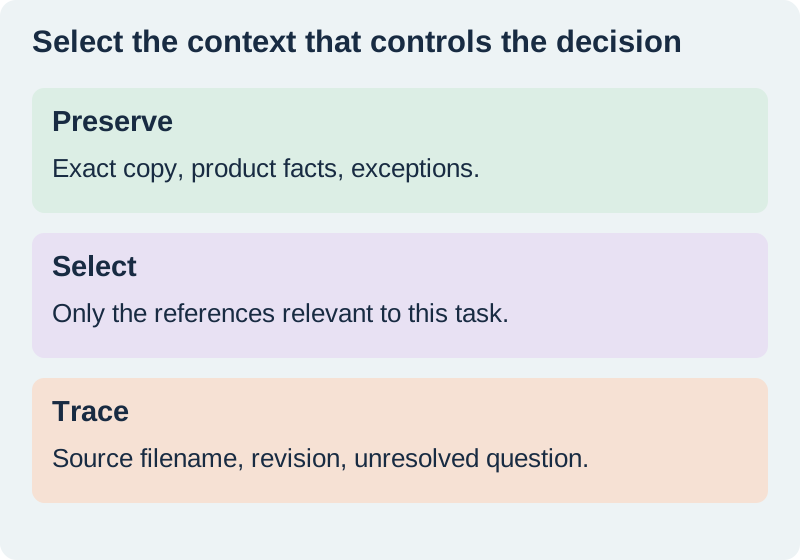
Start with the decision the model must make
Imagine a fictional desk-lamp launch. You have an approved product sheet, interview notes, old campaign drafts, a long catalog, and dozens of reference images. The immediate job is to plan three photographs of the lamp. The model needs its shape, finish, scale, approved claims, and desired shot list. It probably does not need every abandoned headline from last year.
Write a one-sentence task before selecting context: propose three image compositions for the approved lamp, preserving its physical features. Then inspect each source for what it contributes. A catalog paragraph about an unrelated chair does not become useful because there is room in the window. Larger capacity changes what can fit; it does not establish relevance or accuracy.
Build a compact packet with four clear parts
Begin with authoritative facts: dimensions from the approved sheet, the exact product name, and any fixed copy. Follow with task-specific visual constraints, such as keeping the switch visible. Then include the smallest relevant reference excerpts. End with unresolved questions and links or filenames for the full sources. Label paraphrases as paraphrases so nobody mistakes them for approved wording.
In this example, the finish is “matte blue,” while the interview says “it looks almost green beside the window.” Preserve both in their proper roles: approved finish versus subjective observation. A careless summary that replaces blue with green creates a product error. Compression is useful only when the controlling facts remain intact.
TASK: propose three desk-lamp photo compositions.
AUTHORITATIVE FACTS: approved product sheet, revision 4. Finish: matte blue. Keep the visible switch and base shape.
EXACT COPY: preserve product name verbatim from the sheet.
REFERENCES: selected interview excerpt and two approved photographs.
UNKNOWN: final campaign background. Offer options; do not treat one as approved.
FULL SOURCES: product-sheet-r4.pdf; interview-notes.txt; reference-index.csv.
Measure with the relevant tokenizer when exact size matters
Use the provider’s tool or library for the selected encoding when a precise text estimate matters. Record the model or encoding and the text revision alongside the result. A bare number copied into a project note becomes misleading when someone changes the input or switches models. The OpenAI tokenizer is a reference for supported text tokenization, not a universal count for every provider.
Keep output room in mind when planning a request. A long source packet plus a long requested answer may exceed a model’s supported limits even when the source alone fits. Check the current product documentation rather than copying a capacity number from an unrelated guide. This article deliberately gives no shared maximum or cost estimate because those depend on the model and service.
Split a large job at a useful boundary
If the full packet is too large, split by deliverable or evidence set. Review each interview separately, retain source identifiers, and combine only the relevant findings. Then ask for a final decision using the approved summaries and direct excerpts that matter most. Do not cut a specification in the middle of a condition or separate an exception from the rule it qualifies.
For the lamp example, summarize audience preferences separately from physical product facts. The final image brief should inherit product facts directly from the product sheet, not from a secondhand audience summary. This preserves a clear route back to the source and makes conflicting evidence easier to inspect.
Check what the shortened version lost
Compare the packet against a small preservation checklist: exact names, required numbers, exceptions, sources, and unresolved items. Ask whether a person who sees only the compact packet could make the same production decision. If not, restore the missing context. A shorter prompt that changes the task is not an improvement.
A practical test is to remove the packet from the full conversation and read it alone. Does “the second option” still identify a particular image? Does “keep the original” name a file? Replace fragile references with specific labels. Use the creative-brief workflow to approve decisions, then preserve the compact packet with its source version.
How QuestStudio helps you reuse the right context
Organize the final media instructions in Prompt Lab with the relevant example and source filenames. Keep the full archive elsewhere and bring in the materials the current task actually needs. This is a preparation method, not a claim about a specific QuestStudio model’s maximum context window. Check the selected workflow when you need a current limit.
The goal is a usable request with traceable facts. Save the packet date, source revision, unresolved questions, and any tokenizer measurement you actually performed. The worksheet below supplies those fields without inventing token counts. For recurring instructions, the few-shot example guide shows how to include only the examples that teach the required pattern.
Download the original practice worksheet
Frequently asked questions
Is one token always one word?
No. Tokenization depends on text, language, and encoding. A word can use several tokens.
Does a larger context window guarantee better answers?
No. Relevant evidence, clear instructions, and review still matter. Capacity describes what can fit, not whether the result is correct.
Should I delete the full source documents?
No. Keep the full archive and identify the versions behind the compact working packet.
Can I use one token count for every model?
No. Record the encoding or provider used for the measurement and repeat it when the input or model changes.
What is the most useful check after shortening a brief?
Verify that approved names, numbers, exceptions, source references, and unresolved questions remain intact.
Keep the compact brief with its examples
Organize a short approved brief in Prompt Lab and retain the full source archive separately.
Hero: AI-generated editorial illustration. Original teaching materials and documented feature research, checked November 1, 2026. Examples are labeled where synthetic or hypothetical.