

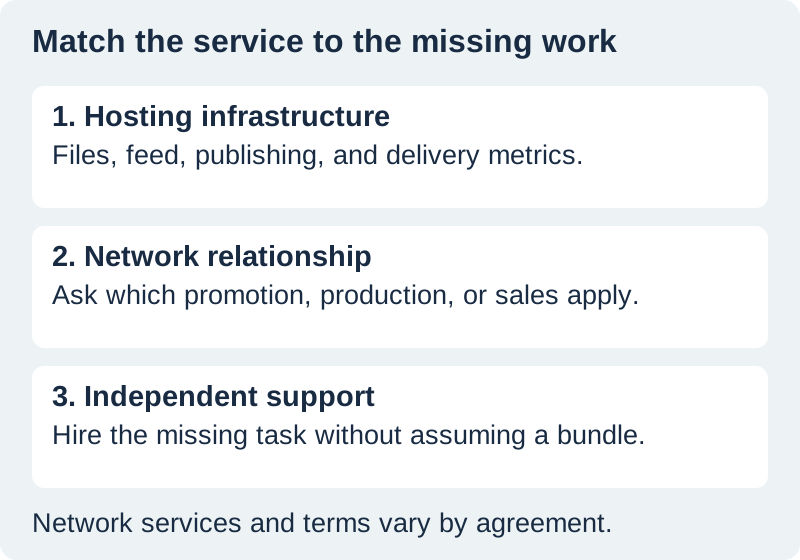
A podcast host supplies publishing infrastructure; a podcast network is a relationship that may include promotion, production, advertising support, or a shared editorial identity. Some organizations provide both. Choose based on the work your show needs and the terms actually offered, rather than treating a network name as an automatic upgrade.
This guide uses a fictional independent show to separate those decisions. It is not a ranking of networks or a prediction of revenue. The useful result is a short service brief and a set of specific questions you can put to a provider.
Separate delivery infrastructure from the partnership
Hosting concerns the operational path from an episode file to a published feed and its distribution. A network relationship can add other services, but those services vary. A network might support promotion without editing your episodes, or provide ad sales while requiring a particular hosting arrangement.
For a concrete distinction, Radiotopia describes itself as a podcast network, while PRX describes Dovetail as publishing and distribution infrastructure. These examples illustrate different roles. They do not establish the terms, admission requirements, or services of every organization using the word “network.”
Keep the two decisions on separate lines in your planning sheet. One line asks whether your episodes can be published reliably under accounts you can recover. The other asks what additional relationship would solve a specific problem for the show.
Write a brief for the show you actually have
Our fictional show, Small Workshop, publishes a weekly conversation with independent makers. The producer can record and edit episodes but struggles to promote the archive consistently. The show already has a working host, a recoverable owner account, and organized source audio.
Its immediate need is therefore not “a network.” It is a repeatable promotion process with a clear audience fit and evidence of what gets delivered. That need could be met through a suitable network relationship, a focused contractor, a collaboration with related shows, or an internal process.
Write the actual release schedule, production capacity, audience evidence, and constraints. Use measured figures with dates and definitions when you have them. If you do not know who listens, record that as a research task instead of filling the brief with an invented audience profile.
Include what you want to preserve: the show's name, editorial direction, release cadence, archive, and ability to communicate with its audience. These priorities help you evaluate a proposal without assuming that every provider structures the relationship the same way.
Turn broad promises into specific deliverables
When a provider offers promotion, ask what form it takes. Is it a named placement, a cross-promotion exchange, advice, or access to a shared channel? Who prepares the creative, who approves it, and what report will show that it ran?
When production help is offered, define the boundary. Editing an episode is different from booking guests, writing a script, correcting a transcript, or making social clips. Ask about turnaround, revisions, file handoff, and the person responsible for the final approval.
For advertising support, ask which tasks are included: finding advertisers, reviewing the fit, scheduling placements, collecting assets, approving reads, reporting delivery, or handling payment. Do not assume that a sales relationship includes all of those jobs.
Record answers in the network-fit worksheet. A useful answer names the service, owner, timing, and evidence. “We help shows grow” is a starting claim, not an operational specification.
Check accounts, files, and the transition path
Identify who controls the hosting account, feed, directory listings, source files, website, and analytics access. These are separate assets. Having access to a shared dashboard does not necessarily mean you can redirect the feed or export everything needed to leave.
Ask for a written transition process before moving the show. What files are returned, in which formats, and on what timeline? Who changes directory information? Which person can authorize a feed redirect? Where will the source archive remain during the transition?
For agreement terms concerning ownership, exclusivity, duration, termination, or revenue shares, obtain clear written terms and qualified review where needed. This worksheet identifies questions; it does not interpret a contract or determine your legal rights.
Keep a current independent inventory of episodes and their approved metadata. The hosting comparison and migration checklist covers the infrastructure side in more detail. Do that review even when the network suggests a host it already uses.
Compare three ways to solve one problem
For Small Workshop, compare three proposals against the same task: promote four archive episodes to listeners interested in independent making. One proposal might be a network placement package, another a contractor managing clips and outreach, and a third a collaboration with two related shows.
List the exact deliverables, required producer time, cost structure, access requirements, and reporting for each option. Do not compare a full production bundle with a single promotional placement as if their prices describe the same service.
Evaluate what would count as a useful result before the work begins. Completed placements and delivered files are operational evidence. Listener growth or subscriptions are outcomes affected by many factors. A small change after one placement is not enough to establish a reliable causal effect.
If the show primarily needs sponsor readiness, the sponsorship package workflow may be the more immediate step. It helps organize the offer and evidence without assuming that joining a network is required.
Prepare a sample that accurately represents the show
Provide a concise show description, an existing representative episode, and a short trailer if requested. Choose material that shows the actual format and production standard. A polished sample unrelated to the normal episodes can create the wrong expectations for both parties.
Keep claims in the trailer aligned with the show. If the program features interviews, do not imply that every episode includes an exclusive guest. If the schedule is seasonal, avoid promising a weekly release that the team cannot maintain.
QuestStudio's Voice Lab can help audition an approved trailer script. Review pronunciation, completeness, and tone before using the result. The read-back proofreading workflow is useful before final narration. A generated trailer is a production asset, not evidence of audience demand or a substitute for real episodes.
Make the decision at the service level
Choose the arrangement that addresses the named problem with responsibilities you understand. If the current host works and promotion is the gap, there should be a clear reason for any required hosting change. If production capacity is the gap, a promotional affiliation alone will not remove the editing workload.
Keep unanswered questions visible. A decision sheet with three unresolved terms is more honest and useful than a numeric score built from guesses. Resolve those terms before committing the show's accounts, archive, or schedule to a new arrangement.
Frequently asked questions
Is a podcast network the same as a hosting platform?
No. Hosting supplies publishing infrastructure, while a network relationship may include other services. An organization can offer both, so inspect the specific arrangement.
Do I need a network to publish a podcast?
No. An independent show can use a hosting and distribution workflow without joining a network. Consider a network when its actual services address a defined need.
Will a network automatically bring advertisers?
Do not assume that. Ask whether ad sales are included, what work is performed, what requirements apply, and how placements and payments are handled.
Should I move hosts just to join a network?
Evaluate the reason and the transition requirements. Confirm account control, archive export, feed handling, and the practical benefit before changing a working publishing setup.
What should I prepare before contacting a network?
Prepare an accurate show brief, representative episodes, dated audience evidence where available, a clear service need, and questions about deliverables, costs, control, and exit procedures.
Prepare an accurate show trailer
Use Voice Lab to explore a short approved trailer script, then review the final sound before sharing it.
Hero: AI-generated editorial illustration. Original teaching materials and documented feature research, checked October 31, 2026. Examples are labeled where synthetic or hypothetical.