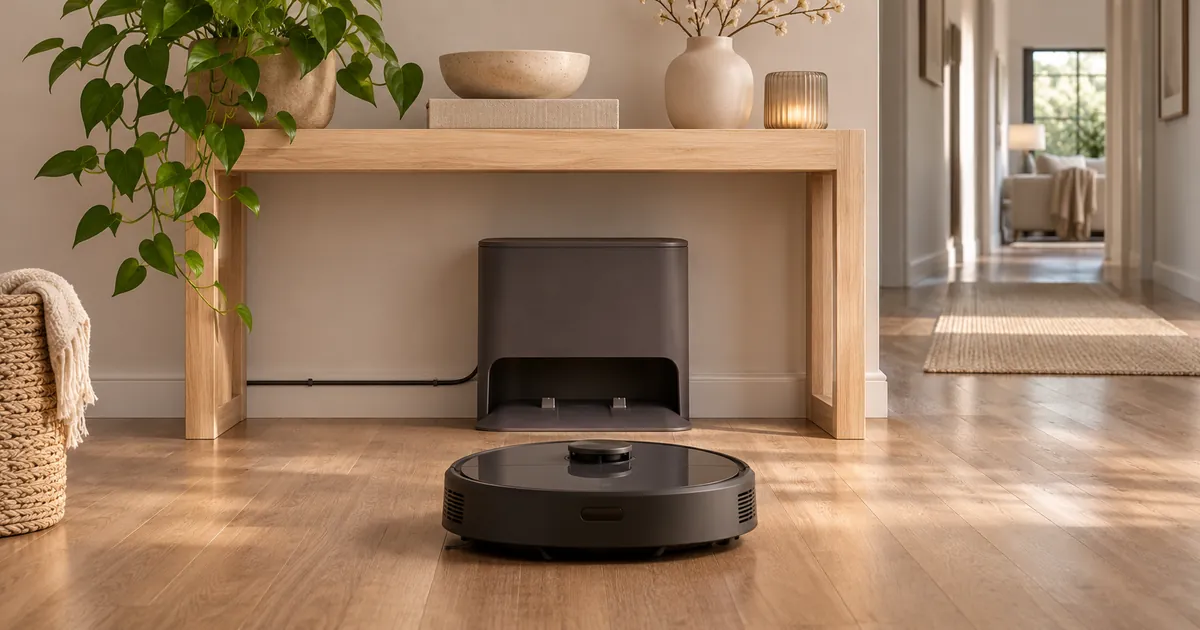

A robot vacuum can fit under a sofa and still need an open bay for its dock. Clear the dock location before choosing a model. For the Roborock Saros 10R, mark the manufacturer's installation envelope on the floor, check access for the water tanks, and walk the route with your studio cables in their usual places.
Gear to consider
We may earn a commission if you buy through these Amazon links.
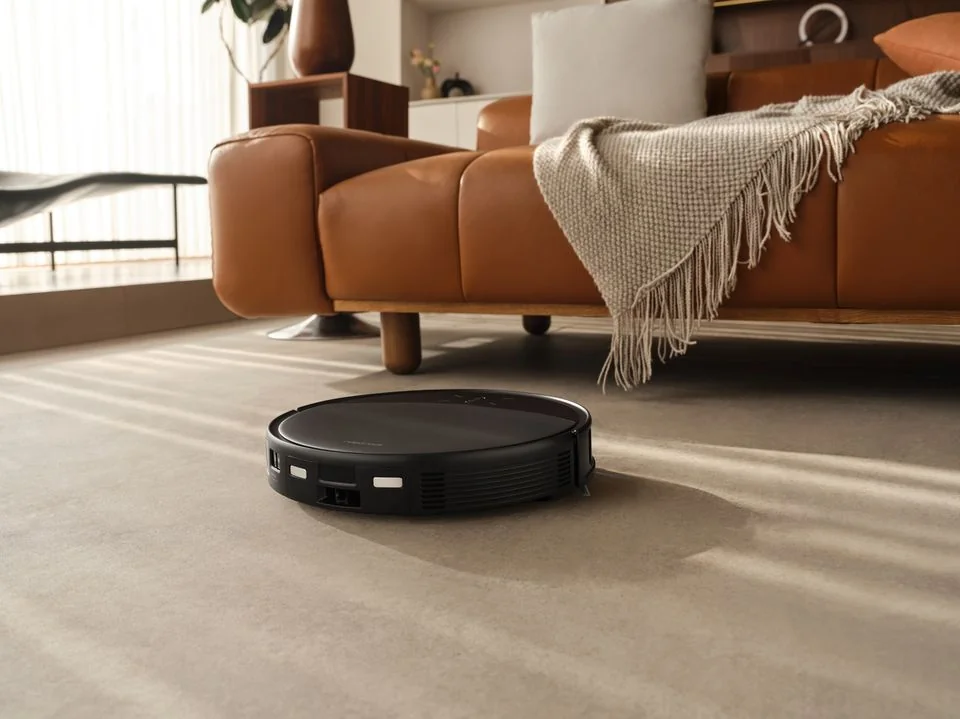
Roborock Saros 10R
For a measured open bay
Consider it if your location meets the specified clearances and you want a multifunction dock. Confirm the listing includes the dock variant you planned for.
Measure three different spaces
Measure the robot's cleaning clearance, the dock's operating clearance, and the space your hand needs for service. These are separate measurements. A robot may pass the edge of a credenza and encounter a lower crossbar farther in. A dock may slide under the lip of an open shelf while leaving too little room to remove its tank. Take the smallest inside measurement at the back, middle and front of the furniture. Include the baseboard, door swing, shelf supports and anything already stored inside.
Roborock calls for a flat hard floor against a wall and a space of at least 0.75 m high, 0.4 m wide and 1.2 m deep for the Saros 10R. Use the model's placement instructions as your starting point. Read the diagram in the manual before measuring the depth. Keep the approach open in normal use, including when a chair is pulled out and the studio door is partly open. Measure the actual bay before ordering or altering furniture.
What hands-on reviews tell you to check
In its Saros 10R test, RTINGS noted the robot's low body. TechRadar's hands-on review reported that its unit went under the reviewer's TV cabinet with very little height to spare. That experience is a reason to measure your furniture at several points. The opening may clear the robot while a leg brace, rug edge or uneven floor farther inside leaves less room.
Put a straightedge under the shelf and take measurements from the finished floor to each low point. If the room has a rug you're keeping, include the rug and pad in the check. Rehearse opening the dock and lifting its tanks with the furniture in place. Leave room for an upright lift if the tank design calls for it. Sketch where you would set a tank down before carrying it away to empty or refill it.
Pick an approach that stays clear between shoots
Start with a wall outlet accessible from the side or behind the installation as the manual allows. Keep the dock's power lead away from the robot's path. Check the route a second time with the room set up for recording. Camera cables, floor-level light stand spreaders and rolling chairs often occupy the exact space that appeared clear when the room was empty. A dock that requires moving your desk chair every day is a poor fit for a frequently used studio.
If the dock fits only behind a door, check that the door can stay safely open whenever the robot is scheduled. Avoid closing the unit into a tight compartment for appearance. Consider an openly accessible wall in an adjacent permitted room if it keeps the route simple. Check any transition or threshold along that path before planning automatic runs, and keep the dock on the level surface specified by the manufacturer.
Mark a bay before spending money
| Candidate | Measure or try | Keep it if |
|---|---|---|
| Open wall | Depth to chair or door in normal use | The full approach stays open |
| Open console | Minimum inside height and tank lift | The space meets the manual and service is easy |
| Adjacent hall | Threshold, turn and power route | The robot can approach without cables across the path |
Make a rectangle with painter's tape on a surface where the tape is safe. Place a cardboard box at dock height to mimic the station. Move your chair through its normal range, then open nearby doors. Carry an everyday object the size of a full water tank out of the opening. An installation may meet the written dimensions and still feel awkward enough that you'll avoid servicing it. Repeat with the studio in its normal working condition before deciding.
Give the first run a job
For the initial setup, clear loose cables and props, supervise the first return to the dock, and observe entry and exit from the same fixed viewpoint. Then repeat with the usual obstacles back in their sensible locations. A reproducible route is more useful than one clean run while everything has been temporarily cleared. Record where the robot turned, hesitated or needed help so you can adjust the route one variable at a time.
The obstacle avoidance guide covers loose objects that remain in the room. If a camera-equipped unit will work around client material or screens, read the camera privacy checklist before enabling remote viewing features.
Example: an open console versus the side wall
Suppose a console has 0.78 m of clearance at the front but a brace reduces it to 0.71 m at the back. The back measurement rules out that bay under the published guidance. The nearby wall remains a candidate if the chair moves without entering the approach. If both locations need moving furniture, mark the path in the adjacent room before buying. The best location leaves room to fill, clean and reach the power lead on an ordinary working day.
Plan room coverage in QuestStudio
If you also film in this room, use Video Lab to plan a simple three-frame storyboard for a studio reset video. Use a wide frame for the approach, a low frame for any threshold, and a close frame for the tank lift. The storyboard can also help document changes before you move furniture. Keep the real clearance measurements in the worksheet.
Frequently asked questions
Can the Saros 10R dock under a console?
Only if the actual installation meets the model-specific height, width and depth requirements, leaves the approach open, and lets you remove its service parts. Measure the inside bay and the floor path with doors and furniture in normal positions.
How much room does the Saros 10R need?
Roborock's US support guidance specifies at least 0.75 m high, 0.4 m wide and 1.2 m deep with the dock on a flat hard floor against a wall. Use the manual diagram for your chosen dock variant.
Does a low robot make the dock low too?
The robot's body height describes where it can clean. The station houses service components, so the relevant number for it is installed clearance. Measure the robot's cleaning path separately from the dock bay.
Should a rug go under the docking station?
Use the floor type specified by the manufacturer. Roborock calls for a hard, flat surface for this model. If a nearby rug edge changes the approach, supervise the first return in the actual layout.
Make the buying decision
If you have a usable bay and want this model's multifunction dock, the Saros 10R is a candidate. Keep your existing vacuum if the room needs cable management or furniture changes before any robot could dock reliably. Confirm the exact dock version in the listing before ordering.
Download the setup checklist (CSV)
Ready to check the listing?
We may earn a commission if you buy through these Amazon links.
Roborock Saros 10R
Sources and further reading
Affiliate disclosure
As an Amazon Associate I earn from qualifying purchases. Recommendations draw on product documentation and the external tests linked above. The hero is an AI-generated setup illustration.
Continue with a useful next step
 Image
Robot Vacuum Camera Privacy: A Setup Checklist
Check robot vacuum camera privacy before the first clean. Separate local recognition, photo uploads and remote viewing, then record model-specific settings.
 Creator Workflows
Robot Vacuum Obstacle Avoidance: What to Check
Compare robot vacuum obstacle avoidance for a busy home office. Understand cable limits, pet-related claims, camera privacy and the checks before buying.