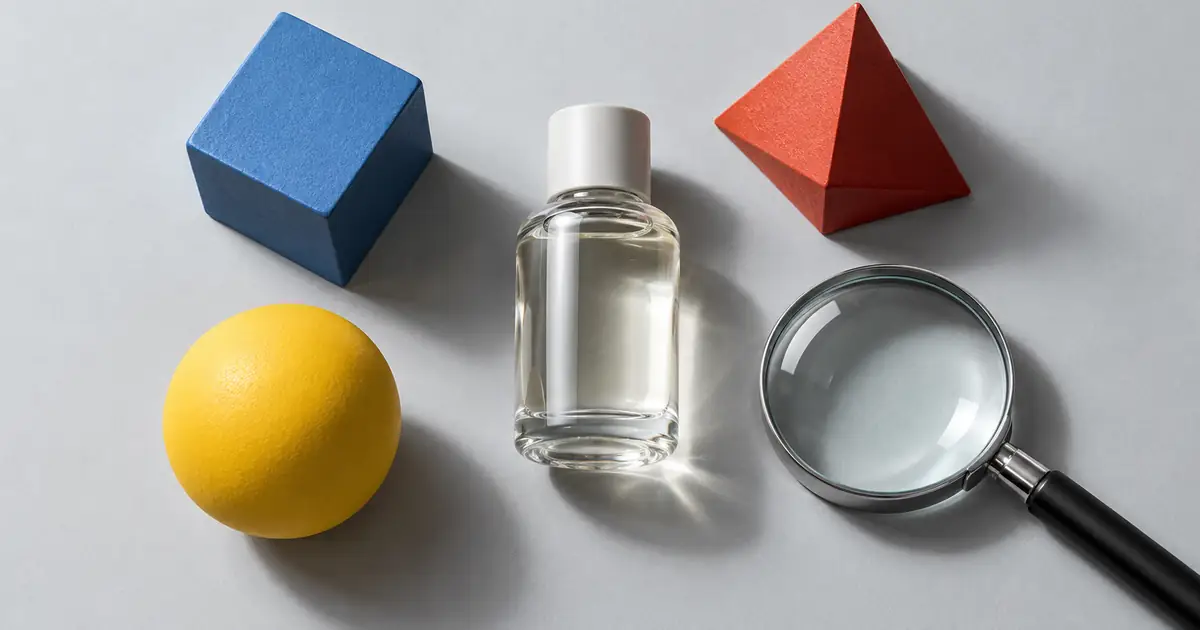

A vision-language model can connect an image with a written question: describe a scene, read a visible label, or compare an image with a brief. The practical challenge is deciding which parts of its answer are supported by the pixels and which require another source. A plausible sentence is not evidence that the image contains the fact.
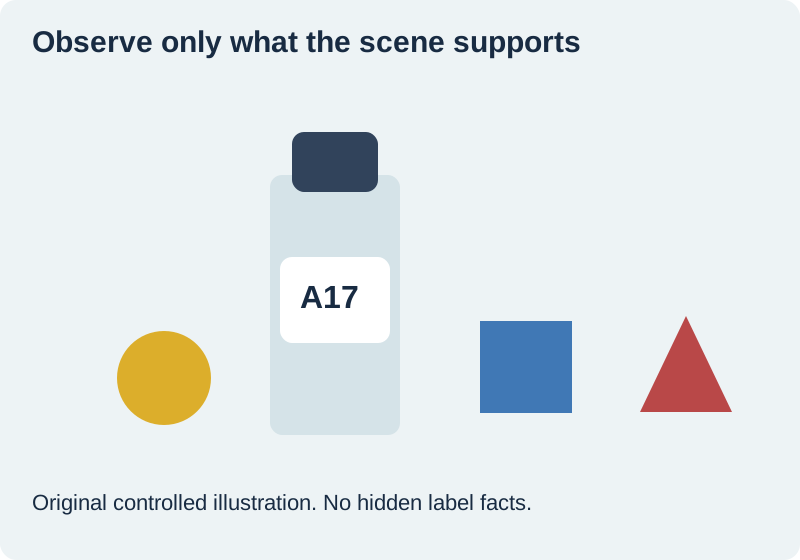
This guide uses an original controlled illustration with a simple bottle and three shapes. The rendered image was inspected by this multimodal assistant, and its responses were compared with the authored source record. This is a non-blind qualitative exercise: the authoring context was available. It is not an independent benchmark, a separate vendor API test, or a measure of general model accuracy.
Start with questions the image can answer
A useful first question is narrow: how many bottle-shaped objects are visible, what string is on the label, and which colored shapes sit around it? Each answer can be checked against the illustration. A question about ingredients or expiry date needs information the drawing does not supply.
Write the acceptance rule before reviewing the response. For the label, the rule is exact transcription of A17. For the scene, the rule is a visible relationship such as the yellow circle being left of the bottle. For absent product facts, the rule is to say that the image does not establish the answer. These checks are more useful than asking whether a response sounds intelligent.
Record observations before accepting the description
The assistant’s rendered-image observations were: one bottle, the string A17, a yellow circle to the left, a blue square to the right, and a red triangle farther right. It left capacity, ingredients, and expiry unknown. Those responses matched the authored source record in the six questions checked.
No disagreement was observed in this small exercise, so no hallucination has been invented for the article. The result is deliberately modest. Large, simple shapes and a short high-contrast label are easier review material than a real packaging photograph with glare, tiny text, overlapping objects, and ambiguous boundaries. A successful easy example does not establish reliable performance on those harder cases.
| Question | Recorded response | Source comparison |
|---|---|---|
| Bottle count | One | Matches. |
| Visible label | A17 | Matches exact string. |
| Surrounding shapes | Yellow circle left; blue square right; red triangle farther right | Matches. |
| Capacity | Not shown | Correctly unknown. |
| Ingredients | Not shown | Correctly unknown. |
| Expiry | Not shown | Correctly unknown. |
Download the recorded observations and authored source truth to inspect the scope. They document this exercise rather than a score for a named commercial model.
Keep visible evidence separate from external truth
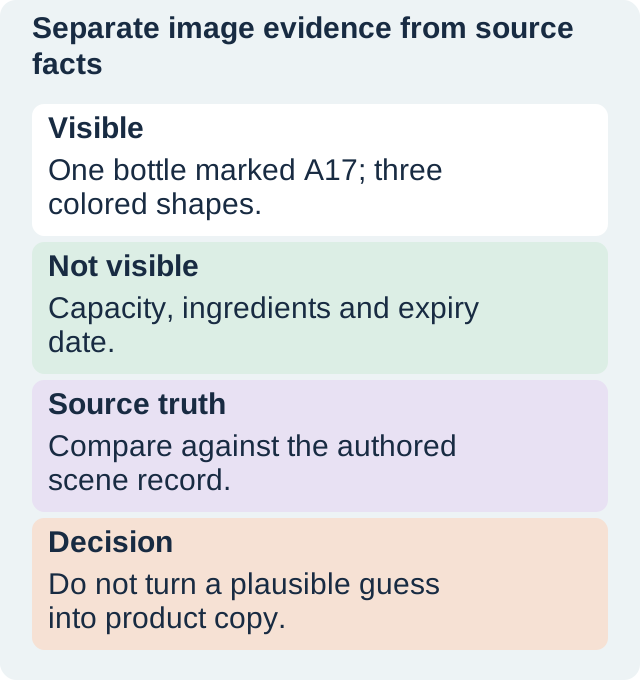
The illustration supports a visible label reading A17. It does not establish that A17 is a product model sold by a real business, that the bottle holds a particular liquid, or that it meets a specification. Those claims require an approved product record. Even a perfectly transcribed string can be attached to the wrong interpretation.
Use three columns: image observation, source confirmation, and release decision. The observation might say “the label appears to read A17.” The source confirmation checks that string against the approved copy sheet. The release decision records whether the exact label is acceptable in the intended asset. Keeping these separate prevents a visual description from quietly becoming product evidence.
This is especially useful when reviewing an AI-generated product scene. A model may describe a bottle as premium or organic because the styling suggests it. Those are interpretations, and some can become commercial claims. The image fact-check workflow helps compare the final scene with the approved brief after the visual observations are recorded.
Expect difficult text and counting to need closer checks
OpenAI’s vision documentation identifies limitations involving small text, counting, precise spatial reasoning, and incorrect descriptions. Use those limitations to design review steps rather than assuming that one general question will catch every problem.
For a real label, inspect the original-resolution region and compare exact strings. If you provide a crop, preserve enough context to know which object it belongs to. If you ask for a count, define whether partly hidden objects or reflections should count. An ambiguous task can produce an answer that looks wrong because the counting rule was never specified.
Do not enlarge a tiny region and assume new detail has become available. A larger display may make existing pixels easier to inspect, but it does not prove the missing characters. Keep unreadable text marked unreadable. Ask for the original source or a better photograph when the release depends on the exact wording.
Use an evidence-constrained request
Ask for the answer and the visible support together. Separate direct observation from uncertainty and from facts that require an external source. This makes a mistaken inference easier to catch, although the instruction itself does not guarantee correctness. The reviewer still needs to inspect the important claims.
For our controlled scene, a useful request is short enough to audit: count the bottle-shaped objects, transcribe the visible label, describe the nearby shapes, and identify which of capacity, ingredients, or expiry is shown. The expected result is not a long story about the product. It is a compact record that can be checked against the drawing.
Use only the supplied image.
1. Count the visible bottle-shaped objects.
2. Transcribe the visible label exactly, or mark it unreadable.
3. Describe the colored shapes and their positions.
4. For capacity, ingredients, and expiry: state whether each is visible.
Separate observation from inference. Do not fill missing facts from packaging style.
Decide what a failed check should change
If a response changes A17 to A71, the correction is an exact-string issue. Recheck the source image and the approved copy rather than simply asking for a more confident answer. If a response invents a capacity, remove the unsupported claim and mark the missing source. If counting fails, clarify the rule and test a simpler crop while retaining context.
Save the original input, request, response, source truth, and review note together. An updated image or different crop creates a new test case. Do not compare responses as though the input stayed the same if one version removes glare or enlarges the label. This discipline makes failures actionable without overstating what one successful retry proves.
For repeat work, include a few known difficult examples alongside ordinary scenes. A case where the right answer is “not visible” is valuable because it checks restraint. Keep the evaluation honest: a constructed failure example is a teaching fixture, and an observed model mistake is an actual result. They should never share the same label.
How QuestStudio helps prepare the visual reference
Use Image Lab for an original concept and keep the approved source facts beside it. For a controlled exercise, simple authored artwork is useful because the expected visible details are known. For a commercial image, compare the concept with the real packaging and copy sheet before release.
Finish with a list of accepted visual observations, unresolved facts, and the person responsible for confirming them. The goal is a usable review decision. A vivid model description is helpful only when the important claims can be traced to the image or to a named source.
Download the original practice worksheet
Frequently asked questions
What is a vision-language model?
It processes visual input together with language tasks, such as answering a written question about an image.
Does this exercise establish model accuracy?
No. It is a small non-blind qualitative review by this assistant, with authoring context available.
Were hallucinations observed in this example?
No disagreements were observed in the six recorded checks. That limited result does not predict performance on other images.
Can the model infer ingredients from the bottle style?
The drawing does not establish ingredients. Use an approved product source rather than a visual guess.
What should I save for a repeatable check?
Keep the exact input image, request, response, expected source facts, and review decision with their revisions.
Prepare a reference image with known facts
Use Image Lab for a concept image, then compare each important detail with approved source material before release.
Hero: AI-generated editorial illustration. Original teaching materials and documented feature research, checked November 1, 2026. Examples are labeled where synthetic or hypothetical.