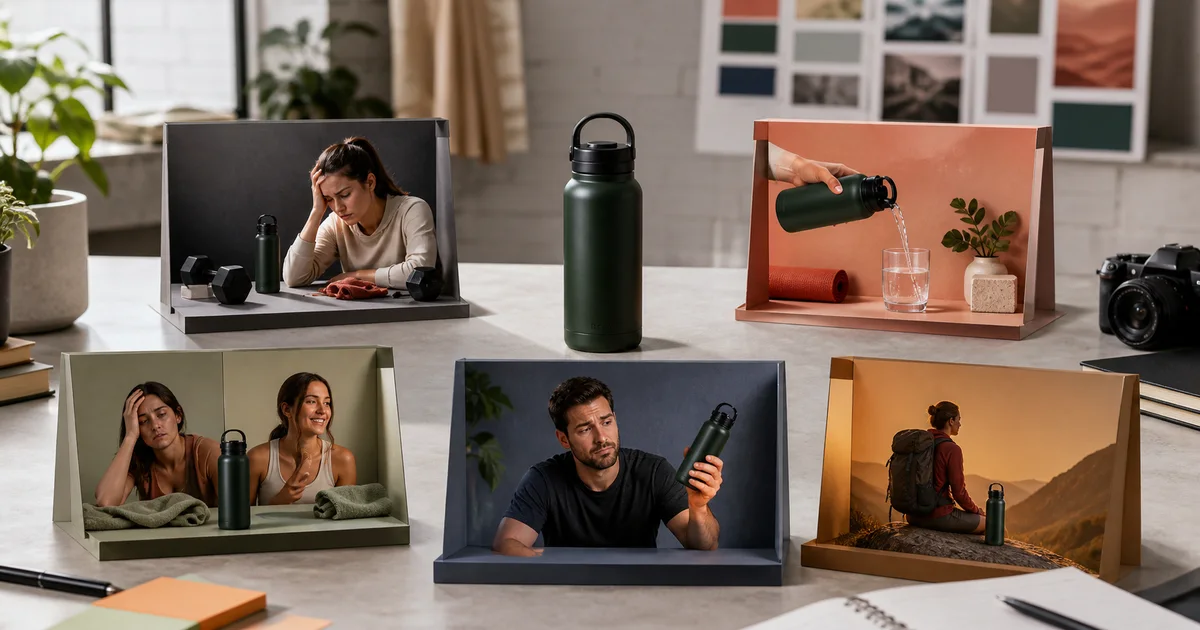

AI ad hooks fail when the opening line, first visual, and product proof tell three different stories. These 50 starters are organized by customer tension, not empty hype. Fill the brackets with facts you can support, then build the first three seconds around the same promise.
A hook has four parts, not one sentence
The first seconds of a product video combine a spoken or written line, a visual interruption, a reason to believe, and a transition into the product. If the line says “I stopped wasting time” while the picture shows a generic beauty shot, the viewer receives no proof. Build the opening as a small contract.
| Layer | Question | Example |
|---|---|---|
| Customer tension | What familiar frustration appears? | A bottle leaking inside a work bag |
| Opening line | Why should this person keep watching? | “If your bottle does this, check the lid.” |
| Visual proof | What can be shown immediately? | Turn the filled bottle upside down |
| Product transition | How does the solution enter honestly? | Close-up of the locking seal |
Problem hooks
2. I was tired of [frustration], so I tested a simpler setup.
3. The annoying part of [task] is not [obvious problem]. It is [real problem].
4. Nobody warns you about [specific moment] until it happens.
5. If [task] takes you longer than [honest range], this may be why.
6. I kept replacing [old solution] because of one tiny design problem.
7. This is what [common failure] looks like before it gets expensive.
8. Stop blaming [surface symptom]. Look at [root cause] instead.
9. The messiest part of [routine] happens in these first ten seconds.
10. If you have ever [recognizable frustration], watch this test.
Use problem hooks when the pain is visible and common. Do not invent a universal complaint. Show the failure with a real or accurately represented product, and avoid implying that every competitor has the same defect.
Demonstration hooks
12. Watch what happens when I [simple action].
13. Here is the fastest way to see whether [feature] matters.
14. I put [feature] through the test I actually care about.
15. Can this handle [real use case]? Let us find out.
16. One take, no hidden cut: [describe test].
17. This detail is easier to show than explain.
18. Look closely at what changes when I [action].
19. I used the same [input] on both setups.
20. Before you buy, watch the [feature] at normal speed.
A demonstration hook needs a fair test. Define the input, condition, duration, and pass rule before filming. If AI generates the product interaction, review geometry and physics so the video does not fabricate performance.
Before-and-after hooks
22. This was my [task] before I fixed [one variable].
23. I changed one thing and compared the result side by side.
24. From [credible starting point] to [specific finished state].
25. The difference is not the filter. It is [real decision].
26. Here is the unedited version first.
27. I kept the same [controlled factor] and changed only [variable].
28. Do not judge the final result until you see the source.
29. The “after” matters less than what stayed true.
30. This is the repair, not a replacement disguised as an edit.
Before-and-after creative is persuasive because it compresses change. It is also easy to mislead. Keep the angle, crop, lighting, timing, and product variant comparable when they affect the claim. Label generated demonstrations when context requires it.
Objection and decision hooks
32. Is [feature] worth it for [specific user]?
33. Buy this for [job], not for [different job].
34. Three questions to ask before choosing [category].
35. The cheaper option wins when [condition].
36. You do not need [premium feature] unless [trigger].
37. Here is who should not buy this.
38. I compared the part the product page does not show.
39. If your priority is [criterion], start here.
40. This solves [job], but it will not solve [boundary].
Decision hooks build trust when the boundary is real. “Who should not buy this” only works if the video gives a credible reason. Do not manufacture a fake drawback before a sales pitch.
Story and identity hooks
42. The first time I used [product], I made this mistake.
43. My [role or routine] needed a version that could [job].
44. I built this setup for days when [situation].
45. Here is the tiny upgrade I notice every morning.
46. I gave [person or team] the same challenge.
47. This lives in my [bag, desk, kitchen] for one reason.
48. I stopped optimizing for [vanity] and chose [practical criterion].
49. This is not a miracle. It is a better [mechanism or workflow].
50. After [honest time period], this is the part I still use.
Story hooks need a real perspective. If an AI avatar delivers the line, do not imply a personal purchase, medical experience, or testimonial that never happened. Rewrite it as a demonstration, scenario, or brand statement.
Turn a starter into a shootable three-second plan
- Replace every bracket with a fact from the product, customer research, or support record.
- Write the exact first visual before expanding the script.
- Name the proof beat that supports the opening.
- Set the product reveal time and the transition into the body.
- Remove any claim you cannot document or show.
- Read the line aloud at normal speed and cut it to the actual duration.
First visual: A clear container test over a tray, not a staged laptop disaster.
Proof beat: Close-up showing the locking seal and one continuous upside-down test.
Transition: “This design uses...” followed by the verified feature.
Test angles, not synonyms
Five versions of “You need this” are one idea wearing different words. A useful batch tests different customer tensions: problem recognition, proof demonstration, price or effort objection, identity fit, and comparison. Keep the product, offer, body, destination, and measurement window stable where possible.
| Variant | What changes | What stays fixed |
|---|---|---|
| A | Visible problem | Product, body, offer, CTA |
| B | Demonstration | Product, body, offer, CTA |
| C | Reasonable objection | Product, body, offer, CTA |
| D | Best-fit identity | Product, body, offer, CTA |
| E | Controlled comparison | Product, body, offer, CTA |
Judge the hook on qualified watch behavior and downstream product action, not a few cheap views. A hook that attracts the wrong audience can improve the top metric while hurting the business result.
Hook approval checklist
- The opening names one real customer tension or decision.
- The first visual supports the spoken or written line immediately.
- The proof beat can be shown without fabricating product performance.
- Every claim is accurate, supportable, and appropriate for the destination.
- An AI avatar does not present a fictional personal testimonial as real.
- Variants test different angles rather than cosmetic wording changes.
- The body, offer, CTA, and measurement window are stable enough to compare.
How QuestStudio helps
Use the Ad Studio to turn one selected hook into a brief with the audience, approved claim, shot list, visual proof, and CTA. Then move the relevant shot into Video Lab. Keep the original product reference and test one opening angle at a time.
The goal is not fifty generated ads. It is a short list of distinct, reviewable hypotheses and at least one trustworthy clip. Save the rejected versions and reason codes so the next batch does not repeat the same failure.
Sources and claim boundary
Current result patterns were reviewed across Clipsell's product video hooks, ImagineArt's hook templates, and Pinprick's annotated ad examples on August 26, 2026. The starters here are creative prompts, not performance claims. Conversion depends on the offer, audience, product, placement, proof, and execution.
Frequently asked questions
What is a good hook for a product video?
A good hook names a relevant tension, shows a matching first visual, and leads to proof the product can honestly support.
How long should an ad hook be?
It should fit the first few seconds at a natural speaking pace. The exact duration depends on the placement and creative, so read it aloud and time it.
Should I use a question or a statement?
Use whichever makes the customer job clearest. A specific statement often beats a vague question, but a demonstration question works when the answer is shown immediately.
Can an AI avatar give a testimonial?
Do not present a fabricated personal experience as real. Use an authorized real testimonial, or rewrite the line as a demonstration, scenario, or brand statement.
How many hooks should I test?
Start with three to five genuinely different angles. Keep the body and offer stable enough to learn which opening changed the result.