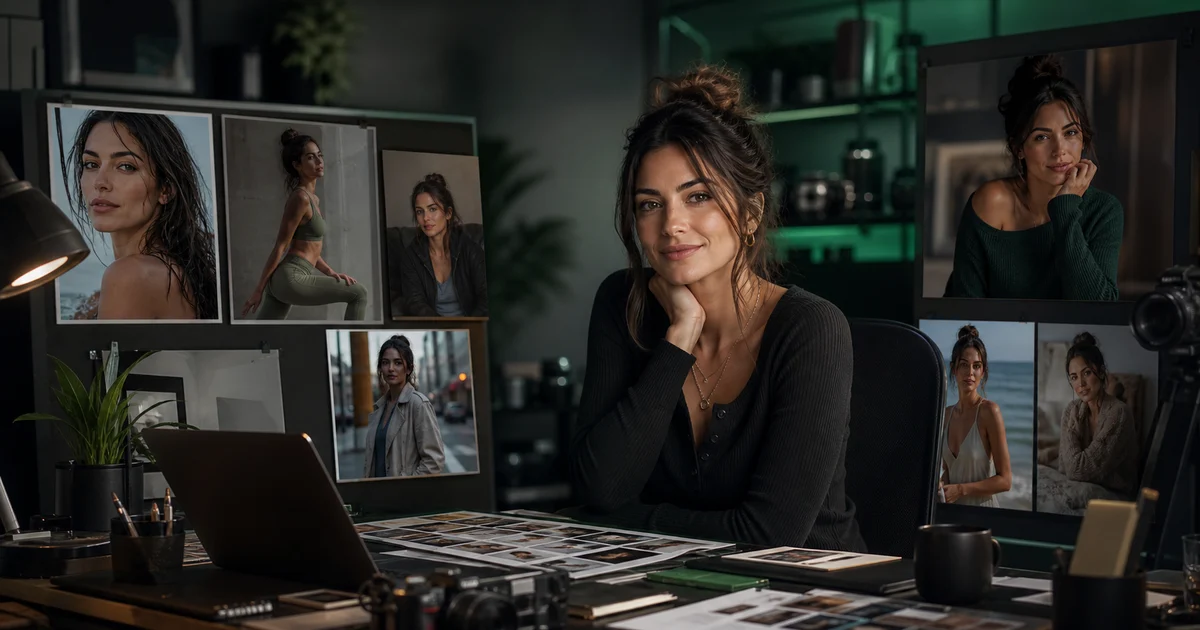

AI influencer prompts work best when they control change instead of trying to describe everything again. First decide which details define the fictional character. Then use a reference-aware prompt for the scene, action, camera, and lighting while the approved reference carries identity.
If your model cannot accept character references, reuse one compact identity block word for word. That can improve continuity, but it is a fallback, not an identity lock. Seeds, phrases such as "same face," and long adjective lists do not guarantee that a new generation will reproduce the same person.
Fastest useful route
Build an original fictional character and approve a multi-angle reference set in Character Forge. Keep those references fixed. Choose one template below, replace only the bracketed scene variables, and reject any output that changes defining identity or product details.
Choose the right AI influencer prompt mode first
Most prompt lists mix two different workflows. That creates conflicting advice. The right structure depends on whether the generation model can actually see an approved character reference.
| Workflow | What carries identity | What the prompt should control | Main risk |
|---|---|---|---|
| Reference-aware | Approved character images or a saved character asset | Scene, action, pose, wardrobe, camera, light, format, and preservation rules | A conflicting appearance description can pull the result away from the reference |
| Text-only | A repeated identity description, model settings, and possibly a seed | Identity block plus scene variables and output instructions | The character can still become a different person between generations |
Use the reference-aware mode whenever it is available. In that mode, do not keep rewriting the character's eye shape, nose, skin tone, and hair with new synonyms. The reference should define appearance. The prompt should describe what changes and what must remain stable.
Text-only prompting is useful for discovering the first character direction. Once you approve the character, move to references. If you need a full setup process before using these templates, follow the AI influencer creation guide.
Build the identity system before writing 25 scenes
A consistent account needs more than a face. Create a small character bible with four layers:
- Identity: original name, approximate adult age, facial structure, hair, body proportions, distinctive features, and traits that must never drift.
- Visual language: normal camera distance, lens feel, texture, color palette, retouching level, and two or three recurring locations.
- Voice and boundaries: subject expertise, tone, phrases to avoid, claim limits, sponsor rules, and disclosure language.
- Reference set: approved front, three-quarter, profile, medium, and full-body views plus two expressions and any signature wardrobe or prop references.
The best reference is clear, well lit, unobstructed, and free from accessories you do not want copied into every scene. A glamorous hero image can be a poor technical reference if hair covers the face, lighting hides one side, or the body is cropped unpredictably.
Reusable reference-aware formula
Reusable text-only fallback
After the character exists, the reference-aware formula should be shorter. More words are not automatically better. The goal is a clean division of labor: reference for identity, prompt for variation.
Prompts 1-5: create a usable AI influencer reference set
Generate these before lifestyle content. Approve them as a set, not one image at a time. If the profile view looks like a sibling instead of the same character, the reference set is not ready.
1. Neutral anchor portrait
Original fictional adult creator, neutral head-and-shoulders portrait, relaxed closed-mouth expression, hair pulled away from both sides of the face, soft even window light, plain warm-gray background, eye-level camera, realistic skin texture, no jewelry, no text, square crop.2. Three-quarter identity view
Use the approved anchor as identity reference. Turn the character approximately 45 degrees while preserving facial proportions, apparent age, hairline, and defining features. Neutral expression, even soft light, plain background, shoulders visible, no accessories, square crop.3. Profile reference
Use the approved character reference. Create a clean side profile with the full forehead, nose, lips, chin, ear, and hair silhouette visible. Preserve identity and apparent age. Soft flat lighting, plain background, no jewelry or text, square crop.4. Full-body proportion reference
Use the approved character reference. Full-body standing view in a simple neutral fitted outfit, arms relaxed and separated from the torso, feet visible, eye-level camera, minimal perspective distortion, plain studio background, even light, natural anatomy, vertical 4:5.5. Expression sheet
Use the approved fictional character identity. Create a clean contact sheet showing the same character with five restrained expressions: neutral, warm smile, curious, focused, and surprised. Identical camera, lighting, hair, wardrobe, and background in every panel. No labels or text.Keep only the images that agree with one another. A larger reference set is not better when two images quietly disagree about eye spacing, jawline, age, or body proportions.
Prompts 6-10: realistic lifestyle and feed posts
These prompts use deliberate imperfection without manufacturing fake evidence. Keep scenes consistent with the persona's documented world. Do not place the character in a location, profession, or event that the account presents as real unless you can disclose the synthetic nature accurately.
6. Coffee-shop working moment
Use the approved character reference. Seated at the recurring neighborhood cafe, reviewing a notebook beside a laptop, candid three-quarter angle as if photographed by a friend, soft overcast window light, believable tabletop clutter, signature neutral wardrobe, natural skin texture, 4:5 portrait.7. Morning routine
Use the approved character reference. At the recurring apartment bathroom mirror during a simple morning routine, one hand tying back the hair, indirect daylight, ordinary counter details, relaxed unposed expression, realistic phone-photo texture, no visible brand labels, vertical 4:5.8. Street-style outfit post
Use the approved character reference. Walking through the established neighborhood visual lane in a documented outfit palette, one natural mid-step pose, eye-level 35mm street-photo feel, late-afternoon side light, mild motion blur only in the background, full outfit visible, 4:5 portrait.9. Desk reset carousel cover
Use the approved character reference. Organizing a realistic creative desk with notebook, headphones, and a plain water bottle, medium-wide overhead-adjacent angle, soft morning light, enough clean negative space on the left for separately added carousel text, no generated text, 4:5 portrait.10. Weekend community question
Use the approved character reference. Relaxed seated portrait in the recurring home setting, looking toward the camera with an inviting curious expression, hands naturally visible, soft lamp and window mix, familiar wardrobe colors, uncluttered lower third for separately added question copy, 4:5 portrait.The realism cue should support the story, not become a pile of camera jargon. One plausible camera perspective, one light source, and one action usually look more convincing than cinematic, editorial, candid, glossy, handheld, and filmic all in the same prompt.
Prompts 16-20: product and sponsored-content concepts
Use an actual product reference and preserve its design. Generated labels and small typography can fail even when the overall image looks good, so treat the AI output as a compositional draft. Replace or verify packaging in editing before publication.
16. Product-in-use lifestyle scene
Reference 1 is the approved fictional character. Reference 2 is the authorized product image. Show the character using the product naturally in [CONTEXT]. Preserve the product's silhouette, material, colors, cap, and label placement. Keep hands anatomically plausible and the product unobstructed. No added claims or generated copy. 4:5 portrait.17. Unboxing frame
Use the approved character and product references. Mid-action unboxing at the recurring desk, package open but contents organized, character looking at the product rather than the camera, natural window light, believable cardboard texture, product design unchanged, no extra items or text, vertical 9:16.18. Product detail with creator context
Use the approved character and product references. Product sharp in the foreground on a clean surface; character recognizable but softly out of focus in the background preparing to use it. Preserve packaging geometry and color. Leave clear negative space for separately designed disclosure and CTA copy. 4:5.19. Routine integration
Use the approved references. Place the product as one believable step inside the character's documented [MORNING, FITNESS, CREATIVE, OR TRAVEL] routine, not as a floating hero object. One clear action, medium shot, natural light, product visible and unchanged, no implied medical or performance claim, 4:5.20. Offer or launch backdrop
Use the approved character and product references. Character beside a clean product arrangement in the established brand color world, confident but natural presentation pose, direct softbox light, lower-right negative space for separately added offer details, preserve all product shapes, no generated pricing, claims, or logos, 4:5.Add disclosure and offer text during design, where spelling and legal review are controllable. Keep the caption honest about the synthetic character and commercial relationship. If a claim concerns health, finance, safety, or measurable performance, obtain appropriate substantiation before publishing.
Prompts 21-25: video-ready frames and motion directions
Generate and approve the still first, then animate it. The image prompt should define a strong, stable starting frame. The motion prompt should describe movement and preservation rather than redesigning the character.
21. Direct-to-camera hook
Starting frame: approved character in a stable medium close-up, facing camera in the recurring studio, shoulders visible, hands below frame, soft key light, vertical 9:16. Motion: preserve identity and wardrobe; one natural breath, subtle blink, small head emphasis on the first phrase, restrained handheld camera drift, no face morphing or background changes.22. Product demonstration motion
Starting frame: approved character holding the referenced product at chest height with both hands clearly visible. Motion: preserve face, fingers, product geometry, label placement, and colors; one slow lift toward camera, subtle focus shift from face to product, stationary background, no rotation that reveals invented packaging.23. Walk-and-talk B-roll
Starting frame: approved character mid-step on the recurring street route, full body visible, simple background depth. Motion: preserve identity and outfit; two natural walking steps, slight fabric movement, smooth parallel camera tracking, consistent afternoon light, no new pedestrians crossing the subject, no sudden camera turn.24. Reaction cutaway
Starting frame: approved character seated at the recurring desk, three-quarter view, looking just off camera. Motion: preserve identity; shift from focused to mildly surprised, small eyebrow and eye movement, one restrained head turn, subtle screen light change, locked camera, no exaggerated mouth movement.25. Loopable ambient post
Starting frame: approved character by a cafe window holding a cup, calm neutral pose. Motion: preserve identity and hand placement; steam rises, curtain moves slightly, character blinks once and makes a tiny gaze shift, slow two-percent camera push-in that can reverse cleanly, no scene cuts or object changes.For a broader shot plan, use the 30-day AI influencer content calendar. Build the still in Image Lab, then move only approved frames into Video Lab.
Review every AI influencer result with the same QA gate
Do not approve a result because the face looks attractive at first glance. Compare it directly with the reference set and the purpose of the post.
| Check | Approve when | Reject when |
|---|---|---|
| Identity | Face, age, hair identity, proportions, and defining features match the approved reference | The result looks like a sibling, younger version, or beauty-filtered redesign |
| Anatomy | Hands, teeth, eyes, limbs, jewelry, and clothing behave plausibly | Details merge, multiply, disappear, or change across the image or clip |
| World continuity | Location, props, palette, and camera language fit an established visual lane | The account jumps into an unrelated visual universe without narrative reason |
| Claim integrity | The asset supports only statements you can substantiate | It implies a real testimonial, event, result, credential, or product behavior that did not occur |
| Commercial safety | Product and disclosure details can be verified and edited accurately | Packaging, price, offer, sponsor relationship, or required disclosure is wrong or unclear |
Save the approved prompt, model, settings, reference set version, output, and rejection reason together. That turns prompt work into a repeatable production system. It also reveals whether a model is failing on identity, hands, product fidelity, motion, or instructions instead of producing one vague note that says "looks off."
Measure accepted assets, posts completed, saves, qualified profile visits, clicks, signups, successful first creations, and paid conversion. Raw generations and posting volume are costs, not outcomes.
Seven prompt mistakes that create generic or inconsistent AI influencers
- Changing identity synonyms: brunette, dark brown, espresso, and black-brown may pull generations in different directions. Keep the approved identity source stable.
- Believing a seed is an identity system: seed behavior varies by model and prompt. Treat it as one control, not proof of continuity.
- Combining five scenes: one post prompt should describe one moment. Build carousels and sequences as separate controlled shots.
- Using perfection words: flawless, perfect, glossy, and hyper-beautiful often remove believable texture and make every post look like an ad.
- Generating important text: add headlines, prices, disclosures, and CTAs in a design step where exact copy can be reviewed.
- Changing everything at once: when face, outfit, location, lens, lighting, and pose all change, you cannot tell which variable caused drift.
- Publishing before review: attractive output can still contain a different identity, malformed product, false implication, or missing disclosure.
Turn these prompts into a repeatable QuestStudio workflow
Start in Character Forge to define and test the fictional identity. Keep the approved references and character bible attached to the project. Use Prompt Lab for stable formulas and versioned scene variables. Generate stills in Image Lab and send only approved frames to Video Lab.
The value is not access to another pile of prompts. It is keeping identity decisions, prompt recipes, stills, and motion tests connected long enough to learn what produces a usable post. Create an account when you are ready to build the first reference set and run one controlled content lane instead of generating random portraits.
A practical first session
- Create one original adult character.
- Approve five reference views.
- Choose one lifestyle template and one authority template.
- Generate two controlled variations of each.
- Reject identity drift before animating anything.
- Animate the strongest frame with one simple motion.
Frequently asked questions
What is the best prompt for an AI influencer?
The best prompt separates fixed identity from variable scene direction. With a character reference, let the reference control appearance and prompt for action, setting, camera, lighting, and preservation constraints. Without a reference, reuse one exact identity block in every prompt.
How do I keep the same AI influencer face in every image?
Use an approved multi-angle reference set whenever the model supports references. Keep the model and identity inputs fixed, change one scene variable at a time, and reject outputs that alter defining facial features. Text alone cannot guarantee the same face.
Should I repeat the character description in every prompt?
For reference-aware models, avoid conflicting appearance descriptions and let the approved reference carry identity. For text-only workflows, reuse the same compact identity block word for word rather than rewriting it with synonyms.
How long should an AI influencer prompt be?
Use the shortest prompt that clearly specifies the scene, action, camera, lighting, output format, and preservation rules. Prompt length is not a quality score; conflicting or unnecessary details can reduce control.
Can AI influencer prompts create realistic sponsored posts?
They can create concepts and draft assets, but every product, label, claim, and disclosure must be reviewed. Use a real product reference, preserve its geometry, keep text out of the generated image when accuracy matters, and add approved copy during design.
Do AI influencers need disclosure?
Disclosure requirements vary by platform, location, and commercial relationship. Clearly identify synthetic personas and paid relationships, avoid deceptive claims, and review the current rules that apply before publishing.