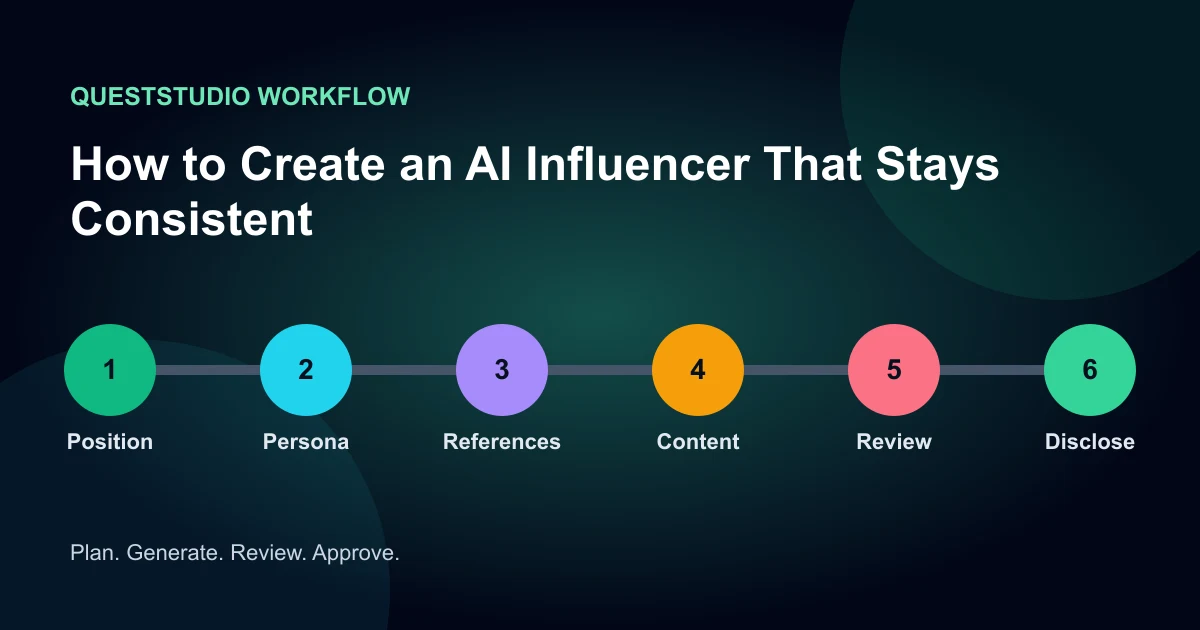

To create an AI influencer, define a specific audience and point of view, write a character bible, build a multi-angle reference set, test identity across controlled scenes, and create a repeatable publishing system. The hard part is not generating one attractive portrait. It is making the same fictional person recognizable across weeks of images, video, voice, captions, and brand partnerships.
Treat the account as a media property with a documented identity. Do not copy a real person's face or voice, imply a real endorsement, or hide a material brand relationship. Consistency and transparency are product requirements, not cleanup tasks.
1. Choose the audience before the face
Write who the account helps or entertains, which platforms it serves, what makes its point of view distinct, and why a synthetic character is appropriate. “Lifestyle influencer” is too broad. “A budget-conscious virtual stylist who restyles one garment three ways” gives you useful recurring formats.
Select three content pillars and one boundary. A travel persona might cover compact itineraries, local food design, and packing systems while avoiding fabricated first-person claims about visiting real places. The boundary protects trust and makes future ideas easier to reject.
2. Write a character bible
Document the name, fictional status, age range, audience, values, expertise, tone, vocabulary, backstory, visual traits, wardrobe lanes, signature props, content pillars, sponsor rules, disclosure wording, and topics the character will not address. Keep the bible short enough to use.
The character should have room to change opinions or outfits without changing identity.
3. Build an approved reference sheet
Create a neutral front portrait, three-quarter views, profiles, full-body images, and a small expression range. Use simple light and minimal accessories for the identity set. Then create separate wardrobe and environment references. Mixing identity, styling, and location into one image makes it hard to know which detail the model is following.
Reject references with ambiguous hands, asymmetrical accessories, unstable eye color, inconsistent hairline, or hard-to-repeat clothing. Save exact crops and label them. A clean reference library is more valuable than dozens of disconnected “best” images.
4. Run a consistency benchmark
Before launching, test the same character in a studio close-up, outdoor medium shot, seated full-body shot, profile, low light, and short motion clip. Keep the identity references fixed. Score face shape, eyes, nose, mouth, hair, skin tone, body proportions, wardrobe, and age appearance.
| Dimension | Pass condition | Common fix |
|---|---|---|
| Face | Recognizable at a glance | Stronger reference, simpler pose |
| Body | Stable proportions | Full-body reference |
| Wardrobe | Same construction and colors | Dedicated outfit sheet |
| Video | Identity survives motion | Shorter, subtler action |
Do not launch until the character passes the situations you plan to publish most often.
5. Create a content matrix
Cross three content pillars with four repeatable formats: teach, demonstrate, react, and story. That produces twelve useful series without inventing a new identity each day. Add cadence, platform, aspect ratio, typical shot count, caption structure, and call to action.
Batch by production variable. Generate several scenes with one approved outfit before changing it. Produce stills before video. Write captions from the same character voice guide. This reduces drift and makes review faster.
6. Move from stills to video carefully
Choose an approved still with clear facial features and body position. Ask for one small action and one camera move. Avoid fast speech, dramatic turns, object handoffs, and crowded interactions until the identity survives simple motion.
Review the first, middle, and last frames. A clip can look acceptable at normal speed while the face changes during motion blur.
7. Add voice without impersonation
Choose a licensed synthetic voice or record an authorized performer. Document pronunciation, pace, pitch range, energy, accent, and phrases the character uses. Do not clone a person's voice without clear permission. Keep the delivery compatible with the visual identity and audience.
Generate short lines, not a page at once. Listen for unstable names, unnatural emphasis, clipped endings, breaths, and emotional mismatch. Save an approved pronunciation list and voice settings for future posts.
8. Disclose the character and brand relationships
Make the synthetic nature understandable in the profile and relevant content. For sponsored posts, disclose the material connection clearly and near the endorsement. The FTC's influencer guidance explains that followers should not be expected to infer a brand relationship.
TikTok says creators must label AI-generated content containing realistic images, audio, or video. Review its current AI-generated content labeling guidance at publishing time. Also keep a record of sponsor approval, claims, sources, and the final disclosed version.
What usually goes wrong
The face is close but never identical
Stop rewriting the description. Improve the references, simplify the scene, and test one variable at a time.
The feed has no reason to follow
A consistent face is not a content strategy. Strengthen the point of view, recurring formats, and audience promise.
The persona claims experiences it never had
Write from an explicitly fictional or editorial perspective and avoid fabricated testimonials or first-person real-world claims.
Sponsored content breaks character
Use sponsor rules in the character bible and accept partnerships that fit the established audience and voice.
How to Create an AI Influencer That Stays Consistent workflow diagram
How QuestStudio helps
Use Image Lab to compare character concepts, Prompt Lab to store the character bible and content recipes, and Video Lab to animate approved frames. For campaigns without a visible presenter, the faceless UGC ad concept generator offers a different route that avoids forcing a synthetic spokesperson into every idea.
Keep the brief and approved references fixed while comparing models. The objective is a repeatable process and a useful final asset, not model switching for its own sake.
Final approval scorecard
- Accuracy: facts, identity, products, and claims match approved sources.
- Continuity: recurring visual and audio elements remain recognizable.
- Communication: the main idea is clear on the first watch.
- Craft: motion, timing, audio, captions, and composition feel intentional.
- Rights and disclosure: permissions, licenses, endorsements, and platform labels are documented.
- Usefulness: the export fits the channel, aspect ratio, safe zones, and intended action.
Approve against a written threshold. “Looks good” is difficult to repeat, while a scorecard creates a record of what passed and why.
Frequently asked questions
Can I create an AI influencer for free?
You can prototype with free tiers, but a durable workflow may require generation, storage, editing, and publishing tools. Track approved output rather than raw generations.
How do I keep the same face?
Use a curated multi-angle reference set, hold identity inputs fixed, separate wardrobe references, and benchmark difficult scenes before publishing.
Do AI influencers need disclosure?
Disclosure duties vary, but transparent identification and clear sponsor disclosures are prudent. Review current platform rules and applicable law.
Can I copy a celebrity look?
Do not use a real person’s likeness or voice without appropriate permission, and do not imply affiliation or endorsement.
What should the first ten posts cover?
Use two or three content pillars across recurring teach, demonstrate, react, and story formats so the audience quickly understands the account.
Start with one controlled project
Choose one real deliverable, lock the source material, and change one variable per test. Save the inputs and the approved result so the next version starts from evidence rather than memory.
Open Image Lab when you are ready to build the workflow, or review QuestStudio plans after the process proves useful.