

Artist name ideas become useful when they can survive a release: spoken introduction, track credits, artwork, distributor metadata, and a listener’s search. Start with the musical identity, build a small shortlist, and investigate the exact strings before putting a name on a permanent release.
This exercise names a fictional instrumental duo. Every candidate below is unverified and is not cleared for use. The point is to build a release identity that can be checked and handed off consistently, rather than treating a generated list as proof that a name is available.
Write the music brief before the names
Our duo makes slow instrumental pieces with acoustic textures, restrained electronics, and field-recording influences. The fictional first release is called Window Signals. There are no lyrics, no established public profile, and no approved artist string yet. The name should feel appropriate on a record sleeve and in a track credit without implying a genre the music does not deliver.
That brief rules out some tempting directions. A name suggesting a large live ensemble could misrepresent the two-person project. A phrase tied to one instrument may become awkward when later work changes its palette. A topical joke might fit a social post while feeling disconnected from the release six months later. Use the music to judge the name, not the other way around.
Build a shortlist with explainable differences
Three fictional candidates are Harbor Relay, Paper Current, and Still Circuit. Harbor Relay suggests a place and a signal passed between people. Paper Current points toward tactile material and movement. Still Circuit suggests restrained electronic work. These associations are editorial observations about the words, not claims about what listeners will prefer.
Keep the reason for each candidate beside it. If someone asks why Paper Current fits the project, the answer should connect to the acoustic texture and gentle motion in the brief. “It sounded cool” may start a brainstorm, but it gives the release team little basis for choosing between alternatives. A small explainable shortlist is easier to investigate than fifty nearly interchangeable names.
| Unverified candidate | Fit to the fictional brief | Question to investigate |
|---|---|---|
| Harbor Relay | Place, exchange, quiet movement | Does it sound like an existing act or organization? |
| Paper Current | Tactile sound and gentle motion | Can someone spell it after hearing it once? |
| Still Circuit | Restrained electronic identity | Does it imply a narrower style than the duo intends? |
Say the exact string as a release credit
Try each candidate in a sentence: “The new single is by Harbor Relay.” Then read a collaboration credit and a short spoken introduction. Listen for word boundaries, pronunciation ambiguity, and extra explanation. The task is not to make every name literal; it is to learn what communication work the chosen name will require.
Ask a person who has not seen the list to repeat and write the name. Record the actual response. If they hear a different spelling, that is evidence about one interaction, not a market study. Try the same approved spelling again after a normal introduction. Do not quietly change punctuation between tests and then compare the results as if the name stayed constant.
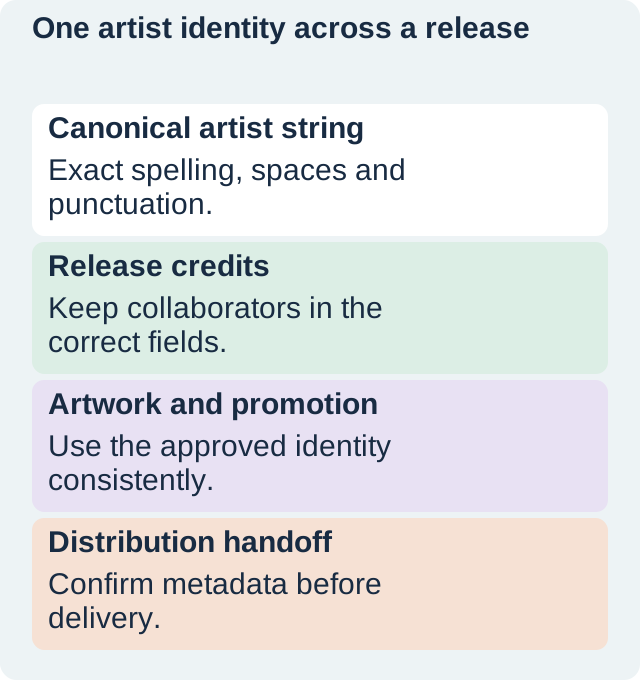
Also test the name in filenames and a release sheet. A decorative symbol that looks attractive on a large sleeve may complicate a spoken credit or a plain-text handoff. Decide which spelling is the canonical artist identity and which styling is merely visual treatment. Keep the canonical string available as text, not only inside artwork.
Investigate confusion before calling a name available
Search the exact phrase and plausible alternate spellings across music services, the wider web, and the places where the project will be promoted. Look at similar artists as well as exact matches. An unused-looking handle on one platform does not establish that a name is clear everywhere. Save the query, destination, date, and what you found.
Separate three questions in the worksheet: can people find the project, might the identity confuse them with another act, and what rights or commercial checks remain unresolved? A search exercise can reveal obvious conflicts. It does not provide legal clearance or prove ownership. Keep unverified candidates marked that way until the appropriate investigation is complete.
If a strong candidate already points toward an active music project, do not assume adding punctuation fixes the problem. Revisit the brief and generate a genuinely different direction. It is less disruptive to change a brainstorm than to change a name after credits, links, artwork, and promotional materials have spread.
Prepare a clean metadata handoff
The release sheet should contain the canonical artist string, the release title, each track title, the artist role fields, and the contributor information supplied by the people responsible for the recording. Do not put every collaborator into one decorative artist-name field just because it looks concise on a mockup. Preserve the roles the distributor asks you to provide.
Spotify’s metadata formatting guidance emphasizes consistent spelling and separate artist fields. CD Baby also explains why generic artist identities can be rejected. Check the requirements of the distributor you actually use before delivery.
For Window Signals, the metadata sheet remains blocked until the duo approves one canonical artist string and supplies the real credits. The artwork designer can explore visual directions meanwhile, but the final name should stay editable. That avoids generating a polished cover around a name that the release owner has not accepted.
Test artwork without turning styling into metadata
Place the candidate on a simple sleeve mockup, then inspect it as a small square. Check whether the name remains distinguishable from the release title. A strong visual hierarchy can make two similar-length strings easier to parse; shrinking everything equally often makes both less useful.
Use the album-cover prompt guide for the visual concept, then add approved lettering in an editable design step. The generated image should support the musical direction without deciding the exact artist spelling. Keep the cover filename, source artwork, and release sheet tied to the same revision.
If the name changes later, review the distributor process before editing public artwork in isolation. Spotify’s artist-name change guidance routes the process through the label or distributor. A profile display is part of a delivery system, so changing only one visible surface can leave the release inconsistent.
How QuestStudio helps build the musical direction
Use Music Lab to explore an original musical brief and compare whether the result fits the identity you are developing. Naming still needs the human checks above. A generated track or a persuasive visual does not establish that an artist name is available, correctly credited, or ready for distribution.
Finish with a compact identity record: approved string, pronunciation note if needed, investigation log, metadata owner, artwork revision, and unresolved checks. That record lets the next person prepare a sleeve or a release description without inventing a different identity. For the fictional exercise, keep every candidate unverified until you perform your own checks.
Download the original practice worksheet
Frequently asked questions
Can I use my own name as an artist name?
That can be an option. Check the distributor requirements, search confusion, and how the exact name will appear on the release.
Are Harbor Relay, Paper Current, and Still Circuit available?
Their availability has not been checked. They are fictional brainstorming candidates, not recommendations cleared for use.
Should the artwork spelling match the release sheet?
Use one approved canonical artist string. Decorative treatment should not silently alter the identity supplied in metadata.
Can a free social handle prove a name is clear?
No. It answers only a limited platform question and does not establish wider availability or rights.
What is the most useful final deliverable?
A checked shortlist and an approved identity record with exact spelling, release roles, source files, and remaining questions.
Develop the music brief behind the identity
Use Music Lab to explore an original musical direction while keeping naming and release credits in an approved record.
Hero: AI-generated editorial illustration. Original teaching materials and documented feature research, checked November 1, 2026. Examples are labeled where synthetic or hypothetical.