
Good podcast name ideas begin with the listener promise: who the show is for, what they will hear, and why they might return. Generate a short list from that promise, then test pronunciation, recall, search confusion, and cover fit. A name that sounds clever in a document may be difficult to say or find after someone hears it once.
This original exercise names a fictional show about repairing everyday objects. The sample names are brainstorming candidates only. They have not been checked for availability or cleared for use. Use the process to build and investigate your own shortlist before commissioning artwork or recording a permanent introduction.
Write the show promise before the title
Our fictional promise is “one ordinary object, one repair decision, and a realistic explanation of what to try next.” The audience is a curious beginner who wants to understand repairs without being promised that every problem is easy. That gives the naming exercise a direction: practical, specific, and approachable.
A broad label such as “conversation” does not tell us much about the recurring experience. Write a sample episode title and a one-sentence opening as well. If you cannot explain what the next three episodes would do, naming may be premature. The podcast format guide can help settle the show structure first.
Explore a few different naming routes
A descriptive route might produce “Everyday Repair Notes.” An evocative route might produce “The Second Use.” A recurring-action route might produce “Fix One Thing.” Each is an unverified fictional candidate. The descriptive name makes the subject clearer; the evocative one may need a subtitle; the action-led one sets a direct expectation.
Generate a small number in each route, then remove names that promise the wrong scope. A title suggesting professional restoration would misrepresent our beginner show. A title tied to one tool may become restrictive when the episodes cover fabric, furniture, and small household objects. The name should fit the actual format rather than the most dramatic idea in the brainstorm.
Say the names inside a real sentence
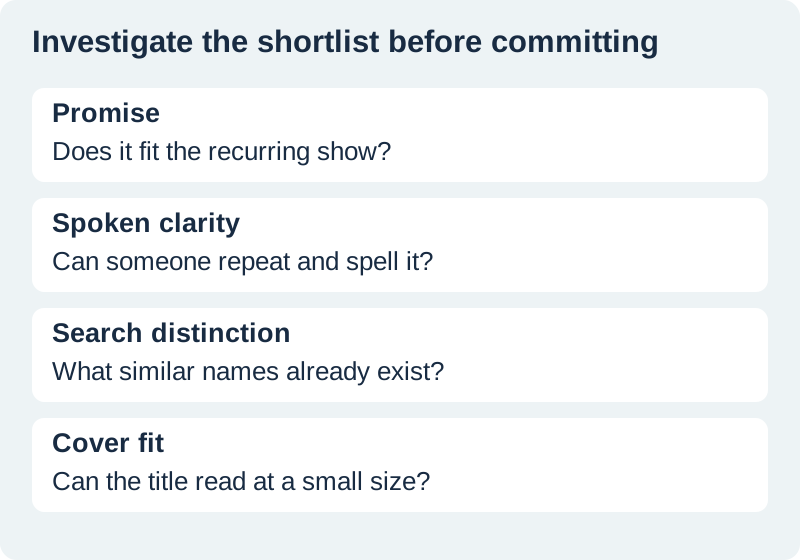
Read: “You are listening to Everyday Repair Notes.” Then try: “Find The Second Use wherever you listen.” Notice awkward rhythm, ambiguous word boundaries, and words that need spelling. A name may look short while taking effort to pronounce. Test it in the host’s natural voice, not only in a polished synthetic performance.
Ask someone unfamiliar with the list to repeat what they heard and write it down. This is a small qualitative check, not proof of market demand. Record the actual misunderstanding rather than scoring the person. If they hear “fix one thing” as a generic instruction and cannot identify a show title, the introduction or name may need more distinction.
Check confusion before calling a name available
Search podcast directories and the wider web for the exact phrase and close spellings. Look for shows, businesses, and active creators that could confuse the intended audience. Record where you searched and the date. A missing result in one directory does not establish exclusive rights, and a free domain does not settle every naming question.
If you are preparing a serious commercial launch, get appropriate advice for the rights questions that apply to your situation. This guide does not provide legal clearance. At the brainstorming stage, the practical job is to identify obvious conflicts and avoid building a full identity around an unchecked phrase. Keep the availability column marked unverified until the relevant investigation is actually done.
Try the name at cover and thumbnail size
Set each shortlisted name in plain editable type before adding artwork. A long title may force tiny lettering; a short ambiguous one may need a supporting line. Inspect a square cover at a small size with the same text and image treatment for each candidate. This keeps the comparison focused on the name rather than on one especially attractive illustration.
The cover-art workflow covers the full design job. For the naming test, keep it simple: can a reader identify the title, and does the visual suggest the intended show? Do not use an AI image containing decorative fake lettering as evidence that the final title will remain accurate or readable.
Make the tradeoff explicit in a shortlist
Use columns for promise fit, spoken clarity, search distinction, visual fit, and unresolved checks. Write one reason per candidate. “I like it” is a useful personal reaction, but it does not replace the practical criteria. You may choose a slightly longer descriptive name because the audience understands it immediately, or an evocative name because its subtitle handles the explanation.
For our exercise, Everyday Repair Notes fits the stated subject but needs a real conflict search. The Second Use is flexible but less explicit about repair. Fix One Thing is direct but could be hard to distinguish from ordinary advice. These are editorial observations about fictional names, not availability findings or predictions of listener growth.
How QuestStudio helps you hear the final choice
Use Voice Lab to audition an approved introduction containing the shortlisted name. Compare how it sounds in context, then have the host read it naturally. A narration sample can reveal pacing or pronunciation issues, but it cannot tell you whether a title is legally available or whether people will subscribe.
Once a name is selected and the necessary checks are complete, update the cover, show description, trailer, and source files consistently. The trailer workflow turns the listener promise into a spoken introduction. Keep the naming worksheet with the production brief so future collaborators understand the choice and its remaining limits.
Download the original practice worksheet
Frequently asked questions
Are the sample podcast names available?
They are unverified fictional brainstorming candidates. Check relevant directories, web results, and rights questions before use.
Should every title contain the word podcast?
Choose based on clarity and the actual identity. The word alone does not explain the listener promise or guarantee discovery.
How can I test a name out loud?
Put it in a normal introduction, have the host say it, and ask an unfamiliar listener to repeat or write it.
Does a free domain mean I can use the name?
No. A domain result is only one check and does not establish exclusive rights or remove audience confusion.
When should I commission the cover?
After narrowing the name and completing the relevant checks, using a simple type mockup first to test readability.
Hear the shortlisted names in an intro
Use Voice Lab to audition an approved introduction and listen for awkward pronunciation or pacing.
Hero: AI-generated editorial illustration. Original teaching materials and documented feature research, checked November 1, 2026. Examples are labeled where synthetic or hypothetical.