

ChatGPT can help a small business turn approved information into drafts, but a useful workflow also needs owners, release conditions, and a record of corrections. Pick one recurring content job and define how it moves from source facts to a reviewed post, email, and image brief. That is easier to manage than a long list of unrelated things AI might do.
This original exercise uses Linden Stem, a fictional flower studio preparing a seasonal bouquet pickup campaign. The copy is authored teaching material, not a transcript of a measured ChatGPT test or a claim about business results. No customer data, sales figures, or actual client approvals are involved.
Define one job and the person who can approve it
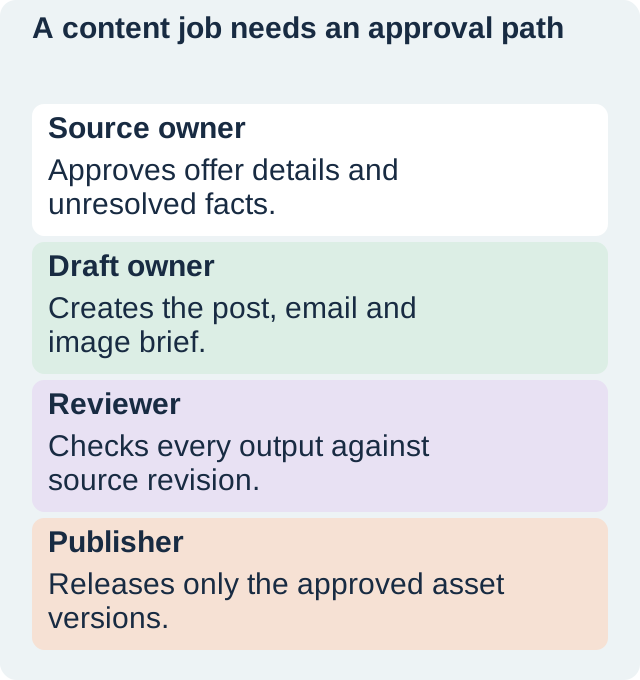
The job is to prepare a small campaign pack for Saturday pickup. The offer owner supplies the facts. A drafter creates the assets. A reviewer compares them with the source pack. The publisher releases the accepted versions. One person may fill several roles in a small team, but the decisions still need to be explicit.
The difference matters when a draft raises a question. If the price is missing, the drafter cannot settle it by choosing a plausible amount. If delivery has not been approved, the image or caption should not imply a delivery service. Give each unresolved question a real owner and keep the campaign on hold until the answer arrives.
Create a source pack that can control every output
The fictional source pack says pickup is Saturday from 10:00 to 14:00, orders close Thursday at 17:00, and the offer includes one wrapped seasonal bouquet. Colors vary. Price and the ordering route remain unknown. Delivery is not part of the supplied offer details. These facts should control all three deliverables.
Write the unknowns alongside the knowns. Otherwise a model may fill the blank and a human may mistake fluent copy for an approved fact. Keep the source pack compact, dated, and easy to compare. An old brainstorm can remain in the archive without being mixed into the current instructions. The creative-brief guide covers the initial request; this workflow adds ownership and cross-asset review.
FICTIONAL SOURCE v1
Offer: one wrapped seasonal bouquet. Colors vary.
Pickup: Saturday 10:00 to 14:00.
Order cutoff: Thursday 17:00.
Unknown: price and ordering link.
No delivery claim approved.
Outputs: social caption, short email, image brief.
Release hold: owner confirms price and ordering route.
Ask for drafts with visible unresolved fields
Give ChatGPT the source revision, output roles, and the facts it must preserve. Ask it to mark unresolved details rather than improvise them. Keep the requested output short enough for the reviewer to compare with the source. A separate field called “questions for the owner” is easier to notice than a caution buried in a long paragraph.
OpenAI’s prompting guidance supports clear requests, relevant context, and refinement. The production decision here goes further: each accepted asset must point back to the same source. A clear prompt helps drafting, while the review record establishes what the business has approved.
| Deliverable | Authored draft excerpt | Review state |
|---|---|---|
| Social caption | Seasonal bouquet pickup is Saturday, 10:00 to 14:00. Colors vary. Ordering details will be added after confirmation. | Internal draft; ordering route missing. |
| Please review the seasonal bouquet pickup details for Saturday. Orders close Thursday at 17:00. | Internal draft; price and ordering route missing. | |
| Image brief | One wrapped bouquet on a restrained studio surface; room for editable copy; no delivery vehicle or discount badge. | Concept may proceed; final campaign copy held. |
Review factual consistency before polishing the voice
A deliberately flawed comparison draft might say “Free delivery all weekend, with matching pink flowers in every bouquet.” Both promises exceed the source. Correct it to the approved pickup window and variable seasonal colors. Do not merely replace “free” with a softer adjective while leaving the unsupported delivery claim in place. This is a constructed review example, not an observed model failure.
Use a fact-to-output checklist. Pickup time appears in the caption and email; the image should not contradict it with a delivery scene. The order cutoff belongs in the audience-facing copy where it affects the next action. Color variability should survive a prettier rewrite. If one asset is revised, inspect the other two for the same issue rather than assuming the correction propagated.
After the facts are right, decide how the studio should sound. A calm local invitation may suit this campaign better than urgency or scarcity. Keep those voice choices separate from the offer facts so a later wording change cannot silently alter what is being sold. A warm sentence can still carry an unapproved promise.
Name versions so the publisher can select the right files
Use filenames or a simple ledger that distinguishes source-v1, caption-v1-review, image-brief-v1-review, and the eventual approved revisions. The exact naming convention is less important than the distinction. A file called final-final can still contain unresolved details; a ledger should say who accepted it and which source revision it follows.
If the owner confirms the price but changes the pickup window, create a new source revision. That change affects the copy, the review sheet, and any graphic containing times. Do not update only the email and leave an older square image in the campaign folder. The publisher needs a list of the accepted files, not a request to infer which ones look newest.
A small team can keep this in a shared document or the downloadable worksheet. There is no need to build an integration before the handoffs work manually. First establish that another person can find the approved copy and identify a release blocker without reading the entire conversation.
Handle the failed or delayed step deliberately
When required details are late, record the hold and the next decision. The campaign may be ready as an internal concept while remaining unready for publication. Do not interpret a completed image as permission to publish an offer with a missing price. Ask the owner for the specific fact needed and explain which deliverable depends on it.
If the image direction is rejected, preserve the accepted copy and retry only the visual stage unless the rejection changes the offer itself. If the copy changes an approved time, correct the source reference and retest every time-bearing asset. This keeps retries focused and makes the reason for the change visible. For the communication step, the client-email examples show how to ask for missing information without inventing a deadline.
After release, record what was actually published and the relevant source revision. If you later measure clicks or orders, keep those observations separate from the drafting process. This exercise makes no revenue or efficiency claim; it provides a way to inspect the work and attribute decisions.
How QuestStudio helps with the campaign image
Once the image brief is accepted, use Image Lab for a restrained bouquet concept. Check the visible flowers, wrapping, scene, and room for editable text against the brief. Add exact price and ordering copy only after the offer owner confirms them. A generated visual is one asset in the pack, not approval of the campaign.
Use the creator content-calendar workflow when the job is stable enough to schedule. Finish this exercise with a source pack, three reviewed outputs, named owners, and a clear release state. That gives the next production run something concrete to reuse.
Download the original practice worksheet
Frequently asked questions
What should a small business try first?
Choose one bounded recurring job with accessible source facts and a person who can review the output.
Is this a tested ChatGPT conversation?
No. The flower-studio pack and corrections are original authored teaching examples.
Can the model fill in a missing price?
Do not treat an invented amount as an approved business fact. Ask the offer owner and retain the release hold.
Do we need automation software for the workflow?
No. Establish the source, approval, and handoff steps manually before deciding whether an integration is useful.
When is the pack ready to publish?
When the required facts are confirmed and the publisher can identify the exact accepted versions of every asset.
Prepare the approved campaign image
Use Image Lab for a clearly labeled campaign concept after the product details and intended use are approved.
Hero: AI-generated editorial illustration. Original teaching materials and documented feature research, checked November 1, 2026. Examples are labeled where synthetic or hypothetical.