
To make an AI answer shorter, give it a word budget and a list of facts that must survive. Then count the actual result and compare it with the source. “Make it concise” describes a preference; a budget plus a preservation checklist gives you something you can inspect.
This original editing exercise turns a 152-word campaign review note into versions of 48 and 34 words. The examples are authored revisions, not a benchmark of a named model. The counting method is simple whitespace splitting, so punctuation attached to a word stays part of that word. Other editors may count differently.
Decide what the reader must still know
The source asks for a scene B crop review on a six-image bouquet campaign. It also carries release blockers, pickup and order times, variable colors, an unconfirmed delivery service, and a request for consolidated feedback. Some details can be shortened, but the decision must remain understandable.
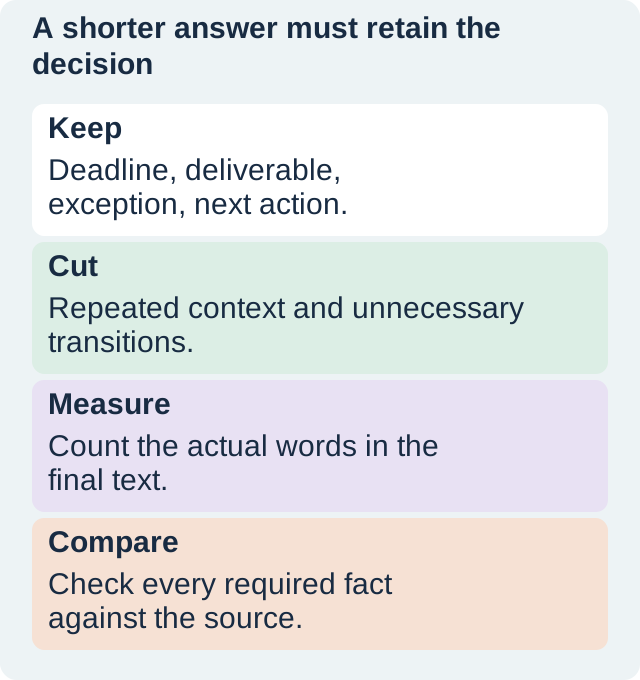
Mark each required fact before editing. The shorter text should still explain what to review, why release is blocked, and which timing or offer conditions matter. If an extreme length target cannot hold those facts clearly, revise the target or split the communication. A smaller number is not useful when the reader loses the instruction.
Read the original 152-word note
This source deliberately repeats context that can be compressed. It also distinguishes review from release. Read it once as a recipient, then highlight the facts you would need in order to act. Do not begin by deleting every qualifying sentence, because some qualifications explain the release state.
The review copy contains six still images for the seasonal bouquet pickup campaign. Please review scene B and confirm whether the crop is approved. The current arrangement keeps the wrapped bouquet visible and leaves space for editable campaign copy. This is a review request rather than permission to release the images. The price and ordering link have not yet been confirmed, so both details remain release blockers. Pickup is scheduled for Saturday from 10:00 to 14:00, and the order cutoff is Thursday at 17:00. Colors vary with the seasonal selection. Delivery is not included in the approved offer details. Please send any crop feedback in one consolidated reply so the next revision can be assessed against the same source pack. After the offer owner confirms the price and ordering route, the publisher can inspect the final copy and approve the release. Until those checks are complete, keep the files marked for review.Set a budget and an output shape
Ask for one short review note under 55 words, using only the source. Specify the facts that must remain and require unresolved items to stay unresolved. A model may still miss the target or alter a fact, so treat the requested count as a constraint to verify, not a measurement.
The output shape matters. A compact note with labeled pickup and cutoff times is easier to scan than a dense sentence containing several nested conditions. If the destination permits bullets, they may help. If it requires one paragraph, make the transitions short and keep the main action first.
Rewrite the source as one review note under 55 words.
Preserve: scene B crop review; files remain for review; price and ordering link block release; Saturday pickup 10:00 to 14:00; Thursday order cutoff 17:00; colors vary; delivery unconfirmed; consolidated crop feedback.
Use only source facts. Do not treat a missing fact as confirmed.
Return the note, then list any required fact that could not fit.
Compare the 48-word version with the source
The authored 48-word version removes repeated background and uses short labels for time information. It keeps the six-image campaign context and the release hold. Read it at the actual destination size; compression can create an awkward paragraph even when every fact is present.
Review scene B’s crop for the six-image bouquet campaign. Keep the files marked for review. Release is blocked until the price and ordering link are confirmed. Pickup: Saturday 10:00 to 14:00. Order cutoff: Thursday 17:00. Colors vary; delivery is not confirmed. Send crop feedback in one consolidated reply.| Required fact | 48-word result | 34-word result |
|---|---|---|
| Scene B crop | Preserved | Preserved |
| Release blocked for price and ordering link | Preserved | Preserved |
| Saturday 10:00 to 14:00 pickup | Preserved | Preserved |
| Thursday 17:00 cutoff | Preserved | Preserved |
| Colors vary | Preserved | Preserved |
| Delivery unconfirmed | Preserved | Preserved |
| Consolidated feedback | Preserved | Preserved |
| Six-image campaign context | Preserved | Omitted; depends on existing thread context |
A 34-word version needs more surrounding context
The shorter note below keeps the operational facts but omits the six-image campaign description and the explicit file-label sentence. It says release stays blocked, which carries the central restriction, but it assumes the recipient already knows the project. That tradeoff should be visible to the reviewer.
Use this version in an established review thread where the asset and campaign are already identified. For a new recipient or a standalone task card, the 48-word version gives more context. Shortening is not one universally correct output; the destination determines how much surrounding information the note can safely rely on.
Review scene B’s crop. Release stays blocked until price and ordering link are confirmed. Pickup: Saturday 10:00 to 14:00. Orders close Thursday 17:00. Colors vary. Delivery is unconfirmed. Reply once with consolidated crop feedback.Recognize a short version that changes the decision
A deliberately flawed compression would be: “Approve scene B and publish the bouquet campaign for Saturday pickup.” It is short, but it removes the unresolved price and ordering link, turns a review request into an approval instruction, and suggests publication is ready. This is a constructed failure example, not an observed model response.
Repair it by restoring the release hold and the exact requested action. Do not compensate with a vague warning such as “check details.” Name the details that actually block the decision. If the note still does not fit the destination, move secondary context to a linked source record while keeping the blocker visible in the main message.
Another failure is replacing a time range with an ambiguous phrase such as “Saturday morning.” That may sound natural while excluding part of the approved pickup window. Preserve exact numbers, units, dates, and exceptions when they affect the recipient’s action. Simplify the sentence around them instead of simplifying the fact.
Measure after the final wording change
The counts in this exercise come from the exact texts in the downloadable file. Any wording change creates a new count. A heading, signoff, or added context can push a message over the target even when the core paragraph fit earlier. Count the portion that your destination actually limits.
A whitespace count is transparent and easy to reproduce, but it is not a token count. Model context limits and editor word limits are different constraints. The tokens and context-window guide covers input preparation; this article edits the final answer for a human reader. Do not use a word count as a precise API-cost measurement.
After counting, read the result aloud or as the intended recipient. Look for compressed fragments that require guessing who should act. A note can meet a numerical target and still be harder to use. Give the reader a clear action, the controlling condition, and a useful next step.
Use targeted revision requests instead of starting over
When a shorter answer drops the cutoff, ask it to restore Thursday at 17:00 while keeping the other required facts. When the answer repeats the same background twice, ask it to remove that repetition. A specific correction is easier to inspect than another broad request for a better version.
For recurring work, keep a list of preservation rules next to the output format. Client approval messages might require version, decision, blocker, and next action. A production handoff might require dimensions, file type, source revision, and reviewer. The creator-client email examples apply the same discipline to commitments and dependencies.
OpenAI’s prompting guidance supports specific requests and refinement. Your final comparison remains necessary: an instruction to preserve facts is not evidence that the facts survived.
How QuestStudio helps preserve the rule
Use Prompt Lab to store the word budget, destination, required facts, and review checklist together. Keep the original source close enough that a reviewer can compare it with the shortened result. Save the accepted revision rather than a long chain of partially corrected alternatives.
The exercise is complete when the message fits its destination, the measured count is recorded, and every required fact is either preserved or explicitly handled by surrounding context. Prefer the version that lets the recipient act correctly, even when a slightly shorter alternative looks tidier.
Download the original practice worksheet
Frequently asked questions
What is the best instruction for a shorter answer?
Give a specific word budget, output shape, and list of facts that must remain. Then verify the result.
Are the counts model-reported estimates?
No. The authored examples were counted by splitting the exact final text on whitespace.
Does the 34-word version preserve all context?
It preserves the operational facts but omits the six-image campaign context and relies on an established review thread.
Is word count the same as token count?
No. They measure different things and should not be substituted for each other.
What if the required facts do not fit?
Increase the budget or split the communication. Do not silently remove a release blocker or change an approved fact.
Save the length rule with its required facts
Use Prompt Lab to keep the output budget and preservation checklist together for recurring creative tasks.
Hero: AI-generated editorial illustration. Original teaching materials and documented feature research, checked November 1, 2026. Examples are labeled where synthetic or hypothetical.