
A useful market-analysis prompt produces a decision you can trace back to evidence. It should help you understand what is already offered, what remains unknown about customers, and which creative idea deserves a small test. A polished SWOT table is not enough if it quietly invents demand, sales, or competitor weaknesses.
Start with a specific audience and business question, collect a bounded set of sources, and ask the model to separate observations from hypotheses. This guide uses a fictional candle-launch packet to demonstrate that process. Its storefront records and customer notes are synthetic teaching materials, not research about real businesses.
Choose one decision the research can support
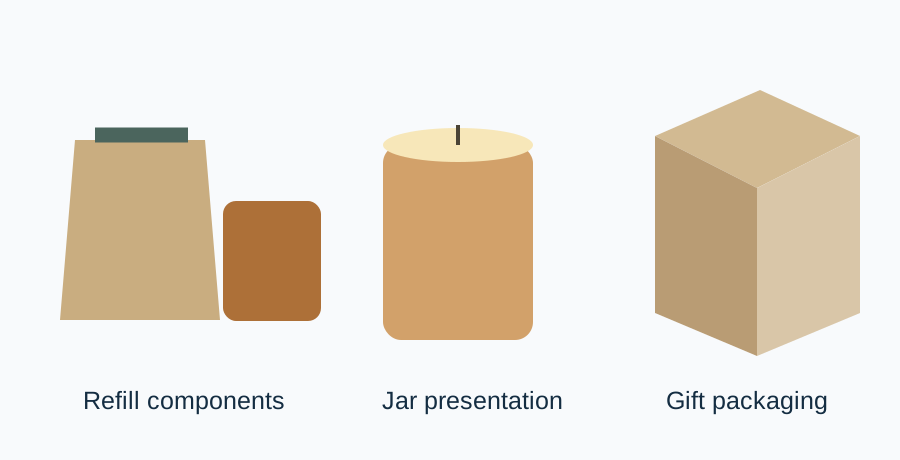
Our fictional maker wants to choose the first supporting image for a refillable-candle launch. The question is whether the creative brief should emphasize the refill process, the jar's appearance, or gift packaging. That is a narrower decision than “analyze the entire candle market” and easier to connect to a finished product image or short demonstration.
Define the intended audience, market, observation date, and decision before collecting sources. A page aimed at wholesale buyers does not automatically describe the concerns of someone choosing one gift. A listing available in one country may not establish local delivery terms somewhere else. Keep those boundaries visible in the worksheet.
The Small Business Administration's planning guidance separates customer and market research from competitive analysis. For a creator, the practical implication is that competitor pages can describe existing offers, while customer needs require their own evidence. Do not treat supply as a direct measurement of demand.
Build a small source ledger
Give each source a stable ID. In a real project, record its exact page address, the date checked, the relevant passage or observation, and the limitation. For an interview, record the permitted note and the question asked. For a public product page, keep the feature claim tied to that page rather than rewriting it as a universal market fact.
| Source | Observation in the exercise | What it does not establish |
|---|---|---|
| STORE-A | Refill pouch is shown beside the jar | Refills are the main reason customers purchase |
| STORE-B | Gift packaging appears in the first image | Gift packaging converts better |
| NOTE-01 | One fictional customer asks how refilling works | Most customers share that concern |
Download the fictional source packet and blank ledger. Replace the synthetic material with current, permitted sources for your own decision. Never paste the example records into a real proposal as if they were interviews or observed competitor data.
Ask for observations before recommendations
Separate extraction from interpretation. First ask the model to report only what the sources support, with IDs attached. Check that table yourself. Then ask which hypotheses those observations suggest. This prevents an early recommendation from becoming an unsupported “fact” in every later output.
Use only the supplied source packet. Extract observations relevant to the first image for the refillable-candle launch. For each row return: observation, source ID, exact supporting detail, date if supplied, and limitation. Do not infer sales, search volume, conversion, market share, or majority customer preference. Mark missing information unknown.
A source-faithful extraction might say that STORE-A visually explains the refill components and that STORE-B foregrounds gift presentation. It should not say that refills are the fastest-growing niche or that gift buyers are the dominant segment. Neither conclusion appears in the exercise packet.
Check references at the sentence level. A source ID attached to the end of a paragraph does not establish that every sentence in the paragraph is supported. If one sentence combines a feature observation with a performance claim, split it and review each part.
Turn a hypothesis into a small creative test
The fictional customer question suggests a possible communication problem: the refill process might need a clearer demonstration. That is a hypothesis to investigate. A useful next step is to make a simple refill-sequence image or a short demonstration and ask whether viewers understand the steps. It is not evidence that a refill-led campaign will sell more.
From the checked observations, propose three creative hypotheses. Label each as a hypothesis. Name the audience question, the source IDs that motivated it, the asset needed to test understanding, the review question, and the evidence that would change the decision. Keep production effort proportionate. Do not forecast revenue or call an idea proven.
For the refill example, the asset could show the empty jar, the refill component, and the assembled result. The review question is whether the intended viewer can explain the sequence after seeing it. If people misunderstand the assembly, fix the explanation before polishing the lighting or adding a stronger slogan.
Reject a plausible but unsupported claim
Consider the deliberately authored statement: “Most gift buyers prefer refillable candles because they save money.” It contains a population claim, a preference claim, and a reason. The source packet supports none of those at that scale. A product listing showing a refill does not prove preference, and a question from one person does not establish what most buyers think.
A bounded replacement is: “The exercise includes a refill feature and one question about how it works, so a clearer demonstration is worth investigating.” This describes the evidence and a proposed action without inventing a market conclusion. In a real project, you would then choose an appropriate research or audience test.
Use the same discipline with price comparisons. Record dates, size, included items, delivery conditions, and market before comparing offers. A cheaper sticker price may represent a smaller product or a different bundle. If those details are absent, keep the comparison unresolved instead of forcing a ranking.
Write the resulting creative brief
The fictional brief now has a concrete job: explain the refill relationship in one supporting image. It names the approved jar, refill component, order of presentation, and the question the viewer should be able to answer. It also records what must not be added, such as unsupported sustainability, savings, or popularity claims.
Keep the brief separate from the research log. The person making the image needs the approved production details, while the reviewer needs the source trail behind the decision. Link the two with a version and source IDs. This avoids turning every production prompt into a long market report while preserving the reasoning that matters.
In Prompt Lab, save the extraction and hypothesis instructions as separate recipes. Use Image Lab for a supported reference-based still, or Video Lab when motion makes the sequence clearer. Review product geometry and order of operations before sharing a demonstration.
Refresh evidence before reusing the recommendation
Competitor pages and offers change. Keep the observation date with the ledger and revisit the specific sources that affected your choice. A recommendation can become stale even if the prompt template still works. Preserve the old decision as history, then create a new dated review instead of silently overwriting the evidence.
Use the reference-context guide if new and old records conflict. Once the creative test is approved, the content-calendar workflow helps schedule the asset and its review. Publishing more content is a separate decision from establishing that an audience question is real.
The finished research handoff should make three things easy to identify: what was observed, what is being proposed, and what is still unknown. If a reviewer cannot separate those, improve the ledger before requesting a more persuasive summary.
Frequently asked questions
Can AI estimate demand from competitor listings?
Listings show what sellers offer. They do not by themselves establish search demand, sales, conversion, or what most customers prefer.
Are the candle records real market research?
No. They are synthetic examples for practicing source attribution and claim review. Replace them with actual evidence before making a business decision.
Should I start with a SWOT prompt?
Start with the decision and a checked source ledger. A SWOT format can organize findings later, but its structure does not make unsupported claims valid.
What if the sources disagree?
Keep the disagreement visible, check dates and scope, and avoid choosing the more convenient claim without a reason.
How can the research help a creative asset?
Translate a supported audience question into a specific image or video task, then review whether the asset explains that question clearly.
Turn evidence into a creative instruction
Use Prompt Lab to turn the reviewed findings into a focused creative brief. Keep hypotheses and unsupported market claims out of the production copy.