

Claude Code pricing depends on the route that is actually authenticating your session. Before estimating a task, determine whether it uses a subscription, an API credential or a configured cloud provider. A paid Claude plan and an API key can exist on the same computer without making their usage the same bill.
This guide follows a fictional creator-site task: add a product campaign page, inspect the diff and run the relevant checks. It uses official documentation checked on November 3, 2026, hypothetical token arithmetic and an offline route exercise. No Claude Code session, account credential or paid task was tested here.
Identify who is paying for this session
Write the authentication route in the work record before starting a long job. Include the responsible account or organization, the intended model and the conditions under which work should stop. Do not rely on remembering which login you used last month.
Anthropic's subscription access guidance states that an ANTHROPIC_API_KEY environment variable takes precedence over subscription authentication. Usage through that credential follows the API route. A subscription login alone does not resolve that ambiguity.
Inspect the actual configuration through the appropriate authorized interface, without printing secret values. If a team uses a cloud provider, identify that provider's billing owner and configuration too. The small exercise below illustrates the decision; it does not discover your machine's settings.
| Recorded situation | What to verify | What not to infer |
|---|---|---|
| Subscription login, no overriding API credential | Current plan access, usage limits and extra-usage settings | Unlimited work or a separate API balance |
| API credential configured | Console organization, model rates and billing owner | That the subscription covers this API usage |
| Cloud-provider route | Configured provider, deployment and billing arrangement | That direct Anthropic list rates equal the invoice |
| Route unresolved | Authentication and ownership before starting | That a successful login proves the intended payer |
Read the usage display in context
The current Claude Code cost guide documents /usage. Interpret its information according to the session's billing route. Subscription usage bars and a token-derived dollar estimate answer different questions.
A session dollar estimate based on token counts and list rates is not an invoice. For included subscription use, it does not mean the displayed amount is an additional charge. Managed pricing and provider-specific arrangements can also change the relevant calculation.
Record the display together with the route and observation time. If you need an accounting answer, use the appropriate billing record. Avoid reconstructing a final charge from one screenshot while ignoring retries, tools, model changes or the account's actual pricing arrangement.
Define a bounded creator-site task
A useful brief for our fictional lamp page names the editable files, approved copy, required media and verification steps. It also says what is outside scope. “Improve the whole website” can expand indefinitely; “add this reviewed page and validate its links” gives the session a finish condition.
Task: prepare the reviewed Cove Lamp campaign page.
Use the approved product facts and supplied images.
Show the proposed file scope before editing.
Complete one implementation pass and the relevant checks.
Stop for review if the work requires new dependencies,
an unrelated redesign or a change to the approved claims.
Return the diff, check results and unresolved questions.
This is an authored task brief, not a measured Claude Code run. Its value is a clearer work boundary. A precise brief still requires active review if the proposed scope changes or a check reveals a larger problem.
Inspect token arithmetic without calling it a forecast
The current Claude model overview lists Sonnet 5.5 standard input and output rates of $2 and $10 per million tokens. The fictional examples below use uncached input and output at those listed rates, checked on November 3, 2026.
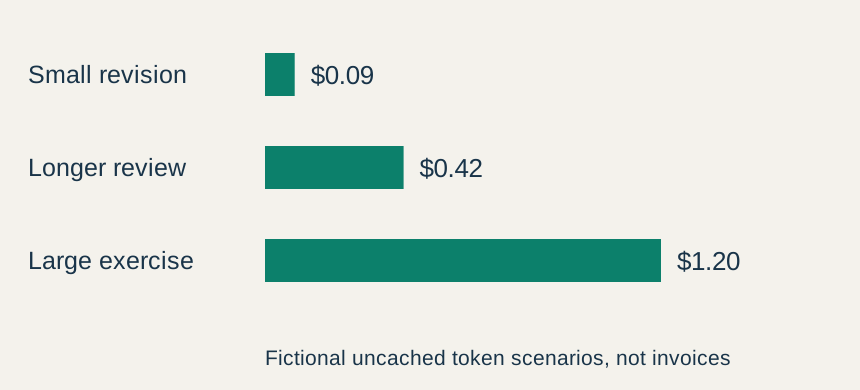
| Fictional uncached input | Fictional output | Calculation |
|---|---|---|
| 20,000 tokens | 5,000 tokens | $0.04 + $0.05 = $0.09 |
| 60,000 tokens | 30,000 tokens | $0.12 + $0.30 = $0.42 |
| 200,000 tokens | 80,000 tokens | $0.40 + $0.80 = $1.20 |
Download the token-calculation worksheet. The arithmetic was checked locally. The token quantities were chosen for the exercise; they do not predict how many tokens a page, repository or revision will consume.
Use this method to understand the units before making a real budget. Then replace the fictional quantities with an authorized usage record and the rates that apply to that route. Keep any tax, credits, tools, caching or cloud-provider conditions in separate fields rather than hiding them inside a supposedly universal estimate.
Try the synthetic route check
The offline route checker evaluates four boolean scenarios: an API credential plus subscription login, subscription alone, an unresolved login and a cloud-provider route.
python claude-route-check.py
The checked output confirms the teaching decisions. The script never reads your environment, key values, login state or billing account. A passing result means its authored cases behave as intended, not that your current Claude Code session uses the desired route.
For a real project, record the observation that supports each field. “API key present” should come from an authorized configuration review. “Subscription route” should not be filled merely because a subscription appears in a different browser tab.
Control revision scope before enlarging the budget
Review the proposed change after the first implementation pass. If the result misses the product facts, correct the source packet before requesting another broad rewrite. If the checks fail, identify the failing behavior rather than repeatedly asking for a general improvement.
Separate necessary work from optional polish. A broken link is a concrete defect. Rebuilding unrelated navigation during a product-page task changes both the scope and the evidence needed to finish. Record that new decision explicitly before continuing.
Use the current cost documentation for controls supported by your mode of operation. Do not assume a command-line option from an older tutorial applies to every interactive session, subscription or provider. A task boundary, usage display and account billing control are different parts of the process.
Keep the plan comparison in its own decision
Our Claude creator-plan guide covers the broader subscription decision. The free Chat, Code and API guide separates eligibility questions. This article handles the narrower question of tracing a coding session to its billing route.
After an authorized task, keep the accepted diff, checks, route and usage observation together. That creates a useful record for the next similar job. It does not turn one task into a universal forecast for every repository or model.
How QuestStudio helps prepare the brief
Use Prompt Lab to organize the approved task brief, source facts and review conditions before a coding handoff. Keep the implementation scope explicit so a creator's request can be reviewed without turning into an open-ended site rewrite.
Resolve the payer first, define the task second, then review the actual work and usage together. If the route remains uncertain, pause before repeated work and clarify the account configuration with its owner.
Frequently asked questions
Does a Claude subscription cover every Claude Code API request?
No. Identify the actual authentication route. The current subscription guidance says ANTHROPIC_API_KEY takes precedence over subscription authentication.
Is the session dollar estimate an invoice?
No. Read it in the context of the billing route. A token-derived estimate is different from the account's actual billing record.
Were the example costs measured from a coding task?
No. They are hypothetical token calculations using the stated standard Sonnet 5.5 rates. Their arithmetic was checked locally.
Does the route checker inspect my credentials?
No. It runs four synthetic boolean cases and reads no environment values, login state or billing information.
What should I record after an authorized task?
Keep the accepted diff, relevant checks, model and route, usage observation and unresolved issues. Use actual billing records for accounting questions.
Prepare a bounded implementation brief
Organize the approved facts, file scope and review conditions in Prompt Lab before a coding handoff.