
Turning a historical documentary script into a video prompt is a translation job. A source supports a claim; narration explains it; a shot helps the viewer understand it. A generated image can illustrate that explanation, but its convincing appearance does not make it a record of the event.
Download the six-shot plan · Download the source ledger · See the 42-second example
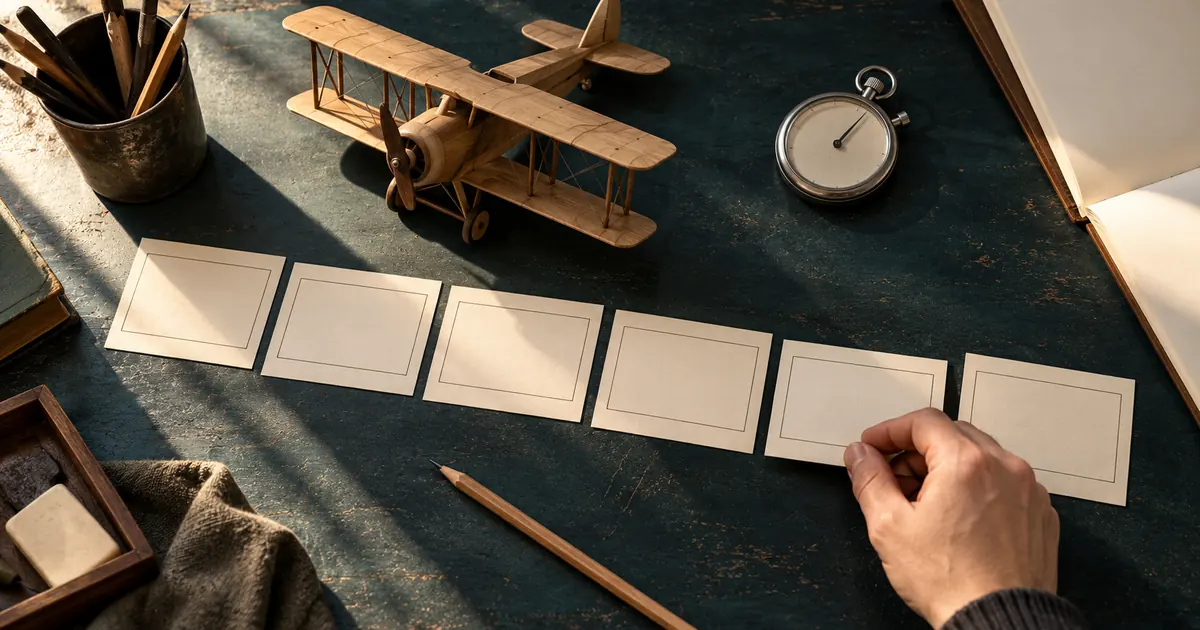
Research checked October 23, 2026. The shot plan, narration and diagrams are original planning artifacts. No finished film, timed narration recording or generated historical footage is claimed. The hero shows a modern planning desk with a generic toy biplane, not the 1903 Flyer or archival evidence.
Start with a question small enough to answer
“Tell the history of aviation” is too broad for a short clip. “What changed between the Wright brothers' first and fourth flights on December 17, 1903?” gives the viewer a concrete comparison. It also limits the evidence you need and the number of claims that can go wrong.
Write the answer in ordinary sentences before adding visual style. Separate factual description from your interpretation. A distance or date needs a source. A phrase such as “a dramatic leap” is editorial judgment and should not be dressed up as a quotation from a participant.
Collect sources before asking a model for a polished script. Otherwise, a fluent draft can anchor the production around an unsupported detail. Keep uncertain claims in a separate list; do not quietly turn uncertainty into a precise date, a number or imagined dialogue because it makes a stronger scene.
Build a claim ledger the editor can use
For this exercise, NASA's historical account supports the December 17 date and the 12-second first flight. The National Park Service account identifies Orville's first flight at roughly 120 feet and Wilbur's fourth at 852 feet in 59 seconds. These are institutional historical summaries; they are not the original flight log.
| ID | Claim used | Supporting source | Production boundary |
|---|---|---|---|
| C1 | Flights occurred December 17, 1903, at Kill Devil Hills. | NASA and NPS accounts | Use the specific site, not an invented city street. |
| C2 | Orville's first flight: 12 seconds, about 120 feet. | NASA for duration; NPS for distance and pilot | Do not assign the fourth flight's figures to the first. |
| C3 | Wilbur's fourth flight: 59 seconds, 852 feet. | NPS account | Identify the pilot and flight number together. |
| C4 | A photograph captured the first takeoff. | NPS account of John Daniels and the camera | A still photograph is not moving footage of the flight. |
The downloadable ledger adds the source URL, access date, a paraphrase and the shots using each claim. For a disputed subject, add independent corroboration and document disagreements instead of treating a single summary as sufficient. A source ledger is a working record, not a guarantee that every interpretation is correct.
Keep image permissions and factual sourcing in different columns. A page can support a historical statement without granting reuse of every photograph on it. Before importing an archival asset, inspect its own record, credit and reuse conditions. This example links to source material but does not distribute an archival photograph.
A six-shot, 42-second documentary plan
The sequence below compares the two flights without pretending we have new footage of either one. Its durations are an editorial plan. Read the narration aloud, then adjust the edit to the actual take; do not force a fast delivery merely to satisfy the proposed timecodes.
Question06–13
Source13–20
First flight20–28
Fourth flight28–35
Compare35–42
Credits
| Time / visual class | Narration draft | Visual job and source |
|---|---|---|
| 00–06 / editorial title | Four flights in one day. What changed between the first and the last? | Typeset question over a plain background. C1–C3. |
| 06–13 / archival still, pending asset clearance | At Kill Devil Hills on December seventeenth, nineteen-oh-three, Orville Wright took off. | Use the verified first-flight photograph only after checking its record. C1, C2, C4. Keep it a still. |
| 13–20 / original diagram | His first flight lasted twelve seconds and covered about one hundred twenty feet. | Typeset duration and a distance bar. C2. No invented aerial footage. |
| 20–28 / original diagram | On the fourth flight, Wilbur traveled eight hundred fifty-two feet in fifty-nine seconds. | Second bar at the same distance scale. C3. Clearly name the fourth flight. |
| 28–35 / editorial comparison | The two measurements describe different flights. Keep the pilot, distance and duration together. | Show both rows together. C2, C3. This is our explanatory framing. |
| 35–42 / source credits | These figures come from NASA and the National Park Service. Diagrams are modern illustrations. | Readable source names and article titles; full links accompany the video. |
For the distance diagram, a 500-pixel bar representing 852 feet gives the 120-foot bar a length of about 70.4 pixels. That calculation is a layout ratio, not a recovered flight path. Label the units and the endpoints. Do not draw a detailed route over a map when the sources used here do not establish that route.
There is deliberately no generated reconstruction in the core six-shot version. The sources and simple graphics can answer the question. If the archival image cannot be cleared, replace that shot with an editorial location/date card and revise the narration's visual relationship; do not synthesize a photograph and present it as the missing original.
Write prompts for a specific visual class
A script paragraph often mixes a location, several actions and a conclusion. Split it into shots before prompting. Each shot needs an input, one visible action, camera behavior, duration target and an explicit list of things the model must not invent. The storyboard workflow helps with that structure.
If a longer documentary needs a conceptual interlude, you can create a clearly modern illustration. The following reusable brief avoids depicting a historical event or a real participant. It is an optional planning example and has not been generated as video for this guide.
The label belongs in the edit as real text. Keep it visible for the relevant shot, including in a cropped excerpt. A disclosure hidden only in a description can disappear when someone shares the clip elsewhere. MIT CoCreate's Reality Check guidance recommends tracking synthetic elements through production and explaining relevant alterations to the audience.
For a reconstruction of a real event, the work is harder: document the evidence for clothing, architecture, machinery, weather and action, identify what remains speculative, and explain the reconstruction beside the image. A confident prompt cannot supply missing evidence. Sometimes a map, photograph or narrated uncertainty is the stronger editorial choice.
Time narration before generating expensive coverage
The Minnesota Historical Society documentary script worksheet recommends reading the script aloud at a natural pace and considering transitions and other audio. Apply that principle to your actual runtime rather than borrowing its school-project duration limit.
Record a rough narration take with your own voice. Put the words, plain cards and temporary diagrams on a timeline. If viewers cannot read the comparison before the next sentence starts, extend the shot or shorten the sentence. Do not solve a crowded script with a more elaborate camera move.
Keep sound effects separate from evidence too. Wind added beneath a photograph is an editorial sound choice, not recovered audio from 1903. Avoid fabricated participant dialogue or a synthetic voice presented as the historical person's own recording. Document these choices in the same cue sheet as the visuals.
Review the sequence as an argument
Watch once with the sound muted. Check whether every image is correctly identified and whether diagrams imply more precision than the sources support. Then listen without the pictures. Make sure the narration identifies the right person, date and measurement without relying on a label that flashes past.
Finally, watch the combined edit. Juxtaposition can create a claim that neither sentence makes alone. A modern aircraft under narration about the Flyer, for example, could be mistaken for a depiction of that machine. Keep a generic model or conceptual visual visibly separate from factual evidence.
Use Prompt Lab to organize approved shot briefs, then Video Lab for a shot that benefits from generation. The establishing-shot guide helps with readable geography when your scene genuinely needs it. Finish ordering, captions, disclosure and credits in your editor before calling the documentary complete.
Frequently asked questions
Can I paste a history script into a video generator?
You can use a script as input, but first verify its claims and divide it into shots. Label each visual's role so the generator is not implicitly asked to invent evidence.
Should every documentary shot be AI generated?
No. Verified archival material, original diagrams, present-day recordings and readable text may explain the subject better. The worked six-shot plan does not require generated historical footage.
How should I label a generated reconstruction?
Explain what was reconstructed beside the relevant image or sound, with enough context to distinguish it from recorded evidence. Keep the label understandable when the shot is excerpted.
Are the 42 seconds a tested narration length?
No. They are planned timecodes for the original shot worksheet. Record the narration at a natural pace and adjust the edit to the actual take.