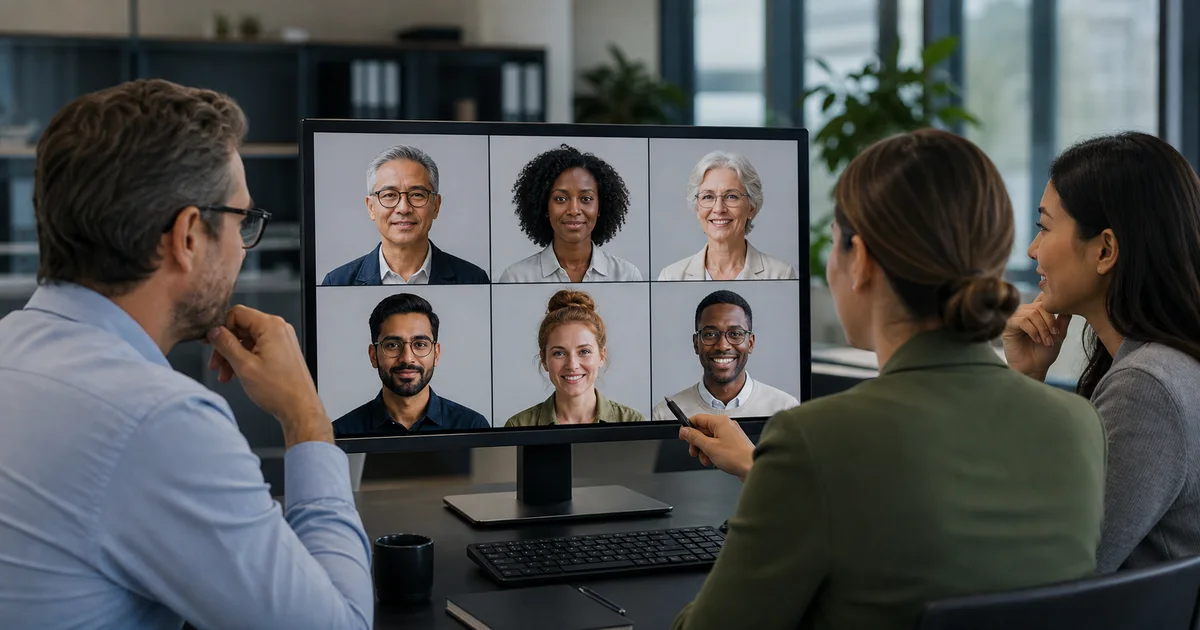

An AI headshot generator for teams is not just an individual portrait tool with bulk credits. The buyer needs a repeatable intake, a shared visual standard, identity-preserving results, correction and rejection paths, privacy answers, and a way to add future hires without rebuilding the set.
Compare the team workflow, not the best demo image
Vendor galleries show selected winners. Your decision should cover the whole system: how employees are invited, which source images are accepted, who selects styles, how results are reviewed, what happens when likeness fails, how files are delivered, and how a new hire matches six months later.
| Criterion | Question | Evidence to request |
|---|---|---|
| Likeness | Does the result remain recognizably the employee? | Unedited source-to-output examples across varied people |
| Consistency | Can background, crop, light, and wardrobe range stay aligned? | One real team set, not individual favorites |
| Correction | Can a person reject, regenerate, or request human editing? | Written redo and review workflow |
| Privacy | How are source photos stored, used, and deleted? | Current privacy and security documentation |
| Repeatability | Can future hires match the approved look? | Saved style and administrator workflow |
Start with a five-person pilot
Choose a representative pilot rather than the five easiest faces. Include variation in age, skin tone, hair texture, facial hair, glasses, head covering, and source-photo quality. Ask each person for the same minimum capture set under the vendor's current guidance. Do not use scraped staff photos or images without permission.
- Write the approved crop, background, light, attire range, and retouching limit.
- Collect consent and source images through the intended workflow.
- Generate without special manual rescue for the first pass.
- Have the employee and a reviewer score likeness independently.
- Record corrections, rejected outputs, time, and final usable count.
- Repeat one person later to test whether the look can be reproduced.
Score likeness before beauty
A polished image can still be the wrong person. Review eye shape and spacing, nose, jaw, smile, hairline, skin marks, age cues, face shape, glasses, facial hair, and characteristic asymmetry. Compare at normal profile size and full size. Ask the employee whether colleagues would recognize the image without the name.
Pass
Recognizable identity, plausible grooming, and professional polish without meaningful invented traits.
Revise
Identity is sound but crop, background, clothing, color, or a local artifact needs correction.
Reject
Face shape, age, ethnicity cues, hairline, expression, or defining features make the person materially different.
Do not average a likeness failure away because the lighting is excellent.
Define team consistency without erasing people
Consistency should come from camera height, crop, background family, light direction, contrast, color treatment, and a reasonable wardrobe range. It should not force every employee into the same face shape, skin smoothing, body presentation, or gendered styling. Create a visual standard with acceptable variation.
- Head size and eye line are consistent across the grid.
- Background tone and light direction belong to one family.
- Skin tone remains natural and individual.
- Glasses, hair, religious attire, and accessibility-related devices are preserved accurately.
- Clothing is plausible for the role and approved by the employee.
- Retouching does not remove age, scars, texture, or identity without consent.
Compare current product approaches
HeadshotPro currently presents individual and team flows, administrator-selected styles, employee uploads, and downloadable sets. Aragon presents individual and team headshots, brand customization, and team integration options. BetterPic Teams emphasizes a team dashboard, approved styles, tracking, AI and human editing, and enterprise security claims. Canva offers a more general design workflow around headshot generation.
These are vendor-described capabilities, not a hands-on ranking. Confirm the current plan, privacy terms, delivery, refund conditions, and correction path directly. The best fit depends on whether you need individual speed, team administration, strong correction support, or broader design editing.
Ask privacy questions before uploading employee faces
Headshots are personal data, and source sets may contain home backgrounds, location clues, family members, badges, screens, or other sensitive details. Have the appropriate owner review the vendor's current terms and privacy documentation before inviting the team.
| Question | Why it matters |
|---|---|
| How long are source photos and generated images retained? | Employees need a clear deletion and lifecycle expectation. |
| Are uploads used to train models? | Consent depends on secondary use, not only generation. |
| Who can access a team member's source and results? | Admin convenience can create unnecessary visibility. |
| Where is data processed and stored? | Organizations may have regional or contractual requirements. |
| What happens after account closure? | The company needs an export and deletion plan. |
Calculate real cost per approved person
The advertised price per person is only one input. Add administrator setup, employee capture time, failed source replacement, review, regeneration, human editing, internal approvals, and the cost of people who still need a photographer. Divide by approved, usable employees rather than invited employees.
A cheap batch with a high rejection rate can cost more than a guided service. A premium service is wasteful if the team only needs a simple directory crop. Use the pilot to estimate your own cost instead of repeating an industry-average claim.
Test the new-hire workflow
The team page will drift if the approved look cannot be reproduced later. Save the exact style choice, background, crop, light direction, attire guidance, source-photo instructions, reviewer, file naming, and export dimensions. Ask the vendor whether team presets remain available and how replacements or future credits work.
Run one delayed repeat during the pilot. If the result cannot match without manual intervention, budget for that intervention or choose a controlled edit workflow. Consistency is an operating process, not a one-time batch.
Know when to use a photographer
Use a professional photographer when the headshot has high identity or reputation risk, the team needs precise art direction, the environment or group interaction matters, the employee cannot provide suitable source images, or repeated AI results fail likeness. Executive leadership, regulated roles, press use, and large campaign assets may justify the certainty and consent process of a real shoot.
A hybrid approach can work: photograph key people and use a controlled system for routine directory updates, or use real photos with background and crop standardization rather than generating a new face.
How QuestStudio helps
QuestStudio's Image Lab can support a controlled small-team experiment with authorized sources, while editor tools can standardize crops or backgrounds after identity passes. QuestStudio does not provide the HR invitation dashboard, enterprise procurement, or team privacy administration described by specialized vendors.
Use the headshot quality checklist for every candidate. The useful result is an approved, recognizable portrait and a repeatable standard, not a large gallery of polished near-misses.
Sources and freshness note
Official product and support pages for HeadshotPro, Aragon, BetterPic Teams, BetterPic support, and Canva were reviewed on August 26, 2026. Features, security certifications, pricing, turnaround, refund rules, and data practices can change. Verify current vendor documentation and contracts before uploading employee images or purchasing a team plan.
Frequently asked questions
What is the best AI headshot generator for a team?
The best fit depends on likeness quality with your people, administrator workflow, brand controls, privacy requirements, correction options, and new-hire repeatability. Run a representative pilot.
How many people should be in the pilot?
Five can reveal common failures if the group represents varied ages, skin tones, hair, glasses, and source-photo conditions. Larger or higher-risk teams may need a broader test.
How do we make AI headshots look consistent?
Standardize crop, eye line, background family, light direction, contrast, and attire range while preserving each person’s real features and identity.
Are AI headshots safe for employee privacy?
That depends on the vendor’s current storage, training, access, deletion, and security practices plus your organization’s requirements. Review them before upload.
When should we hire a photographer instead?
Use a photographer when identity risk, executive importance, art direction, environment, consent, or repeated likeness failures make generated portraits unsuitable.