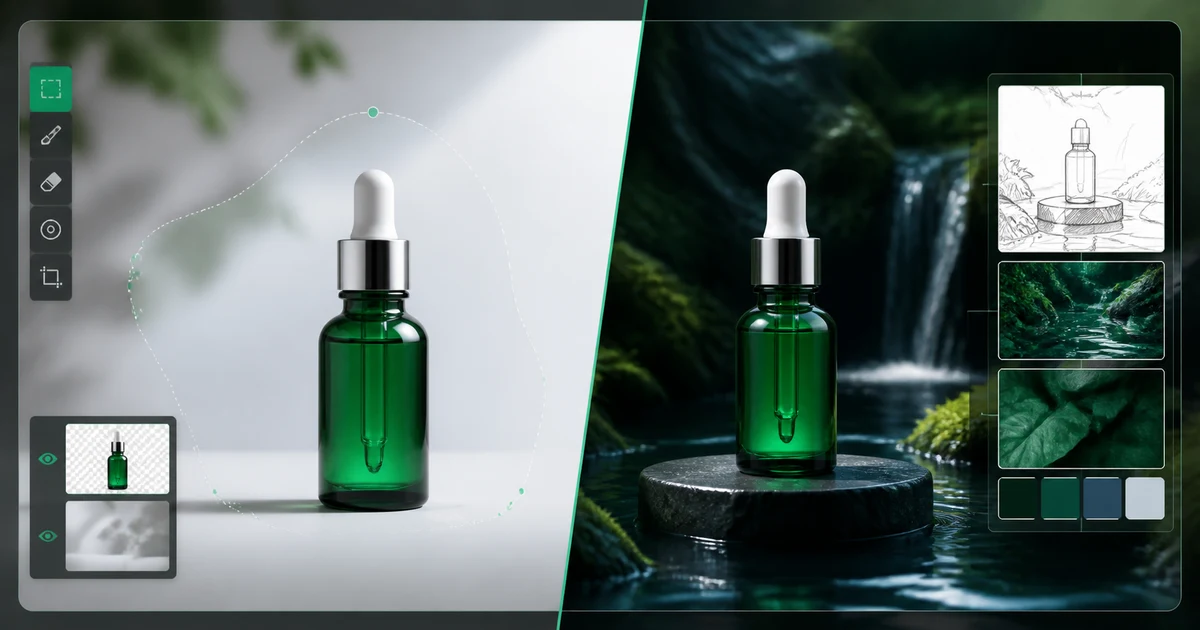

AI Photo Editing vs Image Generation: Choose the Safer Workflow helps you complete one real creation job with a repeatable process and a clear approval standard. It focuses on the decisions that determine whether the output is useful, accurate, and ready for its destination.
Four workflows, not one AI button
| Workflow | Best for | Main risk |
|---|---|---|
| Localized edit | Exposure, cleanup, bounded background or object change | Unrelated pixels drift |
| Full generation | Concept art, fictional campaigns, previsualization | Looks like documentary truth |
| Composite | Exact product, logo, packaging, or approved portrait | Poor edge, scale, light, or perspective match |
| Retake | Missing detail, bad perspective, biometric or evidence needs | More capture effort |
Edit when the source carries valuable truth
A real portrait, product photo, property image, event photo, or documentation shot contains identity and context worth preserving. Define one editable region and list everything outside it as locked. Keep the untouched original and compare after every pass.
Good editing briefs describe a bounded correction: neutralize a green cast, remove sensor dust, extend a plain margin, or replace a background while preserving the subject and honest labeling.
Generate when the scene is openly conceptual
Generation fits mood boards, storyboards, fictional characters, visual metaphors, early ad concepts, and shots that do not claim to record a real event. Make the conceptual status clear when a reasonable viewer might otherwise mistake it for evidence.
Even conceptual work needs constraints. Define audience, message, composition, camera, light, materials, exclusions, and destination. “Photorealistic” is an appearance choice, not a truth guarantee.
Composite when exactness matters
Place the verified product, package, logo, interface, price, or legal line after generating the scene. Match focal length, camera height, scale, contact shadow, reflections, color temperature, depth of field, grain, and edge transparency.
A composite is not automatically honest. The combined scene must not imply product performance, customer endorsement, location, or included items that are untrue.
Retake when the model would have to guess
If a face is blurred, text is unreadable, a product side is hidden, damage is occluded, or perspective is wrong, generation can only invent the missing information. Retake for identity documents, evidence, condition records, accurate inventory, and regulated claims.
Use this decision sequence
- What truth in the source must remain reliable?
- Can the change be bounded to one region or property?
- Does the output need exact text, product, identity, or evidence?
- Would a viewer mistake a concept for a real event or result?
- Is a retake faster and more trustworthy than reconstruction?
Quality review by workflow
For edits, compare preserved regions. For generations, review anatomy, physics, bias, and disclosure. For composites, inspect edges, scale, contact, light, and product truth. For retakes, verify capture settings, color reference, focus, and required views.
Approval checklist
- The chosen workflow matches the truth and exactness requirements
- Source and editing history are retained
- Identity, products, text, claims, and documentary facts are independently verified
- Conceptual material is labeled when context could mislead
- The final asset was reviewed at its actual destination
Frequently asked questions
What is the difference between AI editing and generation?
Editing changes an existing source; generation synthesizes a new image. Some tools blend both, so the approval boundary still matters.
Is inpainting an edit or generation?
It is a localized generative edit: the selected region is synthesized while the rest should remain locked.
When should I composite a product?
Composite when the exact product, label, logo, or text must remain verified and generation cannot reproduce it reliably.
Can AI restore missing photo detail?
It can create a plausible interpretation, not recover unseen truth. Label reconstruction and keep the original.
What is the safest default?
Use the smallest bounded change that achieves the job, and retake when the model would have to invent critical information.
For a controlled color revision of an existing object, learn to preserve protected details in Qwen image edits.