
When a mirror reflection moves differently from the person in an AI video, find the first disagreement before rewriting the prompt. Check the starting geometry, then compare the same action in the direct view and reflection. A correct opening frame helps, but the relationship must survive the whole clip.
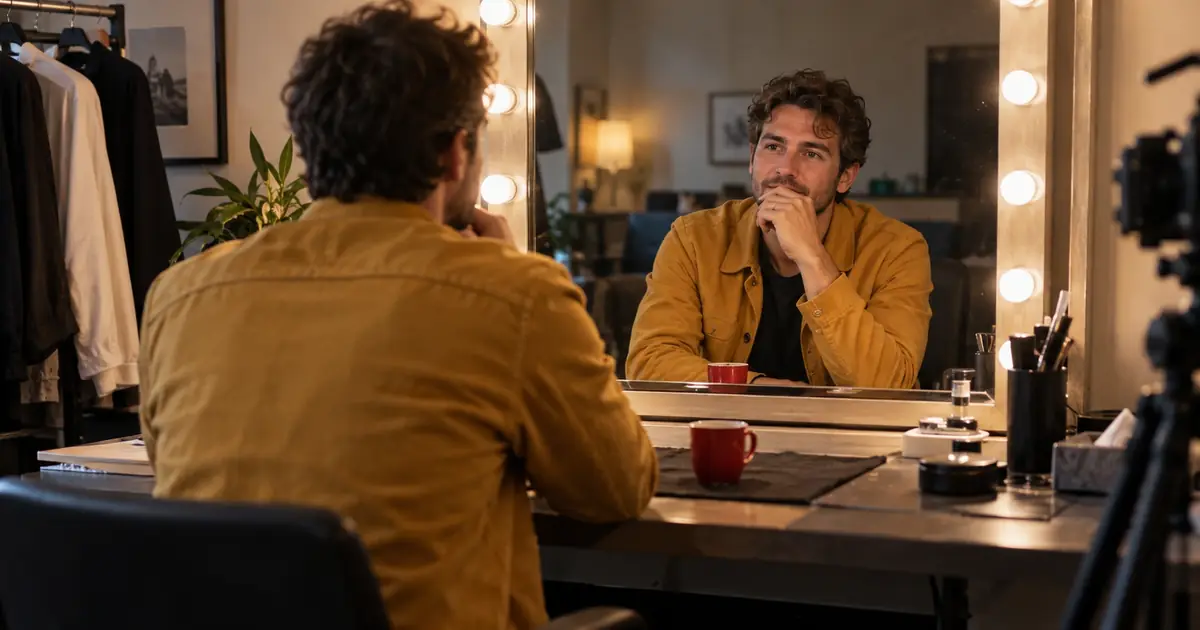
This guide plans a short dressing-room shot: one person in a mustard jacket, a mirror and a red cup on the counter. The person raises a hand, touches the collar and lowers the hand. It is an original diagnostic exercise, not a measured model benchmark. Download the reflection event ledger to compare those three events.
Confirm that the problem is a reflection
A reflected person is not automatically an extra character. Neither is an image on a poster or a face on a screen. Identify the surface and what it should contain before applying a generic “no duplicates” instruction.
A mirror should show the scene from the corresponding reflected viewpoint. It does not simply paste a horizontally flipped copy of the camera's view into a rectangle. Changing the camera angle can change what is visible in the mirror even when the person remains still.
Research such as MirrorWorld specifically studies reflection generation in video. That does not establish that your chosen tool implements the method or guarantees correct reflections. It does show why this deserves its own geometry and motion review rather than a casual check for a second face.
If the issue is a genuinely duplicated person outside a reflective surface, use the extra-people repair guide. The diagnosis determines which constraint you need to change.
Draw the arrangement before generating motion
Make a simple overhead sketch showing the mirror, person, cup and camera. You do not need a technical ray-tracing diagram. You need to know what the shot is supposed to show and whether that arrangement is physically plausible.
For our example, the camera looks over the person's shoulder toward the mirror. The direct view shows the jacket's back; the reflection shows the face and front. The cup sits on the counter between the person and mirror. The mirror frame stays rigid, and the camera remains still.
Inspect the approved still for contradictions: an extra cup, a different collar, an impossible reflected shoulder or a room that changes across the mirror boundary. If the still is wrong, do not expect motion to repair it reliably. Fix the composition or choose another angle first.
Reduce the shot to one testable action
Do not begin with a person turning, lifting a cup, walking away and moving the camera. Each event changes the relationship you must inspect. Start with the hand moving to the collar while the person's body and camera remain mostly stable.
Use the approved still as the reference where supported. The prompt expresses the required relationship; it is not proof that the output obeys it. Watch the result before extending the action or adding a camera move.
If the model supports a closing reference, it may help communicate the intended end state. The middle still needs inspection. See the first-and-last-frame workflow for planning endpoints without assuming they guarantee a correct path between them.
Compare events, not only matching appearances
Scrub through the clip and record the first frame of each meaningful event. Exact timestamps depend on the generated clip; the ledger is for observed times, not invented frame-accurate model control. At normal playback speed, also watch whether the action feels connected.
| Event | Direct-view check | Reflection check | Failure to flag |
|---|---|---|---|
| Hand begins rising | One hand leaves its rest position | Corresponding movement begins together | Reflection waits or starts early |
| Collar contact | Fingers reach the collar | Reflected hand reaches the same action state | Different hand pose or location |
| Hand lowers | Hand moves away from collar | Reflection lowers with it | Hand remains raised in mirror |
| End hold | Person and cup settle | Same final state remains visible | Reflection keeps moving |
Do not use a simplistic left-versus-right screen-position rule. The camera and reflected viewpoint determine where features appear. Track the anatomical action and object identity instead: which hand moves, what it touches and when contact begins.
Compare clothing boundaries and props during the motion. A synchronized hand can still reveal a different sleeve or a cup that appears only in the mirror. These are continuity faults even if no extra person is present.
Choose the smallest repair that preserves the scene
If the failure occurs near the end and the story is complete earlier, trim to a clean endpoint in your video editor. Review the new ending in context so it does not feel abruptly interrupted. A shorter usable shot can be preferable to a longer shot with an obvious contradiction.
If the reflection fails throughout, simplify and regenerate from the original approved still. Reduce the action, avoid a turn that reveals hidden surfaces, or shorten the requested shot where the model offers duration controls. Change one major variable and compare the result.
If the exact reflection is essential, use a controlled filming or compositing workflow. A fixed mirror plane is easier to work with than a bending frame and moving camera. A compositor still needs a plausible reflected view; flipping the direct camera footage is usually not enough to manufacture the missing perspective.
The one-bad-second repair workflow helps decide when a local repair is worth attempting. Reject a repair that fixes the mirror while visibly changing the approved person.
Review the final crop and neighboring shots
Check the delivered aspect ratio. A crop can remove the direct-view hand while leaving the reflection, changing how the action is understood. It can also bring an edge artifact into the center of attention.
Watch the repaired shot beside the preceding and following shots. Does the cup remain on the same side of the person? Does the jacket still close the same way? Does the mirror imply a doorway that disappears in the next angle? Fixing one clip's internal timing is only part of scene continuity.
Save the accepted start frame, prompt, output version and event ledger. If the shot is regenerated later, those records define what must remain true. They also make a revision request more useful than “the reflection feels weird.”
How QuestStudio helps
Use Video Lab to test a constrained image-to-video shot from a mirror composition you have reviewed. Compare one small movement before investing in a longer sequence. Available reference and duration controls vary by model.
Finish trimming, tracked composites and frame-level repair in a suitable video editor. QuestStudio can help produce and compare source clips; the article does not assume a dedicated mirror-correction control or automatic geometry solver.
Frequently asked questions
Should I flip the whole video to fix a mirror?
No. Flipping changes the entire frame and does not repair an independently moving or geometrically incorrect reflection.
Does a correct starting image solve the reflection?
It gives the generation a better starting point, but the reflection can still drift during motion. Review every important action and the final state.
Is the reflection always supposed to appear on the opposite screen side?
No. Screen placement depends on the camera, mirror and subject arrangement. Track the actual action and viewpoint rather than using a simple side rule.
Can I hide the problem with blur?
Only if a softer reflection still serves the shot. Blur is not a good repair when the reflected action carries essential information.
When is a composite the better option?
Consider it when the reflection must be exact and repeated generation cannot preserve the relationship. It needs a suitable source view, tracking and careful edge review.
Approve the relationship across time
A convincing mirror shot is a relationship between two views of one event. Check the arrangement, simplify the action and record where the views agree or diverge. Then choose the repair that preserves the scene's meaning.
Test one reflected movement in Video Lab
Hero image: AI-generated editorial illustration. Examples are original planning exercises, not measured model tests.