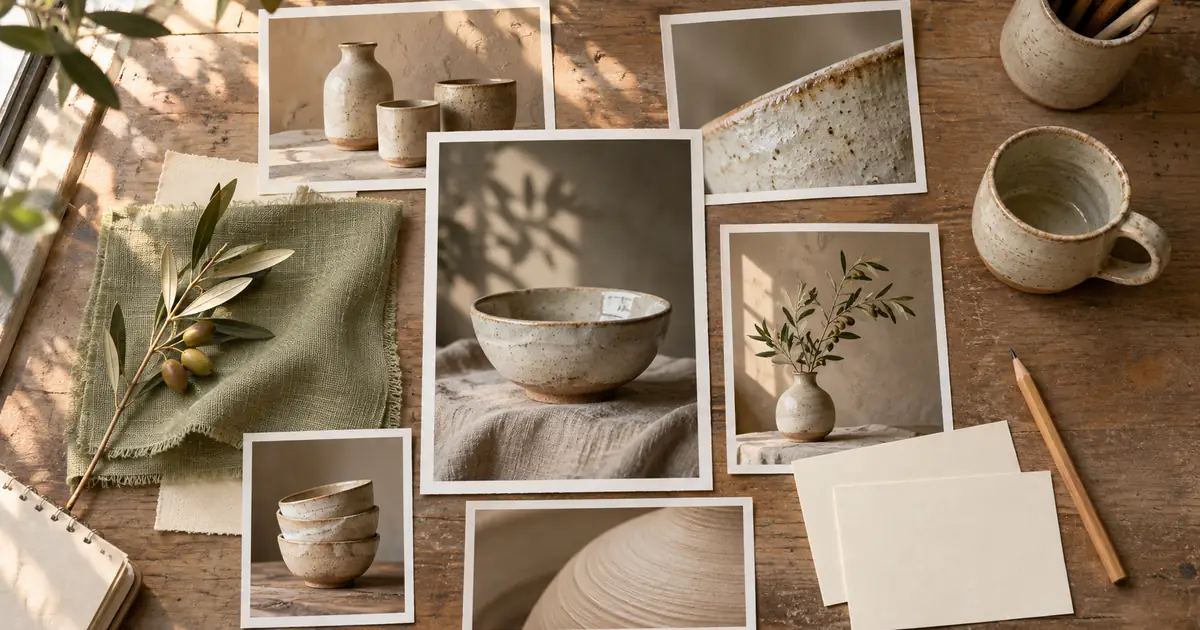

Everyone approves the mood board, then the finished pictures arrive without a usable website banner. The images feel right, but none has room for the headline. That is a planning gap: visual direction was approved without specifying the actual deliverables.
I would keep a small annotated mood board and a separate shot list linked by reference IDs. The board explains the look. The list defines the frames, their purpose, and how each will be approved. Neither document needs to be elaborate to prevent that mismatch.
Give each document a clear job
A mood board collects visual references for qualities such as light, palette, texture, framing, and atmosphere. A shot list specifies the pictures that must be made. A brief supplies the purpose, audience, requirements, and constraints behind both.
Adobe's commercial-photography guide includes mood boards, shot lists, and gear planning as distinct preparation work. The useful principle is to connect creative direction with an executable plan before production begins.
For this original example, the fictional client sells handmade ceramic cups. The campaign needs a wide website banner, a portrait social image, and a square listing detail. The intended feeling is quiet, tactile, and handmade. Those requirements are teaching assumptions, not a report about a real client.
Annotate what each reference is allowed to influence
Instead of saving twenty beautiful images without notes, choose a few that each answer a question. Label one “soft side light,” another “linen texture,” and another “empty space beside the subject.” If a reference contains a different cup, explicitly exclude its shape and decoration from the instruction.
This distinction matters when working with AI. A reference may influence more than the one quality you intended. If the real cup has an irregular handle, an image of a sleek mass-produced mug should not quietly become the product-design reference.
Record the source and the permitted use of each reference. Studying visual direction does not automatically grant permission to republish someone else's photograph or use it as a production input. For a client-facing board, use material you are entitled to share.
I would add one negative example only when it resolves a likely misunderstanding: “avoid glossy luxury lighting; the glaze should remain handmade and softly lit.” A negative reference should clarify a boundary, not become a second competing art direction.
Turn one look into three different frames
The same cup can support three deliverables without repeating the same crop. The banner needs protected copy space. The portrait image needs a composition that survives a narrow frame. The detail image needs enough real surface information to answer a buyer's question.
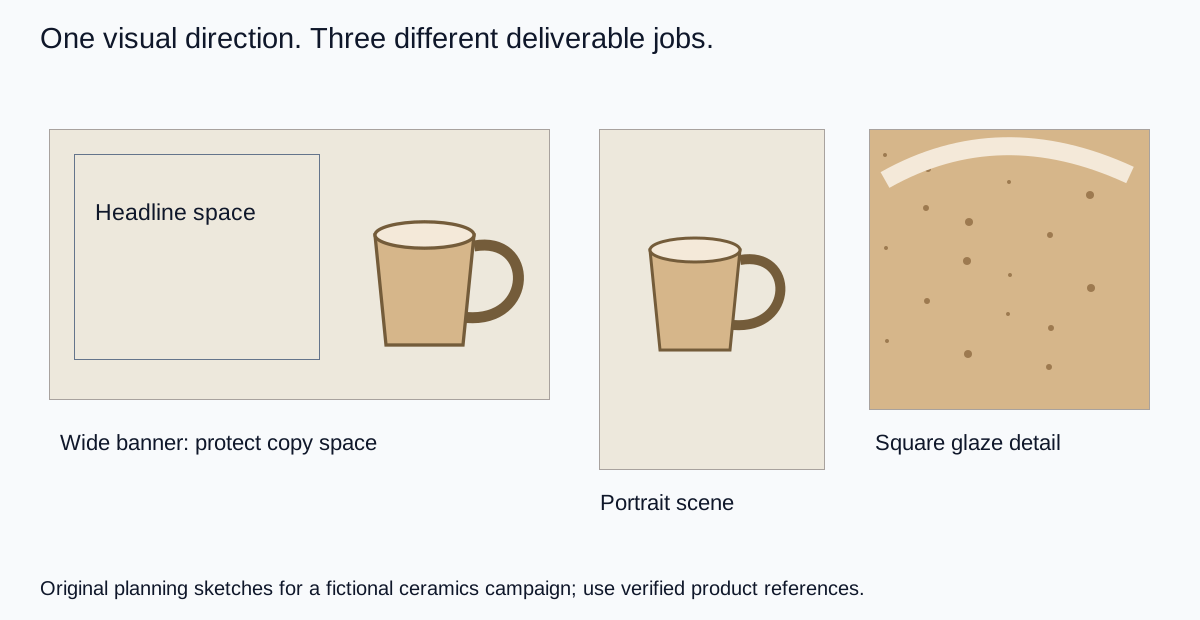
These sketches are intentionally simple. They establish placement and protected space before time is spent on styling or generation. The shapes are not evidence of an actual product, and the exact cup must come from an approved reference.
Download the three-deliverable planning sheet and replace the teaching entries with your campaign. Include the destination, ratio, source method, required detail, reference IDs, and approval owner.
Write a shot row that someone else can execute
For the banner, a useful row might read: “Wide image, cup on the right third, quiet linen and soft side light from reference R1, left half reserved for headline, actual handle and glaze preserved, approved at desktop and mobile crops.” That is more actionable than “premium ceramic lifestyle shot.”
For the portrait image, specify whether a hand is required and what it must demonstrate. If scale is important, use an accurate reference rather than inventing a hand size. For the detail, identify the exact surface or construction feature the buyer should see.
The product photography shot-list guide covers buyer questions across a full listing. This workflow connects the creative board to a small campaign's required assets; it does not replace the broader product evidence set.
| Decision | Mood board | Shot list |
|---|---|---|
| Light | Annotated visual reference | Which reference applies to this frame |
| Composition | Preferred visual rhythm | Ratio, placement, protected copy space |
| Product accuracy | Approved product reference | Details that must survive review |
| Completion | Direction approved | Required frame exists and passes its check |
Resolve contradictions before generating the set
A board can accidentally request hard midday shadows, soft window light, a glossy black background, and a pale natural setting at the same time. Ask which reference controls which property. If two references conflict on the same property, choose one for the specific shot.
Also check whether the board's framing can satisfy the destination. A tightly cropped inspiration photo may be unsuitable for a responsive banner with text. Do not assume image expansion will preserve every product detail later. Plan the copy space while the composition is still flexible.
Make one pilot frame before producing the full set. Review it against both documents: does it communicate the approved look, and does it fulfill the banner's requirements? If the answer to one is no, revise the plan or pilot before multiplying the mistake.
Use the catalog consistency guide when the pilot becomes a larger repeated system. Shared lighting and spacing can help a set feel coherent without making every image identical.
How QuestStudio helps turn the plan into candidates
Use Image Lab for a small set of controlled composition candidates. Attach the approved product reference where the selected model supports reference-based work. Change one major decision at a time, such as the position of the cup or the background texture.
Keep the source-method column honest. A real product detail may need photography. A supporting scene may be suitable for a bounded edit or composite. A purely conceptual image should not be presented as proof of a glaze finish, capacity, or physical construction.
Save the accepted image with its shot ID and the short reason it passed. That makes the next review concrete: “B1 has sufficient copy space and the handle matches,” rather than “this one feels better.” The model prompt is useful production context, but the output still has to pass the visual check.
Approve the set in its actual placements
Place the banner beside the real headline, the portrait in its intended crop, and the detail at the listing's display size. A beautiful standalone image can fail when text covers the subject or a mobile crop removes the handle.
Check completeness before requesting more variations. If the banner and portrait are approved but the detail is missing, the next useful action is producing that detail. Generating another atmospheric hero does not complete the campaign.
My recommendation is to keep the board small, the shot rows specific, and the approval tied to real placement. The result is a coherent set that works, with fewer disagreements about what “matching the mood” was supposed to mean.
Frequently asked questions
Is a mood board a shot list?
No. A mood board communicates visual direction. A shot list defines the frames and requirements needed to complete the job.
How many references should I include?
Use enough to resolve the important decisions without introducing conflicting directions. A few annotated references can be more useful than a large unstructured collection.
Can I copy every detail from a reference image?
Do not assume you have permission or that every detail belongs in the brief. Record the source, permitted use, and the specific visual quality the reference is meant to guide.
Should every campaign image use the same crop?
No. Keep coherent visual direction while designing each frame for its destination and purpose, including copy space and required product detail.
What is the best first production step?
Make one pilot frame and review it against both the visual direction and a concrete deliverable requirement before producing the full set.
Technical references
Continue with a useful next step
 Creator Workflows
AI Storyboard Workflow: Plan Shots Before You Generate Video
Build an AI storyboard that defines story beats, shots, continuity, motion, audio, and approval criteria before spending credits on video generation.
 Creator Workflows
Custom GPT Creative Briefs: Make Instructions Portable
Build a reusable creative-brief instruction pack. Separate facts, rules and tests, and check the current GPT or plugin route and sharing permissions before use.
 Creator Workflows
How to Get a YouTube Transcript and Check Its Timing
Open a YouTube video's transcript, find a quote by timestamp, and verify names and wording against the audio. Learn what to do when no transcript is shown.
Hero: AI-generated editorial illustration. Supporting diagrams and exercises: QuestStudio.