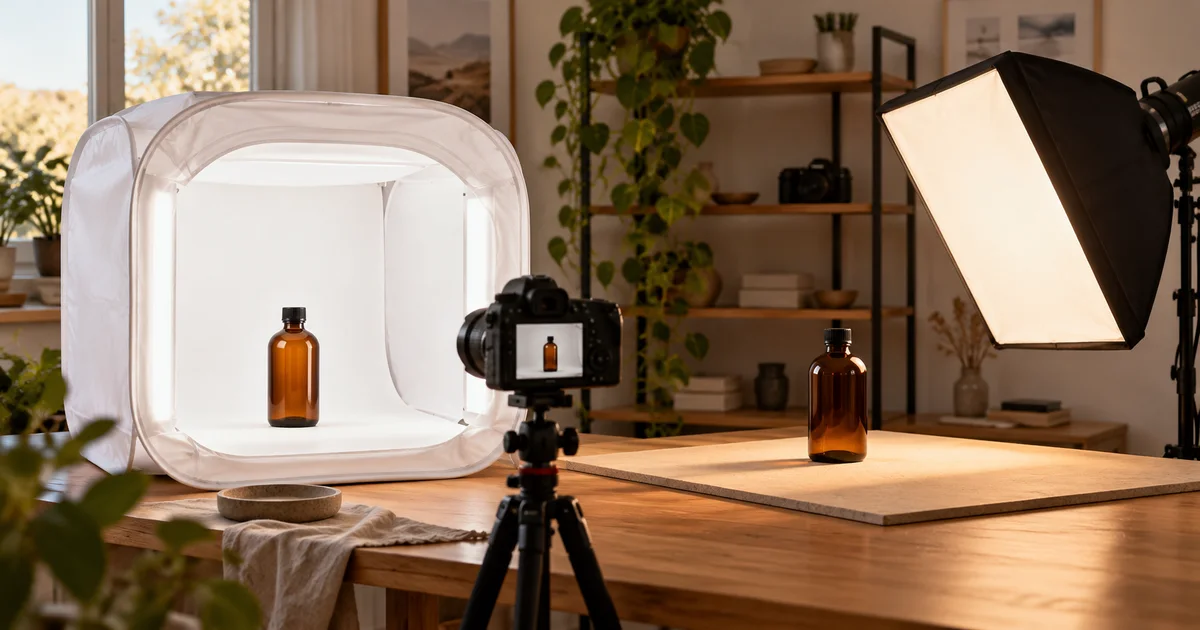

Choose a photo light box for small products and a repeatable enclosed setup. Choose a separate light with a softbox when you need room to move the light, photograph larger objects or shoot video with a person. First check whether the item you are buying includes a light at all.
Download the practical worksheet
Original blank CSV worksheet. Add your own observations; it contains no invented test results.
Three products that often get called a light box
An illuminated photo box combines an enclosure with installed lights. An unlit diffusion tent softens light supplied from outside. A softbox is a modifier attached to a compatible light. Confusing these categories can leave you with fabric and no illumination, or a light fixture and no way to soften it.
This guide helps choose the equipment format. For the actual shooting method, use our beauty packaging photography guide. The purchase decision comes first: the object must fit, you need room for the camera, and the setup must produce the kind of reflection your product needs.
Do not buy a larger light simply because AI editing comes later. A readable real source photograph gives an editing workflow better information. It does not guarantee that a generator preserves labels, dimensions or materials, and it cannot replace photographs of actual product performance.
When an enclosed setup is the sensible choice
A box or tent can simplify repeated images of small items on plain backgrounds. Its walls create a controlled surrounding surface, which can make consistent framing easier. This is useful when you photograph similar-sized objects and pack the setup away between sessions.
The advertised outer size is not the usable subject size. Leave space around the product, behind it for the background curve, and between it and the camera opening. A tall bottle that technically fits may still crowd the top lights. A wide object can leave no room to change the angle.
The NEEWER 24-inch/60-centimeter shooting tent is an example of the unlit category, not an all-in-one LED studio. It can make sense when you already have suitable external lights or a controllable source. Check the exact contents and backdrop colors in the listing. Do not assume a different NEEWER illuminated-box model is the same product.
Check NEEWER 24-inch diffusion tent on Amazon (paid link). You still need illumination and camera support.
Digital Camera World's backdrop guide includes a small NEEWER light tent as a portable background option. Such review context is helpful for handling and storage, but it does not establish that every tent, light or backdrop in a similarly named kit performs identically.
When a separate light and softbox are worth the space
A separate light gives you more freedom to change direction, height and distance. That helps with taller products, shaped shadows, lifestyle scenes and demonstrations involving hands or a presenter. The tradeoff is floor space, support equipment and more setup decisions.
For a current fixture to investigate, the amaran Halo 100x has a Bowens mount and adjustable color temperature. It is a light, not a complete softbox kit. The manufacturer's box-contents list includes the power adapter and mounting adapter, while a softbox and stand need separate confirmation.
The Halo specifications distinguish maximum power consumption from light output and document active cooling. Avoid interpreting “100W” as a direct brightness comparison against every other fixture. A modifier, distance and color-temperature setting all affect the useful illumination reaching your subject.
Check amaran Halo 100x on Amazon (paid link). This is a specification-based candidate, not a QuestStudio-tested winner.
Choose a modifier with the correct mount, manageable dimensions and a support arrangement rated for the combined load. Read the fixture's mounting and ventilation instructions. A large softbox can be awkward in a small room even when the light itself is compact.
Compare the whole setup
| Format | Often useful for | Additional checks |
|---|---|---|
| Illuminated photo box | Small items on repeatable plain backgrounds | Usable dimensions, light placement, power and camera openings |
| Unlit diffusion tent | Small items when external lighting is already available | Lights are separate; check wrinkles and room for the source |
| Fixture plus softbox | Larger products, directional light and mixed photo/video work | Compatible modifier, stand, support, background and storage |
Compare total equipment needs rather than a headline item price. Include a stable camera or phone support, power access and a surface large enough to keep the product away from an edge. For a shared room, measure the setup while it is in use, not just the folded bag.
A beginner with one small product can start with a window and cards before buying either system. That experiment reveals whether the actual problem is weak light, limited space, changing daylight or uncontrolled reflections. Purchase the piece that addresses that problem.
Reflections decide more than the label on the kit
A glossy object shows the shape of its surroundings. An enclosed white tent can create broad bright reflections, which may help one package but flatten another. A separate softbox lets you move a highlight more freely, but it also leaves more of the room available to reflect in the surface.
The B&H softbox guide explains modifier shapes and practical sizing considerations. Use it to understand the tool, then check the actual object. A larger apparent light source can soften shadow transitions, but no modifier guarantees a readable label from every angle.
For chrome, clear glass or dark glossy packaging, try white and black cards before adding another lamp. Look for a clean edge, a readable label and a highlight that describes the material. If the camera or room appears in the product, change the reflected environment or angle. Simply raising brightness may make the unwanted reflection stronger.
For color-sensitive products, use a consistent capture and review process. Manufacturer CRI or TLCI figures describe particular test conditions, not guaranteed color accuracy across every material and camera. Follow the product color-correction workflow and compare with the real item.
Measure your space with one sample object
Download the footprint worksheet and record the product's height, width and depth. Add the camera distance needed to frame it without unwanted perspective. Mark where the background, light, support and power cable will sit. Leave a clear route around the setup.
Make three trial photographs using what you already own: one front view, one angled view and one label detail. Write the failure you need new equipment to solve. “The product does not fit with room for a background curve” points toward a larger setup. “The label is covered by a reflection” points toward light control rather than automatically more power.
If you also record talking-head video, include the presenter's position in the sketch. A small enclosed box cannot serve that second job. A fixture and modifier may, provided you can manage placement, fan sound and the rest of the video setup.
How QuestStudio helps after the source photo passes
Use Image Lab to explore a supporting scene after you have a sharp, truthful source photograph. Select a model that accepts the reference you need and compare its output with the original. Keep real label details and material cues as the standard.
The product fidelity benchmark can help structure that review. A pleasing background is not approval if the cap, logo or proportions changed. Choose lighting that improves the source, then use AI where it adds a useful visual option.
Frequently asked questions
Is a softbox a light?
Usually the term refers to a modifier. Some listings bundle it with a light and stand, while others do not. Read the contents list.
Does every photo tent have LEDs?
No. An unlit diffusion tent needs external illumination. The NEEWER tent linked here is in that category.
Which is better for reflective bottles?
Neither format wins automatically. Choose the setup that lets you control the reflections while preserving readable labels and material cues.
Can the Halo 100x work without a phone app?
The manufacturer documents onboard controls. Check its current manual for the functions you need; an app is not the only way to adjust basic lighting.
Can AI fix a blurry product label?
Do not use invented lettering as product information. Reshoot a readable label or use verified text in a clearly identified graphic.
Sources and further reading
Sources and product details checked October 25–26, 2026. Hero: AI-generated editorial illustration of generic equipment, not a product test photograph. Worksheet and decision framework: QuestStudio.